Results by title
6 books match the query 'Dendrochronology'
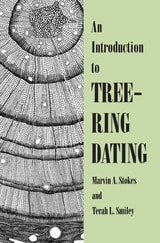
An Introduction to Tree-Ring Dating
Marvin A. Stokes
University of Arizona Press, 1996
Authors Stokes and Smiley first explain the basic principles of tree-ring dating, then describe details of the process, step by step, from the time a sample is collected until it is incorporated into a master chronology.
The book focuses on coniferous evergreens of the Southwest, particularly piñons, because they have wide geographic distribution, constitute a large population, and show excellent growth response to certain controlling factors. The book is specifically concerned with the task of establishing a calendar date for a wood or charcoal specimen.
This concise but thorough explication of an important discipline will make dendrochonology more meaningful to students and professionals in archaeology, forestry, hydrology, and global change.
Chronological Analysis of Tsegi Phase Sites in Northeastern Arizona
Jeffrey S. Dean
University of Arizona Press, 1970
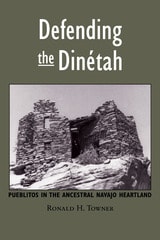
Defending The Dinetah
Ronald H Towner
University of Utah Press, 2003
Using a database of tree-ring dates taken from beams and wood used to construct these pueblitos, Ronald Towner shows in this volume that most pueblitos are unrelated to Puebloan immigration or the re-conquest. He concludes that Navajos constructed the masonry structures and hogans contemporaneously for protection against Ute raiders and later Spanish entradas. Further, most were occupied for relatively brief periods and population density was much lower than has been assumed.
Towner points to a new model of Navajo ethnogenesis, based on a revised early population distribution and a variety of other means of incorporating non-Athapaskan elements into Navajo culture, making Defending the Dinétah a major contribution to Navajo studies.

Fundamentals of Tree Ring Research
James H. Speer
University of Arizona Press, 2010
This comprehensive text addresses all of the subjects that a reader who is new to the field will need to know and will be a welcome reference for practitioners at all levels. It includes a history of the discipline, biological and ecological background, principles of the field, basic scientific information on the structure and growth of trees, the complete range of dendrochronology methods, and a full description of each of the relevant subdisciplines.
Individual chapters address the composition of wood, methods of field and laboratory study, dendroarchaeology, dendroclimatology, dendroecology, dendrogeomorphology, and dendrochemistry. The book also provides thorough introductions to common computer programs and methods of statistical analysis. In the final chapter, the author describes “frontiers in dendrochronology,” with an eye toward future directions in the field. He concludes with several useful appendixes, including a listing of tree and shrub species that have been used successfully by dendrochronologists. Throughout, photographs and illustrations visually represent the state of knowledge in the field.
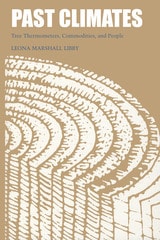
Past Climates
Tree Thermometers, Commodities, and PeopleBy Leona Marshall Libby
University of Texas Press, 1983
Leona Marshall Libby was a pioneer in modern climatic research, a field that gained great impetus in the late twentieth century because of the promise it holds for predicting future climatic trends. Libby’s work led to remarkable new procedures for investigating long-term changes in precipitation and temperature and thereby greatly expanding our knowledge of past climates.
As Professor Rainer Berger writes in his foreword:
“In recent years, tree ring–based temperature data have been collected which go far beyond the records available to historians. These data can be analyzed by Fourier transforms which identify certain periodicities. . . . Climatic changes detected by tree rings have been checked against historic records. . . . The correspondence is astonishing. . . .
“At present weather forecasting is becoming more accurate for periods on the order of days, weeks, and months. Climatic prognoses have also been attempted for very long times of tens of thousands of years. But the intermediate range in the decades and centuries has so far been an enigma. It is here where tree ring thermometry plays its trump cards.
“. . . Its potential is enormous in assessing worldwide crop yields, water inventory, heating requirements, stockpiling policies, and construction planning as well as political and military prospects.”
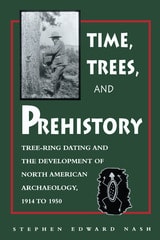
Time, Trees, and Prehistory
Tree Ring dating and the Development of NA Archaeology 1914 to 1950Stephen E Nash
University of Utah Press, 2006
Dendrochronology, the science of assigning precise calendar dates to annual growth rings in trees, provided accurate dates at a time when North American archaeologists had no absolute dating techniques available to guide their analyses. Time, Trees, and Prehistory examines the growth, development, application, and interpretive implications of North American archaeological tree-ring dating from 1914 to 1950.
The development of dendrochronology forced archaeologists to radically revise their understanding of the prehistoric past, compressing by nearly fifty percent the time scale of the archaeological record. Basketmaker sites, for instance, were once thought to be four thousand years old; tree-ring application demonstrated that these sites dated well into the present millennium. Classic sites in Chaco Canyon and Mesa Verde were believed occupied for nearly a thousand years, but tree-ring dates demonstrated that such sites were often built, occupied, and abandoned in just over a century. Other similar changes in temporal scale forced archaeologists to reconsider their interpretations of the rate of prehistoric cultural change, population growth, and the degree of social and political complexity in the Southwest.
Time, Trees, and Prehistory examines archaeological practices of the 1920s, 30s, and 40s and demonstrates that tree-ring dating set the stage that enabled revolutionary developments in archaeological method and theory in succeeding decades.