Results by title
6 books match the query 'Department stores'

CONSUMING FANTASIES
LABOR, LEISURE, AND THE LONDON SHOPGIRL,LISE SHAPIRO SANDERS
The Ohio State University Press, 2006
[more]
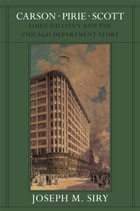
Carson Pirie Scott
Louis Sullivan and the Chicago Department StoreJoseph M. Siry
University of Chicago Press, 1988
Long recognized as a Chicago landmark, the Carson Pirie Scott Building also represents a milestone in the development of architecture. The last large commercial structure designed by Louis Sullivan, the Carson building reflected the culmination of the famed architect's career as a creator of tall steel buildings. In this study, Joseph Siry traces the origins of the building's design and analyzes its role in commercial, urban, and architectural history.
[more]
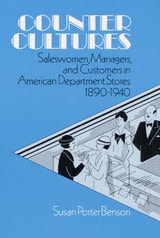
Counter Cultures
Saleswomen, Managers, and Customers in American Department Stores, 1890-1940Susan Porter Benson
University of Illinois Press, 1986
The luxurious appearance and handsome profits of American department stores from 1890 to 1940 masked a three-way struggle among saleswomen, managers, and customers for control of the selling floor. Counter Cultures explores the complex nature and contradictions of the conflict in an arena where class, gender, and the emerging culture of consumption all came together. The result is a fascinating illumination of the emotional labor of the workplace and the work-culture of consumerism that still defines the workday for millions of Americans.
[more]
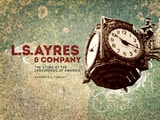
L. S. Ayres and Company
The Store at the Crossroads of AmericaKenneth L. Turchi
Indiana Historical Society Press, 2012
In 1872 Lyman Ayres acquired a controlling interest in the Trade Place, a dry-goods store in Indianapolis. Two years later, he bought out his partners and renamed the establishment L. S. Ayres and Company. For the next century, Ayres was as much a part of Indianapolis as Monument Circle or the Indianapolis 500. Generations of midwestern families visited the vast store to shop, to see the animated Christmas windows, and, of course to visit Santa Claus and enjoy lunch in the Tea Room. But Ayres was more than just a department store. At its helm across three generations was a team of visionary retailers who took the store from its early silk-and-calico days to a diversified company with interests in specialty stores and discount stores (before Target and Wal-Mart). At the same time, Ayres never lost sight of its commitment to women’s fashion that gave the store the same cachet as its larger competitors in New York and Chicago.
[more]
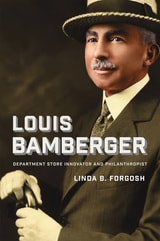
Louis Bamberger
Department Store Innovator and PhilanthropistLinda B. Forgosh
Brandeis University Press, 2016
Louis Bamberger (1855–1944) was the epitome of the merchant prince as public benefactor. Born in Baltimore, this son of German immigrants built his business—the great, glamorous L. Bamberger & Co. department store in Newark, N.J.—into the sixth-largest department store in the country. A multimillionaire by middle age, he joined the elite circle of German Jews who owned Macy’s, Bloomingdale’s, and Filene’s. Despite his vast wealth and local prominence, Bamberger was a reclusive figure who shunned the limelight, left no business records, and kept no diaries. He remained a bachelor and kept his private life and the rationale for his business decisions to himself. Yet his achievements are manifold. He was a merchandising genius whose innovations, including newspaper and radio ads and brilliant use of window and in-store displays, established the culture of consumption in twentieth-century America. His generous giving, both within the Jewish community and beyond it, created institutions that still stand today: the Newark YM-YWHA, Beth Israel Hospital, and the Newark Museum. Toward the end of his career, he financed and directed the creation of the Institute for Advanced Study at Princeton, which led to a friendship with Albert Einstein. Despite his significance as business innovator and philanthropist, historians of the great department stores have paid scant attention to Bamberger. This full-length biography will interest historians as well as general readers of Jewish history nationally, New Jerseyans fascinated by local history, and the Newarkers for whom Bamberger’s was a beloved local institution.
[more]
Something for Everyone
Memories of Lauerman Brothers Department StoreMichael Leanah
Wisconsin Historical Society Press, 2013
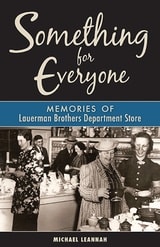
In 1890 the Lauerman brothers opened a general store in the lumber-boom town of Marinette, Wisconsin. The business prospered, and soon the brothers abandoned their small quarters on Main Street for a magnificent department store on Dunlap Square in the heart of Marinette. Thanks to the Lauermans’ devotion to offering diverse merchandise, superior customer service, and loyalty to their employees, the store would remain a lively, vital part of the Marinette fabric for one hundred years.
This book traces the history of the Lauerman enterprise and its importance to the community of Marinette and dozens of counties in northern Wisconsin and the UP. The author takes readers on a tour of the store’s most memorable and delightful features, from the plethora of merchandise offered to the record-listening booths to the famous frosted malt cones. Along the way we hear the recollections of dozens of former customers and employees whose memories form a unique tapestry of family, business, and community story. As it brings to life the people who worked and shopped at Lauermans, Something for Everyone will have readers fondly recalling their own favorite shopping destinations during the golden age of department stores.
This book traces the history of the Lauerman enterprise and its importance to the community of Marinette and dozens of counties in northern Wisconsin and the UP. The author takes readers on a tour of the store’s most memorable and delightful features, from the plethora of merchandise offered to the record-listening booths to the famous frosted malt cones. Along the way we hear the recollections of dozens of former customers and employees whose memories form a unique tapestry of family, business, and community story. As it brings to life the people who worked and shopped at Lauermans, Something for Everyone will have readers fondly recalling their own favorite shopping destinations during the golden age of department stores.
[more]