Results by title

17 books match the query 'Deportation'

cover of Abolitionist Intimacies: Queer and Trans Migrants against the Deportation State

Abolitionist Intimacies

Queer and Trans Migrants against the Deportation State

Eithne Luibheid

Duke University Press, 2025

In Abolitionist Intimacies, Eithne Luibhéid examines writings by and about queer- and trans-identified migrants and allies who contest pervasive US immigration practices and work toward a future without detention, deportation, and border controls. Luibhéid shows how these migrants and activists confront such controls by mobilizing intimacies—forging close connections in order to survive in the present. From forms of kinship beyond the heterosexual nuclear family to networks of solidarity, intimacies allow queer and trans migrants and allies to challenge the infrastructures that support the deportation state: proposed pathways to citizenship for undocumented migrants; marriage as a means for legalization; traffic interactions as a pipeline to deportation; and queer and trans migrant detention. In the process, activists and theorists have advanced new visions and configurations of possible intimacies that not only challenge deportation but also rework what immigration control and citizenship could mean. By focusing on these abolitionist efforts as well as the publicly available records on queer and trans deportees, Luibhéid highlights the new understandings that emerge when the experiences of queer and trans people are centered.
[more]
cover of Against Their Will: The History and Geography of Forced Migrations in the USSR

Against Their Will

The History and Geography of Forced Migrations in the USSR

Pavel Polian

Central European University Press, 2003

During his reign, Joseph Stalin oversaw the forced resettlement of people by the millions – a maniacal passion that he used for social engineering. The Soviets were not the first to thrust resettlement on its population – a major characteristic of totalitarian systems – but in terms of sheer numbers, technologies used to deport people and the lawlessness which accompanied it, Stalin’s process was the most notable. Six million people of different social, ethnic, and professions were resettled before Stalin's death. Even today, the aftermath of such deportations largely predetermines events which take place in the northern Caucasus, Crimea, the Baltic republics, Moldavia, and western Ukraine. Polian's volume is the first attempt to comprehensively examine the history of forced and semi-voluntary population movements within or organized by the Soviet Union. Contents range from the early 1920s to the rehabilitation of repressed nationalities in the 1990s, dealing with internal (kulaks, ethnic and political deportations) and international forced migrations (German internees and occupied territories). An abundance of facts, figures, tables, maps, and an exhaustively-detailed annex will serve as important sources for further researches.
[more]
cover of Against the Deportation Terror: Organizing for Immigrant Rights in the Twentieth Century

Against the Deportation Terror

Organizing for Immigrant Rights in the Twentieth Century

Rachel Ida Buff

Temple University Press, 2017

Despite being characterized as a “nation of immigrants,” the United States has seen a long history of immigrant rights struggles. In her timely book Against the Deportation Terror, Rachel Ida Buff uncovers this multiracial history. She traces the story of the American Committee for the Protection of the Foreign Born (ACPFB) from its origins in the 1930s through repression during the early Cold War, to engagement with “new” Latinx and Caribbean immigrants in the 1970s and early 1980s.

Functioning as a hub connecting diverse foreign-born communities and racial justice advocates, the ACPFB responded to various, ongoing crises of what they called “the deportation terror.” Advocates worked against repression, discrimination, detention, and expulsion in migrant communities across the nation at the same time as they supported reform of federal immigration policy. Prevailing in some cases and suffering defeats in others, the story of the ACPFB is characterized by persistence in multiracial organizing even during periods of protracted repression.

By tracing the work of the ACPFB and its allies over half a century, Against the Deportation Terror provides important historical precedent for contemporary immigrant rights organizing. Its lessons continue to resonate today.

[more]
cover of Aliens and Dissenters: Federal Suppression of Radicals, 1903-1933

Aliens and Dissenters

Federal Suppression of Radicals, 1903-1933

William Preston, Jr.

University of Illinois Press, 1994
This edition features a new foreword by Paul Buhle and a new epilogue by the author.

 
[more]
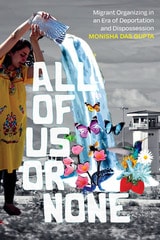
cover of All of Us or None: Migrant Organizing in an Era of Deportation and Dispossession

All of Us or None

Migrant Organizing in an Era of Deportation and Dispossession

Monisha Das Gupta

Duke University Press, 2024

In All of Us or None, Monisha Das Gupta tells the story of contemporary antideportation organizing in the United States by migrants and refugees labeled as criminal aliens. These activists, who live daily with criminalization, work against forms of deportation that Das Gupta calls settler carcerality—the United States’ use of deportation to exert territorial control in the face of Indigenous self-determination. Drawing on fieldwork with antideportation organizing groups in New York, Los Angeles, Long Beach, and Honolulu, Das Gupta documents the inventive methods of struggle against settler carcerality. Das Gupta shows how the organizers’ actions and visions depart from the settler colonial nature of the mainstream demands for a pathway to citizenship and civil rights. Through direct action, storytelling, political education, and youth and queer leadership, these organizations and collectives conceptualize an abolitionist vision of migration justice that rejects the settler state and encompasses all those who are disavowed. By highlighting this work, Das Gupta demonstrates the transformative promise offered by a dissident migrant-led politics working toward dismantling settler structures and logics.
[more]
cover of Czechoslovak Diplomacy and the Gulag: Deportation of Czechoslovak Citizens to the USSR and the Negotiation for their Repatriation, 1945-1953

Czechoslovak Diplomacy and the Gulag

Deportation of Czechoslovak Citizens to the USSR and the Negotiation for their Repatriation, 1945-1953

Milada Polisenská

Central European University Press, 2016

After the entry of the Red Army into Czechoslovak territory in 1945, Red Army authorities began to arrest and deport Czechoslovak citizens to labor camps in the Soviet Union. The regions most affected were Eastern and South Slovakia and Prague. The Czechoslovak authorities repeatedly requested a halt to the deportations and that the deported Czechoslovaks be returned immediately. It took a long time before these protests generated any response. Czechoslovak Diplomacy and the Gulag focuses on the diplomatic and political aspects of the deportations. The author explains the steps taken by the Czechoslovak Government in the repatriation agenda from 1945 to 1953 and reconstructs the negotiations with the Soviets. The research tries to answer the question of why and how the Russians deported the civilian population from Czechoslovakia which was their allied country already during the war. Key words: 1. World War, 1939–1945—Deportations from Czechoslovakia. 2. Forced labor—Soviet Union—History. 3. Labor camps—Soviet Union—History. 4. Czechs—Soviet Union—History. 5. Slovaks—Soviet Union—History. 6. Czechoslovakia—Foreign relations—Soviet Union. 7. Soviet Union—Foreign relations—Czechoslovakia. 8. Czechoslovakia—Foreign relations—1945–1992. 9. Repatriation—Czechoslovakia—History.
[more]
cover of Deported Americans: Life after Deportation to Mexico

Deported Americans

Life after Deportation to Mexico

Beth Caldwell

Duke University Press, 2019

When Gina was deported to Tijuana, Mexico, in 2011, she left behind her parents, siblings, and children, all of whom are U.S. citizens. Despite having once had a green card, Gina was removed from the only country she had ever known. In Deported Americans legal scholar and former public defender Beth C. Caldwell tells Gina's story alongside those of dozens of other Dreamers, who are among the hundreds of thousands who have been deported to Mexico in recent years. Many of them had lawful status, held green cards, or served in the U.S. military. Now, they have been banished, many with no hope of lawfully returning. Having interviewed over one hundred deportees and their families, Caldwell traces deportation's long-term consequences—such as depression, drug use, and homelessness—on both sides of the border. Showing how U.S. deportation law systematically fails to protect the rights of immigrants and their families, Caldwell challenges traditional notions of what it means to be an American and recommends legislative and judicial reforms to mitigate the injustices suffered by the millions of U.S. citizens affected by deportation.
[more]
cover of Extradition Politics & Human Rights

Extradition Politics & Human Rights

Christopher Pyle

Temple University Press, 2001

Three hundred years ago, few people cared about the murky pasts of new arrivals to the United States, and the countries they had left made few efforts to pursue them to their new home. Today, with the growth of bureaucracy, telecommunications, and air travel, extradition has become a full-time business. But the public's knowledge of, and consequent concern about, extradition remains minimal, aroused from time to time by newspaper headlines, only to fade.

In this readable and compelling history of extradition in America, Christopher Pyle remedies that ignorance. Using  American constitutional law and drawing on a wealth of historical cases, he describes the collision of law and politics that occurs when a foreign country demands the surrender of individuals held to be terrorists by some and freedom fighters by others. He shows how U.S. policymakers have attempted to substitute deportation for extradition and turn the surrender of a foreign national (or even an American citizen) into a political rather than a judicial process.

Beginning with the  New England Puritans' refusal to surrender the "regicides" who had signed the death warrant of Charles I, he traces the attitudes and ideologies that have shaped American extradition practice, culminating in the efforts by the Reagan and Bush administrations to turn the legal extradition process into an executive tool of state policy. Along the way we meet such luminaries as James Madison and John Stuart Mill, William Rehnquist and Oliver North, as well as pirates and fugitive slaves, anarchists and refugees, drug lords and runaway sailors.

Woven throughout this story is the author's belief that current developments in extradition law ignore or actually violate the principles of individual liberty, due process, and humanity on which we claim our country was built. As he remarks in the Introduction, "Extradition involves the surrender of human beings -- persons under the protection of our Constitution -- to foreign regimes, many of which are unjust. This reality was well understood in the eighteenth and nineteenth centuries, when the United States was a refuge for the victims of European oppression, but it has  been disregarded frequently in the twentieth century as we have sought to stem the tide of immigration and develop advantageous economic and political relations with autocratic regimes of every stripe."

[more]
cover of Figures of Deportation: Borders, Mobilities, and Andean World-Making

Figures of Deportation

Borders, Mobilities, and Andean World-Making

Ulla D. Berg

Duke University Press, 2027

In Figures of Deportation, Ulla D. Berg reframes public and political discourses on deportation beyond the criminalized figure of the “illegal alien” to instead examine the efforts of South American migrants to make life through mobility under the global deportation regime. Berg bases her analysis on a decade of multi-sited ethnographic fieldwork with deported migrants and their families in Indigenous communities in southern Ecuador, urban districts in Peru, and in US detention centers, immigration courts, and urban communities. Across these sites, Berg recounts the profoundly disruptive effects of sudden separation of individuals from their families and communities but also reveals the mundanity deportation represents for Peruvian and Ecuadorian migrants, often leading to new mobilities. Berg makes the case that deportation studies should not solely center on state-driven and humanitarian logics but consider the social and material world-making activities of migrants and their communities. In doing so, she foregrounds Andean migrants as active and adaptive agents living with, but not defined by, deportation and its consequences.
[more]
cover of Insecurities of Expulsion: Afro-Asian Entanglements in Transcontinental Uganda

Insecurities of Expulsion

Afro-Asian Entanglements in Transcontinental Uganda

Anneeth Kaur Hundle

Duke University Press, 2025
In 1972, Ugandan president Idi Amin expelled close to 80,000 South Asians of Ugandan heritage from the country by dictatorial decree. In Insecurities of Expulsion, Anneeth Kaur Hundle revisits this weighty historical event, arguing that it is neither an exceptional nor a parochial event, neither a result of primordial Afro-South Asian racial conflict nor an opening into a redemptive search for Afro-South Asian interracial solidarities. Hundle explores the aftermaths and continuous nature of the expulsion event, examining its effects and affects; the images, representations, and differentiated experiences and memories of the event; and the tense and ambivalent practices of citizenship, sovereignty, and governance that have emerged in the decades following the expulsion. She examines Afro-Asian entanglements in what she describes as transcontinental Uganda through the lenses of race, ethnicity, class, caste, religion, gender, and sexuality. Throughout, Hundle argues for stronger attention to knowledge production on global Afro-South Asian connections and the continued dynamics of community, citizenship, and identity on the African Continent as central to envisioning Black African self-determinism, racial reconciliation, and interracial pluralisms during shifting imperial, postcolonial, nationalist, and geopolitical times.
[more]
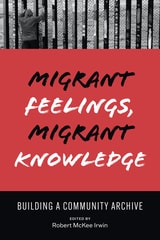
cover of Migrant Feelings, Migrant Knowledge: Building a Community Archive

Migrant Feelings, Migrant Knowledge

Building a Community Archive

Robert McKee Irwin

University of Texas Press, 2022

The digital storytelling project Humanizing Deportation invites migrants to present their own stories in the world’s largest and most diverse archive of its kind. Since 2017, more than 300 community storytellers have created their own audiovisual testimonial narratives, sharing their personal experiences of migration and repatriation. With Migrant Feelings, Migrant Knowledge, the project’s coordinator, Robert Irwin, and other team members introduce the project’s innovative participatory methodology, drawing out key issues regarding the human consequences of contemporary migration control regimes, as well as insights from migrants whose world-making endeavors may challenge what we think we know about migration.

In recent decades, migrants in North America have been treated with unprecedented harshness. Migrant Feelings, Migrant Knowledge outlines this recent history, revealing stories both of grave injustice and of seemingly unsurmountable obstacles overcome. As Irwin writes, “The greatest source of expertise on the human consequences of contemporary migration control are the migrants who have experienced them,” and their voices in this searing collection jump off the page and into our hearts and minds.
[more]
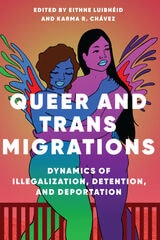
cover of Queer and Trans Migrations: Dynamics of Illegalization, Detention, and Deportation

Queer and Trans Migrations

Dynamics of Illegalization, Detention, and Deportation

Edited by Eithne Luibheid and Karma R. Chavez

University of Illinois Press, 2020

More than a quarter of a million LGBTQ-identified migrants in the United States lack documentation and constantly risk detention and deportation. LGBTQ migrants around the world endure similarly precarious situations. Eithne Luibhéid's and Karma R. Chávez’s edited collection provides a first-of-its-kind look at LGBTQ migrants and communities. The academics, activists, and artists in the volume center illegalization, detention, and deportation in national and transnational contexts, and examine how migrants and allies negotiate, resist, refuse, and critique these processes. The works contribute to the fields of gender and sexuality studies, critical race and ethnic studies, borders and migration studies, and decolonial studies.

Bridging voices and works from inside and outside of the academy, and international in scope, Queer and Trans Migrations illuminates new perspectives in the field of queer and trans migration studies.

Contributors: Andrew J. Brown, Julio Capó, Jr., Anna Carastathis, Jack Cáraves, Karma R. Chávez, Ryan Conrad, Elif, Katherine Fobear, Monisha Das Gupta, Jamila Hammami, Edward Ou Jin Lee, Leece Lee-Oliver, Eithne Luibhéid, Hana Masri, Yasmin Nair, Bamby Salcedo, Fadi Saleh, Rafael Ramirez Solórzano, José Guadalupe Herrera Soto, Myrto Tsilimpounidi, Suyapa Portillo Villeda, Sasha Wijeyeratne, Ruben Zecena

[more]
cover of Rendition to Torture

Rendition to Torture

Clarke, Alan W

Rutgers University Press, 2012

Universally condemned and everywhere illegal, torture goes on in democracies as well as in dictatorships. Nonetheless, many Americans were surprised following the attacks of 9/11 at how easily the United States embraced torture as well as the supposedly lesser evil of cruel, inhuman, and degrading treatment. Nothing seemed extreme when it came to questioning real and imagined terrorists. Extraordinary rendition—sending people captured in the “war on terror” to nations long counted among the world’s worst human rights violators—hid from the public eye cruel and bloody interrogations. “Torture lite” or “torture without marks” became the norm for those in American custody.

In Rendition to Torture, Alan W. Clarke explains how the United States adopted torture as a matter of official policy; how and why it turned to extraordinary rendition as a way to outsource more extreme, mutilating forms of torture; and outlines the steps the United States took to hide its abuses. Many adverse consequences attended American use of torture. False information gleaned from torture was used to justify the Iraq war, adding potency to the charge that the war was illegal under international law. Moreover, European nations and Canada aided, abetted, and became thoroughly enmeshed in U.S.-led torture and renditions, thereby spreading both the problem and the blame for this practice. Clarke offers an extended critique of these activities, placing them in historical and legal context as well as in transnational and comparative perspective.
[more]
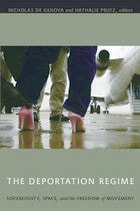
cover of The Deportation Regime: Sovereignty, Space, and the Freedom of Movement

The Deportation Regime

Sovereignty, Space, and the Freedom of Movement

Nicholas De Genova and Nathalie Peutz, eds.

Duke University Press, 2010

This important collection examines deportation as an increasingly global mechanism of state control. Anthropologists, historians, legal scholars, and sociologists consider not only the physical expulsion of noncitizens but also the social discipline and labor subordination resulting from deportability, the threat of forced removal. They explore practices and experiences of deportation in regional and national settings from the U.S.-Mexico border to Israel, and from Somalia to Switzerland. They also address broader questions, including the ontological significance of freedom of movement; the historical antecedents of deportation, such as banishment and exile; and the development, entrenchment, and consequences of organizing sovereign power and framing individual rights by territory.

Whether investigating the power that individual and corporate sponsors have over the fate of foreign laborers in Bahrain, the implications of Germany’s temporary suspension of deportation orders for pregnant and ill migrants, or the significance of the detention camp, the contributors reveal how deportation reflects and reproduces notions about public health, racial purity, and class privilege. They also provide insight into how deportation and deportability are experienced by individuals, including Arabs, South Asians, and Muslims in the United States. One contributor looks at asylum claims in light of an unusual anti-deportation campaign mounted by Algerian refugees in Montreal; others analyze the European Union as an entity specifically dedicated to governing mobility inside and across its official borders. The Deportation Regime addresses urgent issues related to human rights, international migration, and the extensive security measures implemented by nation-states since September 11, 2001.

Contributors: Rutvica Andrijasevic, Aashti Bhartia, Heide Castañeda , Galina Cornelisse , Susan Bibler Coutin, Nicholas De Genova, Andrew M. Gardner, Josiah Heyman, Serhat Karakayali, Sunaina Marr Maira, Guillermina Gina Nuñez, Peter Nyers, Nathalie Peutz, Enrica Rigo, Victor Talavera, William Walters, Hans-Rudolf Wicker, Sarah S. Willen

[more]
cover of The Fifth Sun

The Fifth Sun

Mary Helen Lagasse

Northwestern University Press, 2004

Winner of the 3rd Annual Miguel Mármol Prize from Curbstone Press, Mary Helen Lagasse's The Fifth Sun is an inspiring story of an immigrant who struggles valiantly for a better life for herself and her family. A young Mexican woman, Mercedes, leaves her village to work as a housemaid in New Orleans. This fast-paced novel takes us through her adventures in New Orleans, her marriage, her struggle to raise her children, her deportation, and her attempt to re-cross the river and be reunited with her children.

 
[more]
cover of Unsafe Haven: The United States, the IRA and Political Prisoners

Unsafe Haven

The United States, the IRA and Political Prisoners

Karen McElrath

Pluto Press, 2000

For almost two hundred years the United States has been a safe haven for Irish political prisoners seeking refuge. More recently however the US government has sought deportation, extradition and prosecution to exclude Irish republicans from the country. In the first book to focus on the relationship between these tools of exclusion and US foreign policy, Karen McElrath examines why this change has come about and the extent to which the granting of political asylum in the US is influenced by relations with Britain and other countries.

Karen McElrath questions US government attempts to portray an impartial role in the Irish conflict, arguing that historical and contemporary evidence reveals otherwise. She shows that, far from being a neutral process, the success of bids for political asylum often depends on the relationship between the US and the government of the applicant’s country of origin. Drawing on exclusive interviews with Irish Republicans who have faced deportation or extradition from the United States, or who have been prosecuted in the US for politically-motivated offences, McElrath explores the links between deportation and extradition outcomes and foreign policy issues. The tools of exclusion are defined in their historical context, and the history of US extradition law is described, with particular focus on the treaties with Britain. McElrath also examines the offences for which Irish and Irish-American Republicans have been charged, discusses the various levels of support for Irish political prisoners in the US, and summarises the findings by international human rights organisations.

[more]
cover of We Are Not Dreamers: Undocumented Scholars Theorize Undocumented Life in the United States

We Are Not Dreamers

Undocumented Scholars Theorize Undocumented Life in the United States

Leisy J. Abrego and Genevieve Negrón-Gonzales, editors

Duke University Press, 2020

The widely recognized “Dreamer narrative” celebrates the educational and economic achievements of undocumented youth to justify a path to citizenship. While a well-intentioned, strategic tactic to garner political support of undocumented youth, it has promoted the idea that access to citizenship and rights should be granted only to a select group of “deserving” immigrants. The contributors to We Are Not Dreamers—themselves currently or formerly undocumented—poignantly counter the Dreamer narrative by grappling with the nuances of undocumented life in this country. Theorizing those excluded from the Dreamer category—academically struggling students, transgender activists, and queer undocumented parents—the contributors call for an expansive articulation of immigrant rights and justice that recognizes the full humanity of undocumented immigrants while granting full and unconditional rights. Illuminating how various institutions reproduce and benefit from exclusionary narratives, this volume articulates the dangers of the Dreamer narrative and envisions a different way forward.

Contributors. Leisy J. Abrego, Gabrielle Cabrera, Gabriela Garcia Cruz, Lucía León, Katy Joseline Maldonado Dominguez, Grecia Mondragón, Gabriela Monico, Genevieve Negrón-Gonzales, Maria Liliana Ramirez, Joel Sati, Audrey Silvestre, Carolina Valdivia
[more]