Results by title
4 books match the query 'Deryugina, Tatyana'
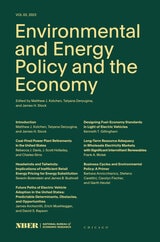
Environmental and Energy Policy and the Economy
Volume 3Edited by Matthew J. Kotchen, Tatyana Deryugina, and James H. Stock
University of Chicago Press Journals, 2022
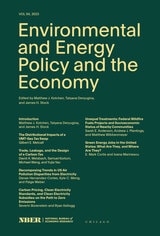
Environmental and Energy Policy and the Economy
Volume 4Edited by Matthew J. Kotchen, Tatyana Deryugina, and James H. Stock
University of Chicago Press Journals, 2023
Environmental and Energy Policy and the Economy focuses on the effective and efficient management of environmental and energy challenges. Research papers offer new evidence on the intended and unintended consequences, the market and nonmarket effects, and the incentive and distributional impacts of policy initiatives and market developments.
This volume presents six new papers on environmental and energy economics and policy. Gilbert Metcalf examines the distributional impacts of substituting a vehicle miles-traveled tax for the existing federal excise tax in the United States. David Weisbach, Samuel Kortum, Michael Wang, and Yujia Yao consider solutions to the leakage problem of climate policy with differential tax policies on the supply and demand for fossil fuels and on domestic production and consumption. Danae Hernandez-Cortes, Kyle Meng, and Paige Weber quantify and decompose recent trends in air pollution disparities in the US electricity sector. Severin Borenstein and Ryan Kellogg provide a comparative analysis of different incentive-based mechanisms to reduce emissions in the electricity sector on a path to zero emissions. Sarah Anderson, Andrew Plantinga, and Matthew Wibbenmeyer document distributional differences in the allocation of US wildfire prevention projects. Finally, Mark Curtis and Ioana Marinescu provide new evidence on the quality and quantity of emerging “green” jobs in the United States.
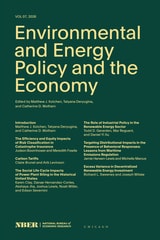
Environmental and Energy Policy and the Economy
Volume 7Edited by Matthew J. Kotchen, Tatyana Deryugina, and Catherine D. Wolfram
University of Chicago Press Journals, 2026
Rigorous, careful, and nonpartisan research with a high policy impact on environmental and energy economics.
Environmental and Energy Policy and the Economy focuses on the effective and efficient management of environmental and energy challenges. Research papers offer new evidence on the intended and unintended consequences, the market and nonmarket effects, and the incentive and distributional impacts of policy initiatives and market developments.
This volume presents six new papers on environmental and energy economics and policy. Judson Boomhower and Meredith Fowlie illustrate the distributional consequences of improving risk pricing efficiency in wildfire insurance markets. Claire Brunel and Arik Levinson develop a conceptual framework for understanding the economic and environmental consequences of taxes on imports of goods based on their carbon content. Karen Clay, Danae Hernandez-Cortes, Akshaya Jha, Joshua Lewis, Noah Miller, and Edson Severnini study the long-run distributional implications of US power plant sitings over more than a century. Todd Gerarden, Mar Reguant, and Daniel Xu provide a comprehensive overview of industrial policy in the renewable energy sector, with comparisons across the US, EU, and China. Jamie Hansen-Lewis and Michelle Marcus show how failure to account for behavioral responses can affect policy predictions regarding maritime emissions. Finally, Richard Sweeney and Joseph Wilske estimate the externalities associated with correlated intermittency in electricity generation from US wind power investments.
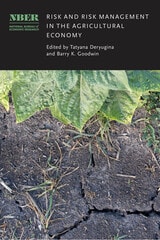
Risk and Risk Management in the Agricultural Economy
Edited by Tatyana Deryugina and Barry K. Goodwin
University of Chicago Press, 0
A wide-ranging examination of the risks agricultural producers face and how risk management policies respond to an uncertain economy.
Agricultural producers face greater risk and uncertainty than those in many other sectors of the economy. Sources of risk include weather shocks, disease, and volatile prices that can upend a season's returns. A wide array of federal policies, including crop and livestock insurance programs, are designed to help producers manage these risks, often at substantial cost to taxpayers. This volume examines how producers respond to and manage various risks across multiple dimensions. Contributors investigate the potential for "subsidy harvesting" in livestock insurance markets, the effects of climate change on insurance participation and crop choice, the relationship between the structure of insurance contracts and diversification incentives, and the role of conservation practices in risk mitigation. The research studies present new evidence on the design and consequences of agricultural risk management policies.