Results by title
4 books match the query 'Descola, Philippe'
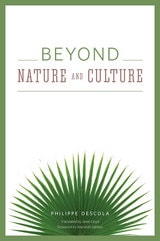
Beyond Nature and Culture
Philippe Descola
University of Chicago Press, 2013
Philippe Descola has become one of the most important anthropologists working today, and Beyond Nature and Culture has been a major influence in European intellectual life since its French publication in 2005. Here, finally, it is brought to English-language readers. At its heart is a question central to both anthropology and philosophy: what is the relationship between nature and culture?
Culture—as a collective human making, of art, language, and so forth—is often seen as essentially different from nature, which is portrayed as a collective of the nonhuman world, of plants, animals, geology, and natural forces. Descola shows this essential difference to be, however, not only a specifically Western notion, but also a very recent one. Drawing on ethnographic examples from around the world and theoretical understandings from cognitive science, structural analysis, and phenomenology, he formulates a sophisticated new framework, the “four ontologies”— animism, totemism, naturalism, and analogism—to account for all the ways we relate ourselves to nature. By thinking beyond nature and culture as a simple dichotomy, Descola offers nothing short of a fundamental reformulation by which anthropologists and philosophers can see the world afresh.
Culture—as a collective human making, of art, language, and so forth—is often seen as essentially different from nature, which is portrayed as a collective of the nonhuman world, of plants, animals, geology, and natural forces. Descola shows this essential difference to be, however, not only a specifically Western notion, but also a very recent one. Drawing on ethnographic examples from around the world and theoretical understandings from cognitive science, structural analysis, and phenomenology, he formulates a sophisticated new framework, the “four ontologies”— animism, totemism, naturalism, and analogism—to account for all the ways we relate ourselves to nature. By thinking beyond nature and culture as a simple dichotomy, Descola offers nothing short of a fundamental reformulation by which anthropologists and philosophers can see the world afresh.
[more]

Journeys into the Invisible
Shamanic Technologies of the ImaginationCharles Stépanoff
HAU, 2025
A lively exploration of the Indigenous traditions of shamanism in the Far North of Eurasia and North America.
Charles Stépanoff draws on ethnographic literature and his fieldwork in Siberia to reveal the immense contribution to the scope of human imagination made by shamans and the cognitive techniques they developed over the centuries.
Northern Shamans travel in mind in ways that appear mysterious to Westerners, but which rely on the human capacity of imagination. They perceive themselves simultaneously in two types of space—one visible, the other invisible—putting them in contact and establishing links with non-human beings in their surroundings. Shamans share their experience of mind travel with their patients, families, or the wider community, allowing them to participate in their odyssey through the invisible. Stépanoff offers an anthropological reflection on the relationships between our uses of the imagination, our relationships with the environment, and the emergence of social hierarchies.
This work will appeal to anthropologists as well as to anyone interested in learning about the power of imagination from the masters of the invisible, the shamans of the Far North.
[more]
The Ecology of Others
Philippe Descola
Prickly Paradigm Press, 2013
Since the end of the nineteenth century, the division between nature and culture has been fundamental to Western thought. In this groundbreaking work, renowned anthropologist Philippe Descola seeks to break down this divide, arguing for a departure from the anthropocentric model and its rigid dualistic conception of nature and culture as distinct phenomena. In its stead, Descola proposes a radical new worldview, in which beings and objects, human and nonhuman, are understood through the complex relationships that they possess with one another.
The Ecology of Others presents a compelling challenge to anthropologists, ecologists, and environmental studies scholars to rethink the way we conceive of humans, objects, and the environment. Thought-provoking and engagingly written, it will be required reading for all those interested in moving beyond the moving beyond the confines of this fascinating debate.
[more]

The Sex Thieves
The Anthropology of a RumorJulien Bonhomme
HAU, 2016
While working in Africa, anthropologist Julien Bonhomme encountered an astonishing phenomenon: people being accused of stealing or shrinking the genitals of strangers on the simple occasion of a handshake on the street. As he soon discovered, these accusations can have dramatic outcomes: the “sex thieves” are often targeted by large crowds and publicly lynched. Moreover, such rumors are an extremely widespread practice, having affected almost half of the African continent since the 1970s. In this book, Bonhomme examines the story of the “penis snatcher,” asking larger questions about how to account for such a phenomenon—unique in its spatial and temporal scale—without falling prey to the cliché of Africa as an exotic other.
Bonhomme argues that the public belief in sex thieves cannot be considered a superstition or form of mass hysteria. Rather, he brings to light multiple factors that explain the rumor’s success and shows how the cultural dynamic can operate on a vast scale. Analyzing the rumor on both transnational and local levels, he demonstrates how it arises from the ambiguities and dangers of anonymity, and thus that it reveals an occult flipside to everyday social interaction. Altogether, this book provides both richly ethnographic and theoretical understandings of urban sociality and the dynamics of human communication in contemporary Africa and beyond.
Bonhomme argues that the public belief in sex thieves cannot be considered a superstition or form of mass hysteria. Rather, he brings to light multiple factors that explain the rumor’s success and shows how the cultural dynamic can operate on a vast scale. Analyzing the rumor on both transnational and local levels, he demonstrates how it arises from the ambiguities and dangers of anonymity, and thus that it reveals an occult flipside to everyday social interaction. Altogether, this book provides both richly ethnographic and theoretical understandings of urban sociality and the dynamics of human communication in contemporary Africa and beyond.
[more]