Results by title
3 books match the query 'Designs'
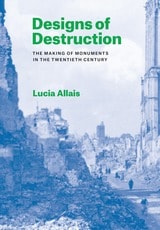
Designs of Destruction
The Making of Monuments in the Twentieth CenturyLucia Allais
University of Chicago Press, 2018
How architectural monuments survived and historical preservation was reinvented during the destructions of the twentieth century.
The twentieth century was highly destructive, but from its landscapes of ruins was born a new architectural type: the cultural monument. In the wake of World War I, an international movement arose which aimed to protect architectural monuments in large numbers, and regardless of style, hoping not only to keep them safe from future conflicts but also to make them worthy of protection from more quotidian forms of destruction. An evolving group—including architects, intellectuals, art historians, archaeologists, curators, and lawyers—grew out of the new diplomacy of the League of Nations. During and after World War II, it became affiliated with the Allied Military Government and was eventually absorbed by the UN as UNESCO. By the 1970s, this organization had begun granting World Heritage status to a global register of significant sites—from buildings to bridges, shrines to city centers, ruins to colossi.
Examining key episodes in the history of this preservation effort—including projects for the Parthenon, the Cathedral of St-Lô, the temples of Abu Simbel, and the Bamyian Buddahs —Lucia Allais demonstrates how the group deployed the notion of culture to shape architectural sites, and how architecture in turn shaped the very idea of global culture. Designs of Destruction emphasizes how the technical project of ensuring various buildings’ longevity jolted preservation into establishing a transnational set of codes, values, and practices. At the same time, this paradoxically helped integrate technologies of destruction—from bombs to bulldozers—into cultural governance. Designs of Destruction not only offers a fascinating narrative of cultural diplomacy, based on extensive archival findings; it also contributes an important new chapter in the intellectual history of modernity by showing the manifold ways architectural form is charged with concretizing abstract ideas and ideals, even in its destruction.
Designs on the Contemporary
Anthropological TestsPaul Rabinow and Anthony Stavrianakis
University of Chicago Press, 2014
The authors continue their prior explorations of the contemporary in past works: How to conceptualize, test, and give form to breakdowns of truth and conduct, as well as how to open up possibilities for the remediation of such breakdowns. They offer a surprising and contrasting pair of case studies of two figures who engaged with contemporary breakdowns: Salman Rushdie and Gerhard Richter. Approaching Richter’s artistic struggles with form and technique in the long wake of modernism and Rushdie’s struggles to find a narrative form—as well as a form for living—to respond to the Iranian fatwa issued against him, they show how both men formulated different new approaches to anthropology for the twenty-first century.

ESG Innovation for Sustainable Manufacturing Technology
Applications, designs and standardsWai Yie Leong
The Institution of Engineering and Technology, 2024