Results by title
5 books match the query 'Desire (Philosophy)'

Afterfeast
Lisa Hiton
Tupelo Press, 2021
Lisa Hiton’s Afterfeast begins by considering philosophical questions arising from the experience of desire and intimacy: What does love reveal about — and make possible within — the individual? Can we ever truly understand another person’s experience of the world around them? To what extent is the other ultimately inaccessible, a world unto herself? Pillared by massive, ambitious poems in the tradition of Modernism, these lyrics imbue landscapes as varied as Greece and America with new tension, new significance, as the speaker searches for answers to these provocative questions of love and inheritance. Through her graceful curation of imagery and enviable command of narrative, Hiton ultimately transforms our understanding of history and desire.
[more]

Anorexia and Mimetic Desire
René Girard
Michigan State University Press, 2008
René Girard shows that all desires are contagious—and the desire to be thin is no exception. In this compelling new book, Girard ties the anorexia epidemic to what he calls mimetic desire: a desire imitated from a model. Girard has long argued that, far from being spontaneous, our most intimate desires are copied from what we see around us. In a culture obsessed with thinness, the rise of eating disorders should be no surprise. When everyone is trying to slim down, Girard asks, how can we convince anorexic patients to have a healthy outlook on eating? Mixing theoretical sophistication with irreverent common sense, Girard denounces a “culture of anorexia” and takes apart the competitive impulse that fuels the game of conspicuous non-consumption. He shows that showing off a slim physique is not enough—the real aim is to be skinnier than one’s rivals. In the race to lose the most weight, the winners are bound to be thinner and thinner. Taken to extremes, this tendency to escalation can only lead to tragic results. Featuring a foreword by neuropsychiatrist Jean-Michel Oughourlian and an introductory essay by anthropologist Mark R. Anspach, the volume concludes with an illuminating conversation between René Girard, Mark R. Anspach, and Laurence Tacou.
[more]

Desire and Imitation in International Politics
Jodok Troy
Michigan State University Press, 2021
Imitating the desire of others is inherent to the struggle for power in international politics. The imitation of desire is a human trait seldom recognized in International Relations studies, let alone conceptualized. The imitation of desire that takes place among entities—as opposed to being intentionally generated by them—challenges the conventional wisdom of International Relations that assumes rational autonomous individuals. This book identifies the root of Realism, pointing out its awareness of the conflicting impact of desire and imitation in a world driven by restless comparison. It subsequently demonstrates the conceptual value of mimetic theory while proposing a template of understanding international polities, starting from assumptions of disorder and violence. This volume not only contributes to the study of conflict based on the imitation of the desire of others among international polities, but also proposes in its conceptualization that it is worth looking at studies of agency and structure, normative change, peace, and reconciliation.
[more]
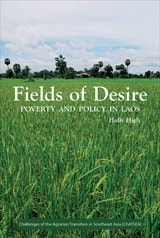
Fields of Desire
Poverty and Policy in LaosHolly High
National University of Singapore Press, 2014
In this important new book, High argues that poverty reduction policies are formulated and implemented in fields of desire. Drawing on psychoanalytic understandings of desire, she shows that such programs circulate around the question of what is lacking. Far from rational responses to measures of need, then, the politics of poverty are unconscious, culturally expressed, mutually contradictory, and sometimes contrary to self-interest.
Based on long-term fieldwork in a Lao village that has been the subject of multiple poverty reduction and development programs, High’s account looks at implementation on the ground. While these efforts were laudable in their aims of reducing poverty, they often failed to achieve their objectives. Local people received them with suspicion and disillusionment. Nevertheless, poverty reduction policies continued to be renewed by planners and even desired locally. High relates this to the force of aspirations among rural Lao, ambivalent understandings of power and the “post-rebellious” moment in contemporary Laos.
Based on long-term fieldwork in a Lao village that has been the subject of multiple poverty reduction and development programs, High’s account looks at implementation on the ground. While these efforts were laudable in their aims of reducing poverty, they often failed to achieve their objectives. Local people received them with suspicion and disillusionment. Nevertheless, poverty reduction policies continued to be renewed by planners and even desired locally. High relates this to the force of aspirations among rural Lao, ambivalent understandings of power and the “post-rebellious” moment in contemporary Laos.
[more]
Ressentiment
Reflections on Mimetic Desire and SocietyStefano Tomelleri
Michigan State University Press, 2015
This book is a response to Friedrich Nietzsche’s provocative question: How much and how does ressentiment condition our daily life? During the twentieth century we witnessed veritable eruptions of this insidious emotion, and we are still witnesses of its proliferation at various levels of society. This book aims to explore, according to René Girard’s mimetic theory, the anthropological and social assumptions that make up ressentiment and to investigate its genesis. The analysis of ressentiment shows that this emotion evolves from mimetic desire: it is an affective experience that people have when a rival denies them opportunities or valuable resources (including status) that they consider to be socially accessible. It is a specific figure of mimetic desire that is typical of contemporary society, where the equality that is proclaimed at the level of values contrasts with striking inequalities of power and access to material resources. This dichotomy generates increasing tension between highly competitive and egalitarian mimetic desires and growing social inequalities. The ressentiment is ambiguous, and its ambiguity is that of mimetic desire itself, which we cannot dismiss from our lives. In that it provides occasions of conflict and baseness, ressentiment can fuel violence, discord, and injustice, but it also can open opportunities for growth and justice, and for inventing institutions that are better adapted to the transformations of our contemporary society.
[more]