Results by title
8 books match the query 'Detective Fiction'
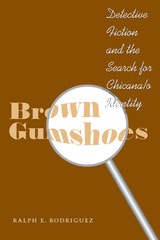
Brown Gumshoes
Detective Fiction and the Search for Chicana/o IdentityBy Ralph E. Rodriguez
University of Texas Press, 2005
Winner, Modern Language Association Prize in United States Latina and Latino and Chicana and Chicano Literary and Cultural Studies, 2006
Popular fiction, with its capacity for diversion, can mask important cultural observations within a framework that is often overlooked in the academic world. Works thought to be merely "escapist" can often be more seriously mined for revelations regarding the worlds they portray, especially those of the disenfranchised. As detective fiction has slowly earned critical respect, more authors from minority groups have chosen it as their medium. Chicana/o authors, previously reluctant to write in an underestimated genre that might further marginalize them, have only entered the world of detective fiction in the past two decades.
In this book, the first comprehensive study of Chicano/a detective fiction, Ralph E. Rodriguez examines the recent contributions to the genre by writers such as Rudolfo Anaya, Lucha Corpi, Rolando Hinojosa, Michael Nava, and Manuel Ramos. Their works reveal the struggles of Chicanas/os with feminism, homosexuality, familia, masculinity, mysticism, the nationalist subject, and U.S.-Mexico border relations. He maintains that their novels register crucial new discourses of identity, politics, and cultural citizenship that cannot be understood apart from the historical instability following the demise of the nationalist politics of the Chicana/o movement of the 1960s and 1970s. In contrast to that time, when Chicanas/os sought a unified Chicano identity in order to effect social change, the 1980s, 1990s, and 2000s have seen a disengagement from these nationalist politics and a new trend toward a heterogeneous sense of self. The detective novel and its traditional focus on questions of knowledge and identity turned out to be the perfect medium in which to examine this new self.

Crimes against the State, Crimes against Persons
Detective Fiction in Cuba and MexicoPersephone Braham
University of Minnesota Press, 2004
An interpretation of the ideologies and kinships of detective fiction in Cuba and Mexico
The transplanted, inherently modern detective genre serves as an especially effective lens for exposing the fissures and divergences of modernity in post-1968 Mexico and revolutionary Cuba.
Combining in-depth critical analyses with the theoretical insights of current literary and cultural theory and Latin American postmodern studies, Crimes against the State, Crimes against Persons shows how the Cuban novela negra examines the Revolution through an incisive chronicle of life under a decaying regime, and how the Mexican neopoliciaco reveals the oppressive politics of modernization and globalization in Latin America.International in scope, comparative in approach, Braham’s study presents a unique inquiry into the ethical and aesthetic complexities that Latin American authors face in adapting genre detective fiction—a modern, metropolitan model—to radically diverse creative and ideological programs. Considering the work of writers such as Leonardo Padura Fuentes and Paco Ignacio Taibo II, as well as such English-language influences as G. K. Chesterton and Chester Himes, Braham also addresses Marxist critiques of the culture industry and emergent Latin American concepts of postmodernity.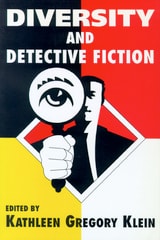
Diversity and Detective Fiction
Kathleen Gregory Klein
University of Wisconsin Press, 1999
Among the issues addressed are definitions of diversity; what constitutes ethnicity or race, especially in terms of multiple subjectivities; how race, gender, and ethnicity are culturally constructed; and what part is played by identity politics.

It's a Print!
Detective Fiction from Page to ScreenUniversity of Wisconsin Press, 0
Mother of Detective Fiction
The Life and Works of Anna Katharine GreenPatricia D. Maida
University of Wisconsin Press, 1989
In examining the life and works of Anna Katharine Green, one discovers a slice of American life: in the social events of New York City, in the plight of young working women, in the moral dilemmas of upright citizens pursuing the American dream.

Murder Most Modern
Detective Fiction and Japanese CultureSari Kawana
University of Minnesota Press, 2008
The quintessential international genre, detective fiction often works under the guise of popular entertainment to expose its extensive readership to complex moral questions and timely ethical dilemmas. The first book-length study of interwar Japanese detective fiction, Murder Most Modern considers the important role of detective fiction in defining the country’s emergence as a modern nation-state.
Kawana explores the interactions between the popular genre and broader discourses of modernity, nation, and ethics that circulated at this pivotal moment in Japanese history. The author contrasts Japanese works by Edogawa Ranpo, Unno Juza, Oguri Mushitaro, and others with English-language works by Edgar Allan Poe, Dashiell Hammett, and Agatha Christie to show how Japanese writers of detective fiction used the genre to disseminate their ideas on some of the most startling aspects of modern life: the growth of urbanization, the protection and violation of privacy, the criminalization of abnormal sexuality, the dehumanization of scientific research, and the horrors of total war.
Kawana’s comparative approach reveals how Japanese authors of the genre emphasized the vital social issues that captured the attention of thrill-seeking readers-while eluding the eyes of government censors.
Sari Kawana is assistant professor of Japanese at the University of Massachusetts, Boston.

Two Guns From Harlem
The Detective Fiction of Chester HimesRobert E. Skinner
University of Wisconsin Press, 1989
Two Guns from Harlem probes Himes’s early life and career for the roots of this series and for its heroes, Coffin Ed Johnson and Grave Digger Jones. Skinner discusses how Himes’s experience as a black man, combined with his unique outlook on sociology, politics, violence, sex, and race relations, resulted not only in an unusual portrait of black America but also opened the way for the creation of the
ethnic and female hard-boiled detectives who followed.
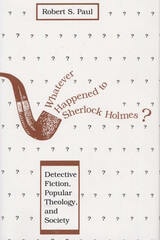
Whatever Happened to Sherlock Holmes?
Detective Fiction, Popular Theology, and SocietyRobert S. Paul
Southern Illinois University Press, 1991
Robert S. Paul suggests that the reason detective fiction has won legions of readers may be that "the writer of detective fiction, without conscious intent, appeals directly to those moral and spiritual roots of society unconsciously affirmed and endorsed by the readers."
Because detective stories deal with crime and punishment they cannot help dealing implicitly with theological issues, such as the reality of good and evil, the recognition that humankind has the potential for both, the nature of evidence (truth and error), the significance of our existence in a rational order and hence the reality of truth, and the value of the individual in a civilized society.
Paul argues that the genre traces its true beginning to the Enlightenment and documents two related but different reactions to the theological issues involved: first, a line of writers who are generally positive in relation to their cultural setting, such as Edgar Allan Poe, Wilkie Collins, Conan Doyle; and second, a reactionary strain, critical of the prevailing culture, that begins in William Godwin’s Caleb Williams and continues through the anti-heroic writers like Arsène Lupin to Raymond Chandler, Dashiell Hammett, and John MacDonald.