Results by title
2 books match the query 'Detente'
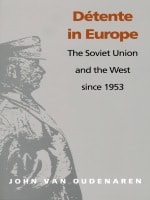
Detente in Europe
The Soviet Union & The West Since 1953John Van Oudenaren
Duke University Press, 1991
The monumental events in Eastern Europe and the Soviet Union must be understood, Jan Van Oudenaren argues, in the context of a process of East-West détente begun in 1953 in the aftermath of Stalin’s death. Van Oudenaren’s comprehensive and timely study examines the development of Soviet-Western détente from the death of Stalin to the unification of Germany.
In redefining détente as a process, rather than a code of conduct, Van Oudenaren looks to its origins in Soviet policy earlier than previously identified and analyzes both its history and character. His study explores the restoration of four-power negotiations in Germany and Austria in the mid-1950s, their subsequent breakdown in the Berlin crisis, their unexpected revival in 1990 in the form of “two plus four” talks on German unity, and the future of the Soviet Union as a European power.
Among the key elements of détente discussed are diplomacy, particularly the role of summit conferences; cooperation among parliaments, political parties, and trade unions; arms control; economic relations; and links among cultural institutions, churches, and peace movements.
[more]
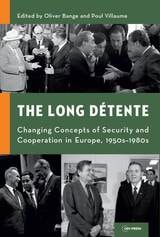
The Long Détente
Changing Concepts of Security and Cooperation in Europe, 1950s–1980sPoul Villaume
Central European University Press, 2017
This book presents pieces of evidence, which – taken together – lead to an argument that goes against the grain of the established Cold War narrative. The argument is that a “long détente” existed between East and West from the 1950s to the 1980s, that it existed and lasted for good (economic, national security, societal) reasons, and that it had a profound impact on the outcome of the conflict between East and West and the quintessentially peaceful framework in which this “endgame” was played. New, Euro-centered narratives are offered, including both West and East European perspectives. These contributions point to critical inconsistencies and inherent problems in the traditional U.S. dominated narrative of the “Victory in the Cold War.” The argument of a “long détente” does not need to replace the ruling American narrative. Rather, it can and needs to be augmented with European experiences and perceptions. After all, it was Europe – its peoples, societies, and states – that stood both at the ideological and military frontline of the conflict between East and West, and it was here that the struggle between liberalism and communism was eventually decided.
[more]