Results by title
9 books match the query 'Deuteronomy'
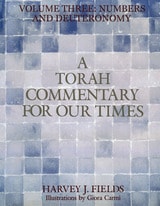
A Torah Commentary for Our Times
Volume 3: Numbers and DeuteronomyRabbi Harvey J. Fields
Central Conference of American Rabbis, 1993
A helpful approach to the weekly parashah, juxtaposing the insights of ancient, medieval, and modern commentators (including the author). Perfect for both beginning Torah students and scholars seeking new angles on the text. The volumes are available individually or as a three-volume set, ideal for a bar or bat mitzvah or confirmation gift.
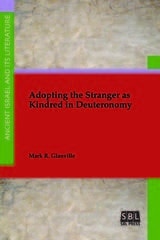
Adopting the Stranger as Kindred in Deuteronomy
Mark R. Glanville
SBL Press, 2018
Investigate how Deuteronomy incorporates vulnerable, displaced people
Deuteronomy addresses social contexts of widespread displacement, an issue affecting 65 million people today. In this book Mark R. Glanville investigates how Deuteronomy fosters the integration of the stranger as kindred into the community of Yahweh. According to Deuteronomy, displaced people are to be enfolded within the household, within the clan, and within the nation. Glanville argues that Deuteronomy demonstrates the immense creativity that communities may invest in enfolding displaced and vulnerable people. Inclusivism is nourished through social law, the law of judicial procedure, communal feasting, and covenant renewal. Deuteronomy’s call to include the stranger as kindred presents contemporary nation-states with an opportunity and a responsibility to reimagine themselves and their disposition toward displaced strangers today.
Features:
- Exploration of the relationship of ancient Israel’s social history to biblical texts
- An integrative methodology that brings together literary-historical, legal, sociological, comparative, literary, and theological approaches
- A thorough study of Israelite identity and ethnicity
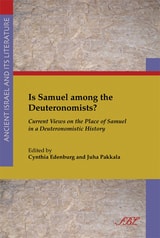
Is Samuel Among the Deuteronomists
Current Views on the Place of Samuel in a Deuteronomistic HistoryCynthia Edenburg
SBL Press, 2013
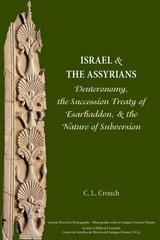
Israel and the Assyrians
Deuteronomy, the Succession Treaty of Esarhaddon, and the Nature of SubversC. L. Crouch
SBL Press, 2014
Was Deuteronomy created to be a subversive text based on Assyian treaties?
In this new book Crouch focuses on Deuteronomy’s subversive intent, asking what would be required in order for Deuteronomy to successfully subvert either a specific Assyrian source or Assyrian ideology more generally. The book reconsiders the nature of the relationship between Deuteronomy and Assyria, Deuteronomy’s relationship to ancient Near Eastern and biblical treaty and loyalty oath traditions, and the relevance of Deuteronomy’s treaty affinities to discussions of its date.
Features:
- A thorough investigation of the nature and requirements of subversion
- A focused examination of the context in which Deuteronomy would have functioned
- An appendix focused on redactional questions related to Deuteronoy 13 and 28
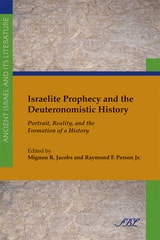
Israelite Prophecy and the Deuteronomistic History
Portrait, Reality, and the Formation of a HistoryMignon R. Jacobs
SBL Press, 2013
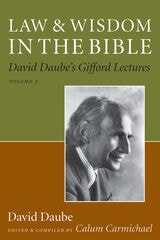
Law and Wisdom in the Bible
David Daube's Gifford Lectures, Volume IIDavid Daube
Templeton Press, 2010
"That over forty years after they were delivered these famous but unavailable Gifford Lectures should be published is occasion for celebration. Once again we hear Daube’s voice, patient and probing, as he turns over, tests, pushes fresh inquiries, and finds new insights. No man has had such a subtle sense of scriptural texts matched by such a supple sense of the practices and peculiarities of human beings engaged in the legal process. Law and Wisdom in the Bible is classic Daube." mdash;John T. Noonan Jr., United States Circuit Judge
David Daube (1909–99) was known for his unique and sophisticated research on Roman law, biblical law, Jewish Law, and medical ethics. In Law and Wisdom in the Bible, the first published collection of his 1964 Gifford Lectures, Daube derives from his complex understanding of biblical texts both ancient and contemporary notions about wisdom, justice, and education.
In addressing these and other profound issues, Daube crosses traditional disciplinary boundaries and bridges the
gap between humanism and religion, especially with regard to Christianity and Judaism. With his sophisticated understanding of Talmudic law and literature, his thinking, which is on full display in these lectures, revolutionized prevailing perceptions about the New Testament.
Notes on the Greek Text of Deuteronomy
John William Wevers
SBL Press, 1995
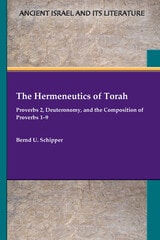
The Hermeneutics of Torah
Proverbs 2, Deuteronomy, and the Composition of Proverbs 1–9Bernd U. Schipper
SBL Press, 2021
This revised and expanded English edition of Bernd U. Schipper’s 2012 Hermeneutik der Tora incorporates the results of his continued research and writings on Proverbs. For nearly a century, many biblical scholars have argued that the main theological traditions, such as the divine law, God’s torah, do not appear in the book of Proverbs. In this volume, however, Schipper demonstrates that Proverbs interacts in a sophisticated way with the concept of the torah. A detailed analysis of Proverbs 2 and other passages from the first part of the book of Proverbs shows that Proverbs engages in a postexilic discourse around “wisdom and torah” concerning the abilities of humans to fulfill the will of YHWH exemplified in the divine torah.

Women at Work in the Deuteronomistic History
Mercedes L. García Bachmann
SBL Press, 2013
A thorough study of the socio-economic and literary contexts of women in the Deuteronomistic History
Mercedes L. García Bachmann examines the key texts in the Deuteronomistic History that mention women in service occupations: slaves and dependents, cooks, wet nurses, childcare givers, prostitutes, and scribes. The mostly anonymous women who performed this work for others are sometimes mentioned only in a single verse. Consequently, they often are as unrecognized in modern scholarship as they seem in the biblical text. García Bachmann shows that these women were honored not in relation to matters such as sexual purity or marital faithfulness but on account of the valuable service that they provided.
- A close examination of unnamed women
- A review of previous work in feminist, ancient Near Eastern, biblical, and social-scientific studies
- Extensive coverage of Hebrew terms used for women workers