Results by title
3 books match the query 'Devadāsīs'

Abundance
Sexuality’s HistoryAnjali Arondekar
Duke University Press, 2023
In Abundance, Anjali Arondekar refuses the historical common sense that archival loss is foundational to a subaltern history of sexuality, and that the deficit of our minoritized pasts can be redeemed through acquisitions of lost pasts. Instead, Arondekar theorizes the radical abundance of sexuality through the archives of the Gomantak Maratha Samaj—a caste-oppressed devadasi collective in South Asia—that are plentiful and quotidian, imaginative and ordinary. For Arondekar, abundance is inextricably linked to the histories of subordinated groups in ways that challenge narratives of their constant devaluation. Summoning abundance over loss upends settled genealogies of historical recuperation and representation and works against the imperative to fix sexuality within wider structures of vulnerability, damage, and precarity. Multigeneric and multilingual, transregional and historically supple, Abundance centers sexuality within area, post/colonial, and anti/caste histories.
[more]
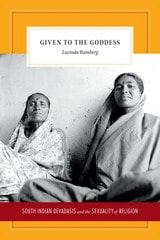
Given to the Goddess
South Indian Devadasis and the Sexuality of ReligionLucinda Ramberg
Duke University Press, 2014
Who and what are marriage and sex for? Whose practices and which ways of talking to god can count as religion? Lucinda Ramberg considers these questions based upon two years of ethnographic research on an ongoing South Indian practice of dedication in which girls, and sometimes boys, are married to a goddess. Called devadasis, or jogatis, those dedicated become female and male women who conduct the rites of the goddess outside the walls of her main temple and transact in sex outside the bounds of conjugal matrimony. Marriage to the goddess, as well as the rites that the dedication ceremony authorizes jogatis to perform, have long been seen as illegitimate and criminalized. Kinship with the goddess is productive for the families who dedicate their children, Ramberg argues, and yet it cannot conform to modern conceptions of gender, family, or religion. This nonconformity, she suggests, speaks to the limitations of modern categories, as well as to the possibilities of relations—between and among humans and deities—that exceed such categories.
[more]
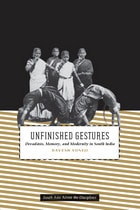
Unfinished Gestures
Devadasis, Memory, and Modernity in South IndiaDavesh Soneji
University of Chicago Press, 2011
Unfinished Gestures presents the social and cultural history of courtesans in South India who are generally called devadasis, focusing on their encounters with colonial modernity in the nineteenth and early twentieth centuries. Following a hundred years of vociferous social reform, including a 1947 law that criminalized their lifestyles, the women in devadasis communities contend with severe social stigma and economic and cultural disenfranchisement. Adroitly combining ethnographic fieldwork with historical research, Davesh Soneji provides a comprehensive portrait of these marginalized women and unsettles received ideas about relations among them, the aesthetic roots of their performances, and the political efficacy of social reform in their communities.
Poignantly narrating the history of these women, Soneji argues for the recognition of aesthetics and performance as a key form of subaltern self-presentation and self-consciousness. Ranging over courtly and private salon performances of music and dance by devadasis in the nineteenth century, the political mobilization of devadasis identity in the twentieth century, and the post-reform lives of women in these communities today, Unfinished Gestures charts the historical fissures that lie beneath cultural modernity in South India.
[more]