Results by title
5 books match the query 'Developmental psychology'

Birth of the Living God
A Psychoanalytic StudyAna-Marie Rizzuto
University of Chicago Press, 1981

Creating Contexts for Learning and Self-Authorship
Constructive-Developmental PedagogyMarcia B. Baxter Magolda
Vanderbilt University Press, 2000
This book is intended to help college faculty create conditions in which students learn to construct knowledge in their disciplines and achieve self-authorship. A significant, and often overlooked, dimension mediating learning and self-authorship centers on learners' ways of knowing, or their assumptions about the nature, limits, and certainty of knowledge. A learner who assumes that all knowledge is certain expects to hear answers from an authority figure; in contrast, a learner who views knowledge as relative expects to explore multiple viewpoints. By taking a constructive-developmental approach, Baxter Magolda demonstrates how students' ability to construct knowledge is intertwined with the development of their assumptions about knowledge itself and their role in creating it. She shows how the structure of constructive-developmental teaching hinges on three principles: validating students' ability to know, situating learning in students' experience, and defining learning as teachers and students mutually constructing meaning.
Unlike most of the literature on the subject, this book takes abstract pedagogical principles and translates them into practical methods. By observing four semester-length college courses in mathematics, zoology, human development, and education and intensively interviewing students and their instructors, Baxter Magolda provides much-needed, concrete principles that will lead to valuable improvements in the classroom environment. With an enhanced level of understanding of the teaching-learning relationship, professors will be able to teach better, and students will be able to learn better, thus preparing them to meet the demands inherent in adulthood and preparing them to take an active role in creating a better society.
Those actively involved in higher education, whether college faculty or students in graduate programs, as well as anyone focused on education in general will find much of interest in this book.
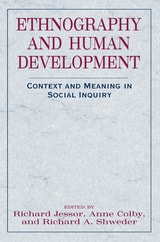
Ethnography and Human Development
Context and Meaning in Social InquiryEdited by Richard Jessor, Anne Colby, and Richard A. Shweder
University of Chicago Press, 1996
Part 1, informed by a post-positivist philosophy of science, argues for the validity of ethnographic knowledge. Part 2 examines a range of qualitative methods, from participant observation to the hermeneutic elaboration of texts. In Part 3, ethnographic methods are applied to issues of human development across the life span and to social problems including poverty, racial and ethnic marginality, and crime.
Restoring ethnographic methods to a central place in social inquiry, these twenty-two lively essays will interest everyone concerned with the epistemological problems of context, meaning, and subjectivity in the behavioral sciences.

Evolution's Eye
A Systems View of the Biology-Culture DivideSusan Oyama
Duke University Press, 2000
While acknowledging that, in an uncertain world, it is easy to “blame it on the genes,” Oyama claims that the renewed trend toward genetic determinism colors the way we think about everything from human evolution to sexual orientation and personal responsibility. She presents instead a view that focuses on how a wide variety of developmental factors interact in the multileveled developmental systems that give rise to organisms. Shifting attention away from genes and the environment as causes for behavior, she convincingly shows the benefits that come from thinking about life processes in terms of developmental systems that produce, sustain, and change living beings over both developmental and evolutionary time.
Providing a genuine alternative to genetic and environmental determinism, as well as to unsuccessful compromises with which others have tried to replace them, Evolution’s Eye will fascinate students and scholars who work in the fields of evolution, psychology, human biology, and philosophy of science. Feminists and others who seek a more complex view of human nature will find her work especially congenial.
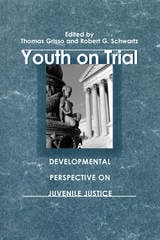
Youth on Trial
A Developmental Perspective on Juvenile JusticeEdited by Thomas Grisso and Robert G. Schwartz
University of Chicago Press, 2003