Results by title
6 books match the query 'Devils'
Angels, Devils
The Supernatural and Its Visual RepresentationGerhard Jaritz
Central European University Press, 2011
Devils & Islands
PoemsTurner Cassity
Ohio University Press, 2007
As he approaches eighty, Turner Cassity may finally be out of control. His hatchet has never fallen more lethally, meaning if you have the stomach for him he is more enjoyable than ever. Under the blade come Martha Graham, Johann Sebastian Bach, musicologists, tree huggers, Frank Gehry, folk music, folk art of all times and all places, folk… . There are, however, his unpredictable sympathies: Edith Wilson, skyscrapers, Pontius Pilate, Pilate’s legionnaires. He obviously has a soft spot for Pop Culture, although he cannot avoid seeingit de haut en bas.
As usual, he is all over the place geographically. One feels he would slash his wrists before he would write a poem about any city on the traditional Grand Tour. Manaus, Campeche, Trieste, Budapest (as destroyed by Godzilla)—these are his places. He has a disturbing willingness to write on both sides of an issue, resembling in this Bernard Shaw. You have to read very carefully to see whether he tips his hand.
One looks forward to Mr. Cassity’s posthumous poems, when he is beyond the reach of libel. For now, at least, we have Devils & Islands.
Devils and Rebels
The Making of Hawthorne's Damned PoliticsLarry J. Reynolds
University of Michigan Press, 2010
"An outstanding combination of literary interpretation and cultural and historical context that will be an important addition to the critical literature on Hawthorne."
---Nina Baym, University of Illinois
"It is difficult to imagine a more timely book than Devils and Rebels. Examining the role of the public intellectual and writer during a time of political conflict and war, Reynolds takes up his charges with great precision and historical finesse. What particularly distinguishes this book is its attention to the ways in which one of this country's most important authors struggled to resist the waves of political extremism and patriotic hysteria that swept around him."
---Jeffrey Steele, University of Wisconsin—Madison
Widely condemned even in his own time, Nathaniel Hawthorne's views on abolitionism and slavery are today frequently characterized by scholars as morally reprehensible. Devils and Rebels explores the historical and biographical record to reveal striking evidence of the author's true political values---values grounded in pacifism and resistant to the kind of binary thinking that could lead to violence and war.
The book offers fresh readings of not only Hawthorne's four major romances but also some of his less familiar works like "Legends of the Province House," The Whole History of Grandfather's Chair, Journal of an African Cruiser, The Life of Franklin Pierce, and "Septimius Felton." Reynolds argues that Hawthorne---whether in his politics or his art---drew upon racialized imagery from America's past revolution and war on witchcraft to create a politics of quiet imagination, alert to the ways in which New England righteousness could become totalitarian by imposing its narrow view of the world on others.
Meticulously researched and cogently argued, this groundbreaking work demonstrates the need to examine perspectives and values from beyond the New England region when studying the literary history of the American Renaissance and illuminates the difficulties faced by public intellectuals during times of political strife---an issue as relevant today as it was some one hundred and fifty years ago.
Larry J. Reynolds is Thomas Franklin Mayo Professor of Liberal Arts and Professor of English at Texas A&M University. His previous books include A Historical Guide to Nathaniel Hawthorne, National Imaginaries, American Identities: The Cultural Work of American Iconography, and European Revolutions and the American Literary Renaissance as well as an edition of the European writings of Margaret Fuller.

Dostoevsky's "The Devils"
A Critical CompanionWilliam Leatherbarrow
Northwestern University Press, 1999
Landscapes of Devils
Tensions of Place and Memory in the Argentinean ChacoGastón R. Gordillo
Duke University Press, 2004
As Gordillo explains, the bush is the result of social, cultural, and political processes that intertwine this place with other geographies. Labor exploitation, state violence, encroachment by settlers, and the demands of Anglican missionaries all transformed this land. The Toba’s lives have been torn between alienating work in sugar plantations and relative freedom in the bush, between moments of domination and autonomy, abundance and poverty, terror and healing. Part of this contradictory experience is culturally expressed in devils, evil spirits that acquire different features in different places. The devils are sources of death and disease in the plantations, but in the bush they are entities that connect with humans as providers of bush food and healing power. Enacted through memory, the experiences of the Toba have produced a tense and shifting geography. Combining extensive fieldwork conducted over a decade, historical research, and critical theory, Gordillo offers a nuanced analysis of the Toba’s social memory and a powerful argument that geographic places are not only objective entities but also the subjective outcome of historical forces.
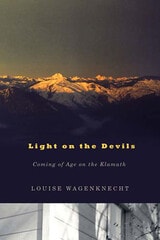
Light on the Devils
Coming of Age on the KlamathLouise Wagenknecht
Oregon State University Press, 2011
When Louise Wagenknecht’s family arrived in the remote logging town of Happy Camp in 1962, a boundless optimism reigned. Whites and Indians worked together in the woods and the lumber mills of northern California’s Klamath country. Logging and lumber mills, it seemed, would hold communities together forever.
But that booming prosperity would come to an end. Looking back on her teenage years spent along the Klamath River, Louise Wagenknecht recounts a vanishing way of life. She explores the dynamics of family relationships and the contradictions of being female in a western logging town in the 1960s. And she paints an evocative portrait of the landscape and her relationship with it.
Light on the Devils is a captivating memoir of place. It will appeal to general readers interested in the rural West, personal memoir, history, and natural history.