Results by title
6 books match the query 'Dewey'
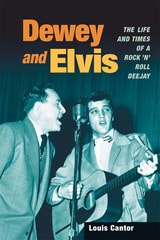
Dewey and Elvis
The Life and Times of a Rock 'n' Roll DeejayLouis Cantor
University of Illinois Press, 2010
Louis Cantor illuminates Phillips's role in turning a huge white audience on to previously forbidden race music. Phillips's zeal for rhythm and blues legitimized the sound and set the stage for both Elvis's subsequent success and the rock 'n' roll revolution of the 1950s. Using personal interviews, documentary sources, and oral history collections, Cantor presents a personal view of the disc jockey while restoring Phillips's place as an essential figure in rock 'n' roll history.
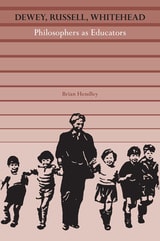
Dewey, Russell, Whitehead
Philosophers as EducatorsBrian Patrick Hendley
Southern Illinois University Press, 1986
In Philosophers as Educators Brian Patrick Hendley argues that philosophers of education should reject their preoccupation with defining terms and analyzing concepts and embrace the philosophical task of constructing general theories of education. Hendley discusses in detail the educational philosophies of John Dewey, Bertrand Russell, and Alfred North Whitehead. He sees in these men excellent role models that contemporary philosophers might well follow. Hendley believes that, like these mentors, philosophers should take a more active, practical role in education. Dewey and Russell ran their own schools, and Whitehead served as a university administrator and as a member of many committees created to study education.
James and Dewey on Belief and Experience
Edited by John M. Capps and Donald Capps
University of Illinois Press, 2010
In these essays, you'll find William James deeply embroiled in debates between religion and science. Combining philosophical charity with logical clarity, he defended the validity of religious experience against crass forms of scientism. Dewey identified the myriad ways in which supernatural concerns distract religious adherents from pressing social concerns, and sought to reconcile the tensions inherent in science's dual embrace of common sense and the aesthetic.
James and Dewey on Belief and Experience is divided into two sections: the former showcases James, the latter is devoted to Dewey. Two transitional passages in which each reflects on the work of the other bridge these two main segments. Together, the sections offer a unique perspective on the philosophers' complex relationship of influence and interdependence. An editors' introduction provides biographical information about both men, an overview of their respective philosophical orientations, a discussion of the editorial process, and a brief commentary on each of the selections.
Comparing what these foremost pragmatists wrote on both themes illumines their common convictions regarding the nature of philosophical inquiry and simultaneously reveals what made each a distinctive thinker.
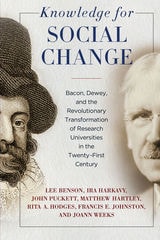
Knowledge for Social Change
Bacon, Dewey, and the Revolutionary Transformation of Research Universities in the Twenty-First CenturyLee Benson, Ira Harkavy, Matthew Hartley
Temple University Press, 2017
Employing history, social theory, and a detailed contemporary case study, Knowledge for Social Change argues for fundamentally reshaping research universities to function as democratic, civic, and community-engaged institutions dedicated to advancing learning and knowledge for social change. The authors focus on significant contributions to learning made by Francis Bacon, Benjamin Franklin, Seth Low, Jane Addams, William Rainey Harper, and John Dewey—as well as their own work at Penn’s Netter Center for Community Partnerships—to help create and sustain democratically-engaged colleges and universities for the public good.
Knowledge for Social Change highlights university-assisted community schools to effect a thoroughgoing change of research universities that will contribute to more democratic schools, communities, and societies. The authors also call on democratic-minded academics to create and sustain a global movement dedicated to advancing learning for the “relief of man’s estate”—an iconic phrase by Francis Bacon that emphasized the continued betterment of the human condition—and to realize Dewey’s vision of an organic “Great Community” composed of participatory, democratic, collaborative, and interdependent societies.
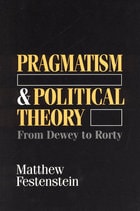
Pragmatism and Political Theory
From Dewey to RortyMatthew Festenstein
University of Chicago Press, 1997
The book's second part traces how Dewey's approach has been differently developed, especially in the work of three contemporary pragmatic thinkers: Richard Rorty, Jurgen Habermas, and Hilary Putnam. This first full-length critical study of the relationship between the pragmatist tradition and political philosophy fills a significant gap in contemporary thought.
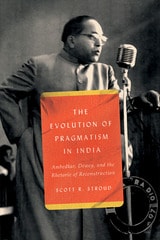
The Evolution of Pragmatism in India
Ambedkar, Dewey, and the Rhetoric of ReconstructionScott R. Stroud
University of Chicago Press, 2023
In The Evolution of Pragmatism in India, Scott R. Stroud delivers a comprehensive exploration of the influence of John Dewey’s pragmatism on Bhimrao Ambedkar, architect of the Republic of India’s constitution. Stroud traces Ambedkar’s development in Dewey’s Columbia University classes in 1913–1916 through his final years in 1950s India when he rewrote the story of Buddhism. Stroud examines pragmatism’s influence not only on the philosophical ideas underpinning Ambedkar’s fight against caste oppression but also how his persuasive techniques drew on pragmatism’s commitment to reconstruction and meliorism. At the same time, Stroud is careful to point out the ways that Ambedkar pushed back against Dewey’s paradigm and developed his own approach to challenges in India. The result is a nuanced study of one of the most important figures in Indian history.