Results by title
4 books match the query 'Dialogue in literature'
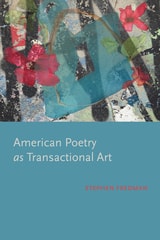
American Poetry as Transactional Art
Stephen Fredman
University of Alabama Press, 2020
Explores the ways American poetry engages with visual art, music, fiction, spirituality, and performance art
Many people think of poetry as a hermetic art, as though poets wrote only about themselves or as if the subject of poetry were finally only poetry—its forms and traditions. Indeed much of what constitutes poetry in the lyric tradition depends on a stringently controlled point of view and aims for a timeless, intransitive utterance. Stephen Fredman’s study proposes a different perspective.
American Poetry as Transactional Art explores a salient quality of much avant-garde American poetry that has so far lacked sustained treatment: namely, its role as a transactional art. Specifically Fredman describes this role as the ways it consistently engages in conversation, talk, correspondence, going beyond the scope of its own subjects and forms—its existential interactions with the outside world. Poetry operating in this vein draws together images, ideas, practices, rituals, and verbal techniques from around the globe, and across time—not to equate them, but to establish dialogue, to invite as many guests as possible to the World Party, which Robert Duncan has called the “symposium of the whole.”
Fredman invites new readers into contemporary poetry by providing lucid and nuanced analyses of specific poems and specific interchanges between poets and their surroundings. He explores such topics as poetry’s transactions with spiritual traditions and practices over the course of the twentieth century; the impact of World War II on the poetry of Charles Olson and George Oppen; exchanges between poetry and other art forms including sculpture, performance art, and ambient music; the battle between poetry and prose in the early work of Paul Auster and in Lyn Hejinian’s My Life. The epilogue looks briefly at another crucial transactional occasion: teaching American poetry in the classroom in a way that demonstrates that it is at the center of the arts and at the heart of American culture.
Joining the Conversation
Dialogues by Renaissance WomenJanet Levarie Smarr
University of Michigan Press, 2005
Avoiding the male-authored model of competing orations, French and Italian women of the Renaissance framed their dialogues as informal conversations, as letters with friends that in turn became epistles to a wider audience, and even sometimes as dramas. No other study to date has provided thorough, comparative view of these works across French, Italian, and Latin. Smarr's comprehensive treatment relates these writings to classical, medieval, and Renaissance forms of dialogue, and to other genres including drama, lyric exchange, and humanist invective -- as well as to the real conversations in women's lives -- in order to show how women adapted existing models to their own needs and purposes.
Janet Levarie Smarr is Professor of Theatre and Italian Studies at the University of California, San Diego.
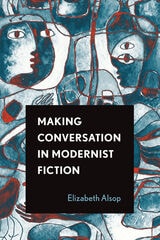
Making Conversation in Modernist Fiction
Elizabeth Alsop
The Ohio State University Press, 2019
If historically dialogue had been treated as a subordinate element in fiction—a tool for developing character or advancing plot—this book demonstrates that writers such as Henry James, Ernest Hemingway, James Joyce, William Faulkner, Virginia Woolf, and Gertrude Stein would increasingly emphasize it as a poetic structure in its own right. In this way, Alsop argues, modernist writers “make” conversation in radically new ways and for a diverse range of expressive and communicative ends. Over the course of five chapters that explore this previously overlooked avenue of modernist innovation, Making Conversation offers readers a radical new paradigm not only for understanding fictional talk but also for interpreting some of the most celebrated examples of early twentieth-century narrative.
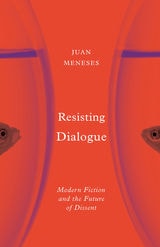
Resisting Dialogue
Modern Fiction and the Future of DissentJuan Meneses
University of Minnesota Press, 2019
A bold new critique of dialogue as a method of eliminating dissent
Is dialogue always the productive political and communicative tool it is widely conceived to be? Resisting Dialogue reassesses our assumptions about dialogue and, in so doing, about what a politically healthy society should look like. Juan Meneses argues that, far from an unalloyed good, dialogue often serves as a subtle tool of domination, perpetuating the underlying inequalities it is intended to address.
Meneses investigates how “illusory dialogue” (a particular dialogic encounter designed to secure consensus) is employed as an instrument that forestalls—instead of fostering—articulations of dissent that lead to political change. He does so through close readings of novels from the English-speaking world written in the past hundred years—from E. M. Forster’s A Passage to India and Jeanette Winterson’s The Passion to Indra Sinha’s Animal’s People and more. Resisting Dialogue demonstrates how these novels are rhetorical exercises with real political clout capable of restoring the radical potential of dialogue in today’s globalized world. Expanding the boundaries of postpolitical theory, Meneses reveals how these works offer ways to practice disagreement against this regulatory use of dialogue and expose the pitfalls of certain other dialogic interventions in relation to some of the most prominent questions of modern history: cosmopolitanism at the end of empire, the dangers of rewriting the historical record, the affective dimension of neoliberalism, the racial and nationalist underpinnings of the “war on terror,” and the visibility of environmental violence in the Anthropocene.
Ultimately, Resisting Dialogue is a complex, provocative critique that, melding political and literary theory, reveals how fiction can help confront the deployment of dialogue to preempt the emergence of dissent and, thus, revitalize the practice of emancipatory politics.