Results by title

8 books match the query 'Diamonds'
cover of Acres Of Diamonds

Acres Of Diamonds

Russell Conwell

Temple University Press, 2002
Considered by many to be one of the finest speeches ever written, Acres of Diamonds offers a multitude of lessons about the rewards of work, education, and finding the riches of life in one's own back yard.In an era when many Americans would pack public halls to hear speeches given by the greatest citizens of their day, Russell Conwell read his world-famous lecture hundreds of times, and used the income he earned delivering it to found a small seminary to train Baptist ministers. That school soon grew into Temple University, one of the first universities to offer affordable education to working-class Americans: it stands today as the most visible example of Russell Conwell's legacy and vision.There are a multitude of gems to mine from Russell Conwell's words, no matter what your walk of life. Acres of Diamonds remains a significant—and inspirational—lesson about where the true riches of life may be found.
[more]
cover of Ashes and Diamonds

Ashes and Diamonds

Jerzy Andrzejewski

Northwestern University Press, 1997

Originally published in Poland in 1948, and acclaimed as one of the finest postwar Polish novels, Ashes and Diamonds takes place in the spring of 1945, as the nation is in the throes of its transformation to People' Poland. Communists, socialists, and nationalists; thieves and black marketeers; servants and fading aristocrats; veteran terrorists and bands of murderous children bewitched by the lure of crime and adventure—all of these converge on a provincial town's chief hotel, a microcosm of an uprooted world.
[more]
cover of Bear, Diamonds and Crane

Bear, Diamonds and Crane

Claire Kageyama-Ramakrishnan

Four Way Books, 2011
Bear, Diamonds and Crane depicts the sansei, the grandchildren of Japanese immigrants to America in villanelles, haiku, and lyric poems collaged from family letters. Kageyama-Ramakrishnan recounts her relatives’ internment in Manzanar, the California concentration camp where Japanese Americans were imprisoned during World War II. Honoring Sadako Sasaki, who, “after Hiroshima and Nagasaki, / […] folded / a thousand cranes/ for world peace,” Bear, Diamonds and Crane looks to the yonsei (fourth generation) to transform “the wound” that “resists erasure and cultural amnesia”: “For you, I will keep the ripe weight,/ […]/ The limes and climbing wisteria vines.”
[more]
cover of Diamonds in the Marsh: A Natural History of the Diamondback Terrapin

Diamonds in the Marsh

A Natural History of the Diamondback Terrapin

Barbara Brennessel

Brandeis University Press, 2021

A new edition of a classic on a beloved turtle species.
 
She’s the mascot for the University of Maryland’s sports teams and her ancestors were nearly driven to extinction by Victorians who indulged in turtle soup. But as she buries herself in the mud every night to sleep, the diamondback terrapin knows none of this. The size of a dinner plate and named for the beautiful concentric rings on her shell, she can live at least forty years and is the only turtle in North America who can live in brackish and salty waters. Several diamondback populations have been the subjects of ecological studies in recent years, but most of that information was buried in scientific literature and various state and federal reports—until this book.
 
Synthesizing all known research on this remarkable animal, Diamonds in the Marsh is the first full-scale natural history of the diamondback terrapin. Focusing on the northern diamondback, Barbara Brennessel examines its evolution, physiology, adaptations, behavior, growth patterns, life span, genetic diversity, land use, reproduction, and early years. She also discusses its relationship to humans, first as an important food source from colonial times through the nineteenth century, and more recently as a cultural icon, frequently depicted in Native American art and design. She concludes with a look at contemporary hazards to the terrapin and urges continued study of this marvelous creature. Updated with a new introduction by Brennessel, and with a foreword by Bob Prescott, former executive director of Massachusett’s Audubon Wellfleet Bay Sanctuary, Diamonds of the Marsh is perfect for those interested in the conservation of a species. 
[more]
cover of Diamonds in the Rough: A History of Alabama's Cahaba Coal Field

Diamonds in the Rough

A History of Alabama's Cahaba Coal Field

James Sanders Day

University of Alabama Press, 2013

Diamonds in the Rough reconstructs the historical moment that defined the Cahaba Coal Field, a mineral-rich area that stretches across sixty-seven miles and four counties of central Alabama.
 
Combining existing written sources with oral accounts and personal recollections, James Sanders Day’s Diamonds in the Rough describes the numerous coal operations in this region—later overshadowed by the rise of the Birmingham district and the larger Warrior Field to the north.
 
Many of the capitalists are the same: Truman H. Aldrich, Henry F. DeBardeleben, and James W. Sloss, among others; however, the plethora of small independent enterprises, properties of the coal itself, and technological considerations distinguish the Cahaba from other Alabama coal fields. Relatively short-lived, the Cahaba coal-mining operation spanned from discovery in the 1840s through development, boom, and finally bust in the mid-1950s.
 
Day considers the chronological discovery, mapping, mining, and marketing of the field’s coal as well as the issues of convict leasing, town development, welfare capitalism, and unionism, weaving it all into a rich tapestry. At the heart of the story are the diverse people who lived and worked in the district—whether operator or miner, management or labor, union or nonunion, white or black, immigrant or native—who left a legacy for posterity now captured in Diamonds in the Rough. Largely obscured today by pine trees and kudzu, the mining districts of the Cahaba Coal Field forever influenced the lives of countless individuals and families, and ultimately contributed to the whole fabric of the state of Alabama.
 

Winner of the 2014 Clinton Jackson Coley Award for Best Work on Alabama Local History from the Alabama Historical Association
[more]
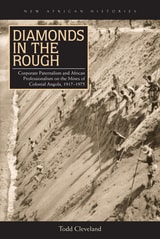
cover of Diamonds in the Rough: Corporate Paternalism and African Professionalism on the Mines of Colonial Angola, 1917–1975

Diamonds in the Rough

Corporate Paternalism and African Professionalism on the Mines of Colonial Angola, 1917–1975

Todd Cleveland

Ohio University Press, 2015

Diamonds in the Rough explores the lives of African laborers on Angola’s diamond mines from the commencement of operations in 1917 to the colony’s independence from Portugal in 1975. The mines were owned and operated by the Diamond Company of Angola, or Diamang, which enjoyed exclusive mining and labor concessions granted by the colonial government. Through these monopolies, the company became the most profitable enterprise in Portugal’s African empire. After a tumultuous initial period, the company’s mines and mining encampments experienced a remarkable degree of stability, in striking contrast to the labor unrest and ethnic conflicts that flared in other regions. Even during the Angolan war for independence (1961–75), Diamang’s zone of influence remained comparatively untroubled.

Todd Cleveland explains that this unparalleled level of quietude was a product of three factors: African workers’ high levels of social and occupational commitment, or “professionalism”; the extreme isolation of the mining installations; and efforts by Diamang to attract and retain scarce laborers through a calculated paternalism. The company’s offer of decent accommodations and recreational activities, as well as the presence of women and children, induced reciprocal behavior on the part of the miners, a professionalism that pervaded both the social and the workplace environments. This disparity between the harshness of the colonial labor regime elsewhere and the relatively agreeable conditions and attendant professionalism of employees at Diamang opens up new ways of thinking about how Africans in colonial contexts engaged with forced labor, mining capital, and ultimately, each other.
[more]
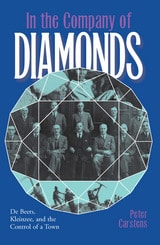
cover of In the Company of Diamonds: De Beers, Kleinzee, and the Control of a Town

In the Company of Diamonds

De Beers, Kleinzee, and the Control of a Town

Peter Carstens

Ohio University Press, 2001

After the 1925 discovery of diamonds in the semi-desert of the northwest coast of South Africa, De Beers Consolidated Mines Ltd. virtually proclaimed its dominion over the whole region. In the town of Kleinzee, the company owns all the real estate and infrastructure, and controls and administers both the town and the industry.

Peter Carstens’s In the Company of Diamonds draws a stark and startling portrait of this closed community, one that analyzes the power and hegemonic techniques used to acquire that power and maintain it.

As a prototypical company town, Kleinzee is subordinated to the industry and will of the owners. Employees and workers are variously differentiated and ordered according to occupation, ethnic variation, and other social criteria, a pattern reflected most markedly in the allocation of housing. Managers live in large, ranch-style houses, while contract workers are lodged in single-sex compounds.

As a community type, company towns like Kleinzee are not entirely unique, and Professor Carstens successfully draws a number of structural parallels with other closed and incomplete social formations such as Indian reservations, military bases, colleges, prisons, and mental hospitals.
[more]
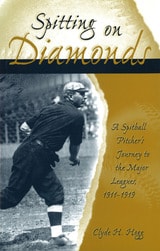
cover of Spitting on Diamonds: A Spitball Pitcher's Journey to the Major Leagues, 1911-1919

Spitting on Diamonds

A Spitball Pitcher's Journey to the Major Leagues, 1911-1919

Clyde H. Hogg

University of Missouri Press, 2005

Spitball n., an illegal pitch in which a foreign substance (spit or Vaseline) is applied to the ball by the pitcher before it is thrown.
Dead ballera n., a time period during baseball, usually regarded as 1900–1919, when the game used a "dead" or almost soft ball during play. Usually, the same ball was used for the entire game.
In 1911, when Bradley Hogg began his major-league pitching career for the National League’s Boston Rustlers, baseball was a different game. Hogg played during a time known as the dead ball era, when a pitcher could spit on, shine up, or even roughen a ball to secure an advantage over a hitter. Although only seven World Series had been played at that point, the names of the best and most colorful players remain familiar today: Cy Young, Casey Stengel, Honus Wagner, Rogers Hornsby, and Christy Mathewson.
During his major and minor league career, Hogg played with or against twenty-seven Hall of Fame ballplayers and under the critical gaze of two Hall of Fame umpires and eleven Hall of Fame sportswriters. In Spitting on Diamonds, Clyde Hogg details the life of baseball’s everyman, including excerpts from newspapers throughout the country to bring to life the times in which Bradley Hogg played. The author shows how Hogg’s career is representative of the thousands of men who have played professional baseball since its inception more than 125 years ago, men who didn’t make it into the Hall of Fame or win awards but made it possible for millions of fans to enjoy the game. These players were the flannelled hosts of America’s favorite pastime and the ones who made the game what it was and is today.
The author uses Hogg’s career as a spitball pitcher in leagues from coast to coast to show the rapid change and growth of our nation between 1910 and 1920. With enough baseball statistics to satisfy even the most hard-core fan, this time capsule of early-twentieth-century America will appeal to sports enthusiasts and readers of general historical nonfiction alike. They will find in its pages an America now visible only in faded photographs, along with a version of the national pastime that no longer exists. Featuring multiple bunts, double steals, inside pitching, and the now outlawed “spitball,” as well as the skill it took to hit such deliveries, this game was hard, fast, and nonstop. Spitting on Diamonds lets the reader understand what it was like to live and play professional sports when America and its national pastime were coming of age.
[more]