Results by title
2 books match the query 'Dias, Nélia'
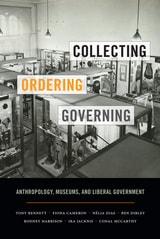
Collecting, Ordering, Governing
Anthropology, Museums, and Liberal GovernmentTony Bennett, Fiona Cameron, Nelia Dias, Ben Dibley, Harrison Rodney, Ira Jacknis, and Conal McCarthy
Duke University Press, 2017
The coauthors of this theoretically innovative work explore the relationships among anthropological fieldwork, museum collecting and display, and social governance in the early twentieth century in Australia, Britain, France, New Zealand, and the United States. With case studies ranging from the Musée de l'Homme's 1930s fieldwork missions in French Indo-China to the influence of Franz Boas's culture concept on the development of American museums, the authors illuminate recent debates about postwar forms of multicultural governance, cultural conceptions of difference, and postcolonial policy and practice in museums. Collecting, Ordering, Governing is essential reading for scholars and students of anthropology, museum studies, cultural studies, and indigenous studies as well as museum and heritage professionals.
[more]

Critical Heritage Studies and the Futures of Europe
Edited by Rodney Harrison, Nélia Dias, and Kristian Kristiansen
University College London, 2023
This book applies heritage studies to the present and the future of Europe.
Cultural and natural heritage are central to ideas of what Europe and “the European project’” are. Heritage studies were prevalent in the emergence of nation-states in the eighteenth and nineteenth centuries, where they were used to justify differences over which border conflicts were fought. Later, the idea of a “common European heritage” provided a rationale for the development of the European Union. Now, the emergence of “new” populist nationalisms shows how the imagined past continues to play a role in cultural and social governance, while a series of interlinked social and ecological crises are changing the ways that heritage operates, with new discourses and ontologies emerging to reconfigure heritage for the circumstances of the present and the uncertainties of the future.
Cultural and natural heritage are central to ideas of what Europe and “the European project’” are. Heritage studies were prevalent in the emergence of nation-states in the eighteenth and nineteenth centuries, where they were used to justify differences over which border conflicts were fought. Later, the idea of a “common European heritage” provided a rationale for the development of the European Union. Now, the emergence of “new” populist nationalisms shows how the imagined past continues to play a role in cultural and social governance, while a series of interlinked social and ecological crises are changing the ways that heritage operates, with new discourses and ontologies emerging to reconfigure heritage for the circumstances of the present and the uncertainties of the future.
[more]