54 books match the query 'Diaspora' and 6 start with a
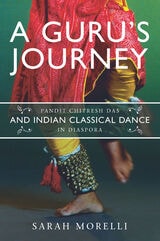
cover of A Guru’s Journey: Pandit Chitresh Das and Indian Classical Dance in Diaspora

A Guru’s Journey

Pandit Chitresh Das and Indian Classical Dance in Diaspora

Sarah Morelli

University of Illinois Press, 2019

An important modern exponent of Asian dance, Pandit Chitresh Das brought kathak to the United States in 1970. The North Indian classical dance has since become an important art form within the greater Indian diaspora. Yet its adoption outside of India raises questions about what happens to artistic practices when we separate them from their broader cultural contexts.

A Guru's Journey provides an ethnographic study of the dance form in the San Francisco Bay Area community formed by Das. Sarah Morelli, a kathak dancer and one of Das's former students, investigates issues in teaching, learning, and performance that developed around Das during his time in the United States. In modifying kathak's form and teaching for Western students, Das negotiates questions of Indianness and non-Indianness, gender, identity, and race. Morelli lays out these issues for readers with the goal of deepening their knowledge of kathak aesthetics, technique, and theory. She also shares the intricacies of footwork, facial expression in storytelling, and other aspects of kathak while tying them to the cultural issues that inform the dance.
[more]
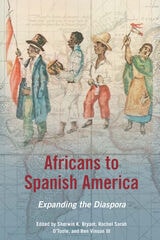
cover of Africans to Spanish America: Expanding the Diaspora

Africans to Spanish America

Expanding the Diaspora

Edited by Sherwin K. Bryant, Rachel Sarah O’Toole, & Ben Vinson III

University of Illinois Press, 2014

Africans to Spanish America expands the Diaspora framework that has shaped much of the recent scholarship on Africans in the Americas to include Mexico, Peru, Ecuador, and Cuba, exploring the connections and disjunctures between colonial Latin America and the African Diaspora in the Spanish empires. While a majority of the research on the colonial Diaspora focuses on the Caribbean and Brazil, analysis of the regions of Mexico and the Andes opens up new questions of community formation that incorporated Spanish legal strategies in secular and ecclesiastical institutions as well as articulations of multiple African identities. Editors Sherwin K. Bryant, Rachel Sarah O'Toole, and Ben Vinson III arrange the volume around three themes: identity construction in the Americas; the struggle by enslaved and free people to present themselves as civilized, Christian, and resistant to slavery; and issues of cultural exclusion and inclusion. Across these broad themes, contributors offer probing and detailed studies of the place and roles of people of African descent in the complex realities of colonial Spanish America.

Contributors are Joan C. Bristol, Nancy E. van Deusen, Leo J. Garofalo, Herbert S. Klein, Charles Beatty-Medina, Karen Y. Morrison, Rachel Sarah O'Toole, Frank "Trey" Proctor III, and Michele Reid-Vazquez.
[more]
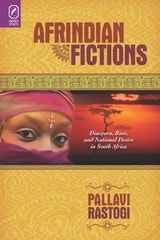
cover of Afrindian Fictions: Diaspora, Race, and National Desire in South Africa

Afrindian Fictions

Diaspora, Race, and National Desire in South Africa

Pallavi Rastogi

The Ohio State University Press, 2008
In the first published book-length study of Indian fiction in South Africa, Pallavi Rastogi demonstrates that Indians desire South African citizenship in the fullest sense of the word, a longing for inclusion that is asserted through an “Afrindian” identity. Afrindian Fictions: Diaspora, Race, and National Desire in South Africa examines Afrindian identity and blurs the racial binary of black and white interaction in South African studies as well as unsettles the East-West paradigm of migration dominant in South Asian diaspora studies.
 
While offering incisive analyses of the work of the most important South African Indian writers today—Ahmed Essop, Farida Karodia, Achmat Dangor, Imraan Coovadia, and Praba Moodley among others—the author also places South African Indian fiction within broader literary traditions. Rastogi’s project of recovery shines a light on the rich but neglected literature by South African Indians. The book closes with interviews conducted with six key South African Indian writers. Here the authors not only reflect on their own writing but also comment on many of the issues raised in the book itself, particularly the role of Indians in South Africa today, and the status of South African Indian writing.
 
Afrindian Fictions is a valuable introduction to South African Indian literature as well as a major interrogation of some of the foundational notions of post-colonial literary studies.
 
[more]
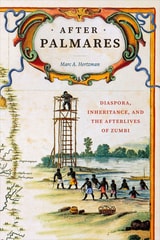
cover of After Palmares: Diaspora, Inheritance, and the Afterlives of Zumbi

After Palmares

Diaspora, Inheritance, and the Afterlives of Zumbi

Marc A. Hertzman

Duke University Press, 2024

In After Palmares, Marc A. Hertzman tells the rise, fall, and afterlives of Palmares, one of history’s largest and longest-lasting maroon societies. Forged during the seventeenth century by formerly enslaved Africans in what would become northeast Brazil, Palmares stood for a century, withstanding sustained attacks from two European powers. In 1695, colonial forces assassinated its most famous leader, Zumbi. Hertzman examines the remarkable ways that Palmares and its inhabitants lived on after Zumbi’s death, creating vivid portraits of those whose lives and voices scholars have often assumed are inaccessible. With an innovative approach to African languages, and paying close attention to place as well as African and diasporic spiritual beliefs, Hertzman reshapes our understanding of Palmares and Zumbi and advances a new framework for studying fugitive slave communities and marronage in the African diaspora.
[more]
cover of Archiving Mexican Masculinities in Diaspora

Archiving Mexican Masculinities in Diaspora

Nicole M. Guidotti-Hernández

Duke University Press, 2021
In Archiving Mexican Masculinities in Diaspora, Nicole M. Guidotti-Hernández challenges machismo—a shorthand for racialized and heteronormative Latinx men's misogyny—with nuanced portraits of Mexican men and masculinities along and across the US-Mexico border. Guidotti-Hernández foregrounds Mexican men's emotional vulnerabilities and intimacies in their diasporic communities. Highlighting how Enrique Flores Magón, an anarchist political leader and journalist, upended gender norms through sentimentality and emotional vulnerability that he performed publicly and expressed privately, Guidotti-Hernández documents compelling continuities between his expressions and those of men enrolled in the Bracero program. Braceros—more than 4.5 million Mexican men who traveled to the United States to work in temporary agricultural jobs from 1942 to 1964—forged domesticity and intimacy, sharing affection but also physical violence. Through these case studies that reexamine the diasporic male private sphere, Guidotti-Hernández formulates a theory of transnational Mexican masculinities rooted in emotional and physical intimacy that emerged from the experiences of being racial, political, and social outsiders in the United States.
[more]
cover of At Home in Diaspora: Black International Writing

At Home in Diaspora

Black International Writing

Wendy Walters

University of Minnesota Press, 2005

Although he never lived in Harlem, Chester Himes commented that he experienced “a sort of pure homesickness” while creating the Harlem-set detective novels from his self-imposed exile in Paris. Through writing, Himes constructed an imaginary home informed both by nostalgia for a community he never knew and a critique of the racism he left behind in the United States. Half a century later, Michelle Cliff wrote about her native Jamaica from the United States, articulating a positive Caribbean feminism that at the same time acknowledged Jamaica’s homophobia and color prejudice. 

In At Home in Diaspora, Wendy Walters investigates the work of Himes, Cliff, and three other twentieth-century black international writers—Caryl Phillips, Simon Njami, and Richard Wright—who have lived in and written from countries they do not call home. Unlike other authors in exile, those of the African diaspora are doubly displaced, first by the discrimination they faced at home and again by their life abroad. Throughout, Walters suggests that in the absence of a recoverable land of origin, the idea of diaspora comes to represent a home that is not singular or exclusionary. In this way, writing in exile is much more than a literary performance; it is a profound political act. 

Wendy W. Walters is assistant professor of literature at Emerson College.
[more]