Results by title
3 books match the query 'Dick, Philip K.'

I Think I Am
Philip K. DickLaurence A. Rickels
University of Minnesota Press, 2010

Retrofitting Blade Runner
Issues in Ridley Scott's Blade Runner and Phillip K. Dick's Do Androids Dream of Electric Sheep?Judith B. Kerman
University of Wisconsin Press, 1997
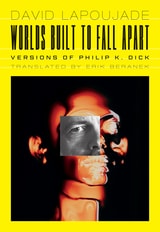
Worlds Built to Fall Apart
Versions of Philip K. DickDavid Lapoujade
University of Minnesota Press, 2024
Philosophically analyzing the work of one of the twentieth century’s most popular, and peculiar, science fiction authors
Despite his enduring popularity, Philip K. Dick (1928–1982)—whose short stories and novels were adapted into or influenced many major films and television shows, including Blade Runner, Total Recall, The Truman Show, and The Man in the High Castle—has long been a marginal figure in American literature, even in the science fiction genre he helped revolutionize. Here, an influential French philosopher offers a major new perspective on an author who was known as much for his eccentricities and excesses as for his writing. For David Lapoujade, it is precisely the many ways in which Dick’s works seem to hover on the brink of losing all touch with reality that make him such a singular figure, both as a sci-fi author and as a thinker of contemporary life.
In Worlds Built to Fall Apart, Lapoujade defines sci-fi as a way of thinking through the creation of worlds and argues that Dick does so by creating worlds that fall rapidly to pieces. Whatever his mechanism to bring this about (drugs or madness, alien satellite transmissions or encroaching parallel universes), the effect is always to reveal reality to be a construction, in which certain people determine what appears as real to the rest of us. Orienting Dick within philosophy and drawing connections to a wide variety of other thinkers and artists, this remarkable reading shows how he proposes unstable, fluctuating futures in which tinkering with reality has become the best means of resisting total control.
Engaging with most of Philip K. Dick’s published works, as well as with several of his essays and his notorious psychic autobiography The Exegesis, Lapoujade hones in on the “war of the psyches” that underlies Dick’s critique of reality. He puts Dick’s work in conversation with a vast array of subjects—from cybernetics to schizoanalysis, and from Pop art to David Lynch, J. G. Ballard, and William S. Burroughs—revealing Dick’s oeuvre to comprise a profound reality defined by artifice, precarity, and control.
Retail e-book files for this title are screen-reader friendly.