Results by title
24 books match the query 'Dictionary'
A Dictionary of Ch'orti' Mayan-Spanish-English
Kerry Hull
University of Utah Press, 2016
Each entry contains examples of Ch’orti’ sentences along with their translations. Each term is defined grammatically and linked to a grammatical index. Variations due to age and region are noted. Additionally, extensive cultural and linguistic annotations accompany many entries, providing detailed looks into Ch’orti’ daily life, mythology, flora and fauna, healing, ritual, and food. Hull worked closely with native speakers, including traditional ritual specialists, and presents that work here in a way that is easily accessible to scholars and laypersons alike.
A Dictionary of Iowa Place-Names
Tom Savage
University of Iowa Press, 2007
Savage includes information on the place-names of all 1,188 incorporated and unincorporated communities in Iowa that meet at least two of the following qualifications: twenty-five or more residents; a retail business; an annual celebration or festival; a school; church, or cemetery; a building on the National Register of Historic Places; a zip-coded post office; or an association with a public recreation site. If a town’s name has changed over the years, he provides information about each name; if a name’s provenance is unclear, he provides possible explanations. He also includes information about the state’s name and about each of its ninety-nine counties as well as a list of ghost towns. The entries range from the counties of Adair to Wright and from the towns of Abingdon to Zwingle; from Iowa’s oldest town, Dubuque, starting as a mining camp in the 1780s and incorporated in 1841, to its newest, Maharishi Vedic City, incorporated in 2001.
The imaginations and experiences of its citizens played a role in the naming of Iowa’s communities, as did the hopes of the huge influx of immigrants who settled the state in the 1800s. Tom Savage’s dictionary of place-names provides an appealing genealogical and historical background to today’s map of Iowa.
“It is one of the beauties of Iowa that travel across the state brings a person into contact with so many wonderful names, some of which a traveler may understand immediately, but others may require a bit of investigation. Like the poet Stephen Vincent Benét, we have fallen in love with American names. They are part of our soul, be they family names, town names, or artifact names. We identify with them and are identified with them, and we cannot live without them. This book will help us learn more about them and integrate them into our beings.”—from the foreword by Loren N. Horton
“Primghar, O’Brien County. Primghar was established by W. C. Green and James Roberts on November 8, 1872. The name of the town comes from the initials of the eight men who were instrumental in developing it. A short poem memorializes the men and their names:
Pumphrey, the treasurer, drives the first nail;
Roberts, the donor, is quick on his trail;
Inman dips slyly his first letter in;
McCormack adds M, which makes the full Prim;
Green, thinking of groceries, gives them the G;
Hayes drops them an H, without asking a fee;
Albright, the joker, with his jokes all at par;
Rerick brings up the rear and crowns all ‘Primghar.’
Primghar was incorporated on February 15, 1888.”
A Dictionary of Language
David Crystal
University of Chicago Press, 2001
A Dictionary of New Mexico and Southern Colorado Spanish
Revised and Expanded EditionRubén Cobos
Museum of New Mexico Press, 2011
Ruben Cobos spent a decade working on the revised and expanded edition of the dictionary, published in 2003. The Dictionary of New Mexico and Southern Colorado Spanish has assumed its place as the most authoritative reference on the archaic dialect of Spanish spoken in this region.
A Dictionary of Selected Synonyms in the Principal Indo-European Languages
Carl Darling Buck
University of Chicago Press, 1988
A Grammar and Dictionary of the Timucua Language
Julian Granberry
University of Alabama Press, 1993
Preserving the voice of a vanished people through language, history, and scholarship.
Taken from the surviving contemporary documentary sources, Julian Granberry's volume describes the grammar and lexicon for the extinct 17th-century Timucua language of Central and North Florida and traces the origins of the 17th-century Timucua speakers and their language. Originally privately published in 1987, with limited circulation, this is the only available publication on the Timucuan language. It provides full grammatical analysis and complete lexical data, and it synthesizes both linguistic and archaeological data in order to provide a coherent picture of the Timucua peoples. Granberry traces the probable historical origins of Timucua speakers to a central Amazonian homeland at approximately 2,500 B.C. and proposes that Timucua speakers were responsible for introducing ceramic wares into North America.

An Index by Region to the Dictionary of American Regional English, Volume III, Volume 73
Luanne von Schneidemesser
Duke University Press, 0
Basque-English, English-Basque Dictionary
Gorka Aulestia
University of Nevada Press, 1992
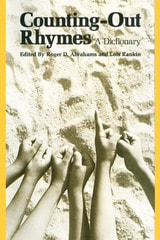
Counting-Out Rhymes
A DictionaryEdited by Roger D. Abrahams and Lois Rankin
University of Texas Press, 1980
Eeny, meeny, figgledy, fig.
Delia, dolia, dominig,
Ozy, pozy doma-nozy,
Tee, tau, tut,
Uggeldy, buggedy, boo!
Out goes you. (no. 129)
You can stand,
And you can sit,
But, if you play,
You must be it. (no. 577)
Counting-out rhymes are used by children between the ages of six and eleven as a special way of choosing it and beginning play. They may be short and simple ("O-U-T spells out/And out goes you") or relatively long and complicated; they may be composed of ordinary words, arrant nonsense, or a mixture of the two.
Roger D. Abrahams and Lois Rankin have gathered together a definitive compendium of counting-out rhymes in English reported to 1980. These they discovered in over two hundred sources from the nineteenth and twentieth centuries, including rhymes from England, Scotland, Ireland, Australia, New Zealand, and the United States. Representative texts are given for 582 separate rhymes, with a comprehensive listing of sources and variants for each one, as well as information on each rhyme's provenience, date, and use. Cross-references are provided for variants whose first lines differ from those of the representative texts. Abrahams's introduction discusses the significance of counting-out rhymes in children's play.
Children's folklore and speech play have attracted increasing attention in recent years. Counting-Out Rhymes will be a valuable resource for researchers in this field.
Dictionary Of The Maya Language
As Spoken in Hocaba YucatanVictoria Bricker
University of Utah Press, 1998
The Maya language of Yucatan is known as Yucate by linguists, but its speakers refer to it as May. Dialiectical differences are minimal across the peninsula, and the more than 750,000 speakers of Maya can be understood wherever they go. Moreover, it is not only a living language but is of great use to epigraphers working on ancient Maya glyphs.
This dictionary is the culmination of fourteen years’ labor centering on the town and dialect of Hocaba. Whereas other dictionaries of may use Latin paradigms, this is the first to provide a comprehensive, systematic listing of the stems that can be derived from each root and that give Maya its distinctive character. The entries cover the full range of Maya speech, from simple expressions and idioms to compound stems. Maya sample sentences provide a window into the richness of everyday communication, with its mixture of wit, epithets, insults, riddles, aphorisms, and exchanges of information, including a wonderful assortment of metaphorical expressions like "peccary’s eyelashes" for a type of bean, "the end of the road" for marriage, and a verb meaning "to draw breath with puckered mouth after eating chili." Among the cultural domains encompassed by the dictionary are agriculture, architecture, astronomy, culinary practices and recipes, education, folklore, games, humor, medical prescriptions, ritual, toys, and weaving, many of which have roots in the Precolumbian past. In addition to the dictionary entries, this work also contains a short grammar, a botanical index, and bibliography.
Dictionary of Indo-European Concepts and Society
Émile Benveniste
HAU, 2016
This book has famously inspired a wealth of thinkers, including Roland Barthes, Claude Lévi-Strauss, Pierre Bourdieu, Jacques Derrida, Umberto Eco, Giorgio Agamben, François Jullien, and many others. In this new volume, Benveniste’s masterpiece on the study of language and society finds new life for a new generation of scholars. As political fictions continue to separate and reify differences between European, Middle Eastern, and South Asian societies, Benveniste reminds us just how historically deep their interconnections are and that understanding the way our institutions are evoked through the words that describe them is more necessary than ever.

Dictionary of Indonesian Islam
Mis Sea#94Howard M. Federspiel
Ohio University Press, 1994
This dictionary will be indispensable to English–speaking students and researchers working in Indonesian or Southeast Asian studies. It will also be useful for scholars working in Bahasa Indonesian, reading texts written about Islam by Indonesian Muslims, as well as for Southeast Asia area scholars generally who are using sources in Western languages.
Dictionary of Manitoba Biography
J.M. Bumsted
University of Manitoba Press, 1999
Dictionary of Missouri Biography
Edited by Lawrence O. Christensen, William E. Foley, Gary R. Kremer & Kenneth H.Winn
University of Missouri Press, 1999
In the making for almost a decade, the Dictionary of Missouri Biography is the most important reference work on Missouri biography to be published in the last half century. Written by nearly three hundred talented authors from around the country and edited by four of the leading authorities on Missouri history, this monumental work contains biographies of more than seven hundred individuals who have in some way made a contribution to the course of state and national history.
Covering all periods as well as all regions of the state, this remarkable volume illustrates the state's cultural, racial, and ethnic diversity. Although the men and women chosen for inclusion in this book came from many walks of life, all of them were either born in Missouri or through their lives touched the state in a significant way. Many of the people will be instantly recognizable, but others will be less well known. Each of them, however, achieved notoriety in some area of activity—politics, business, agriculture, the arts, entertainment, sports, education, military service, diplomacy, social reform, civic improvements, science, or religion.
Providing information on and insight into the lives, careers, personalities, and eras of all of the subjects, the book clearly presents the achievements of the featured individuals, as well as the richness of the state's heritage. Brief bibliographies after each entry direct the reader toward further research on a given subject.
Written in an easy-to-read and accessible style, the Dictionary of Missouri Biography will be an indispensable reference. Scholars, researchers, and the general reader will turn to this guide repeatedly to discover useful and reliable information about noteworthy Missourians. Every library, every school, every historian, and every Missouri family will want this important new work.
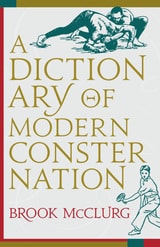
Dictionary of Modern Consternation
Brook McClurg
University of Alaska Press, 2024
A Dictionary of Modern Consternation is a genre-bending nonfiction lyric following one family through the years from the financial crisis to the COVID-19 pandemic. In this cheeky dictionary-shaped exploration of how language can often alienate and dehumanize, weakening feelings of community with societal trends that subsume individual lives, Brook McClurg offers a footnote narrative of an international life pursuing the business of words.
What starts as a lighthearted academic exploration becomes real when the pandemic hits—at the letter P—and the ability to treat each other humanely suddenly has grave consequences. Questioning the ways specialized jargon in language—often corporate, legal, and militaristic in nature—encroaches on our feelings of community and responsibility to one another, McClurg employs an abecedarian format, concealing his meaningful and sensitive explorations of personal strife inside a more formal facade. A Dictionary of Modern Consternation reveals its subjective viewpoint and ironic tone over the course of the text, confronting themes of loneliness and isolation, global strife and endless war, and intimacy, love, and family.
With approximately 500 satirical dictionary entries and 143 flash essays as footnotes, this experimental memoir is filled with satirical definitions, pseudo-aphorisms, and inquisitions into words or phrases. A Dictionary of Modern Consternation is for general readers, collectors, book-as-art lovers, and anyone interested in the political economy of language, as well as graduate classes exploring experimental forms.
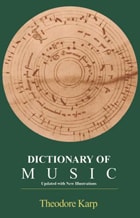
Dictionary of Music
Theodore Karp
Northwestern University Press, 1983
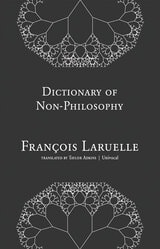
Dictionary of Non-Philosophy
François Laruelle
University of Minnesota Press, 2013
In The Dictionary of Non-Philosophy, the French thinker François Laruelle does something unprecedented for philosophers: he provides an enormous dictionary with a theoretical introduction, carefully crafting his thoughts to explain the numerous terms and neologisms that he deems necessary for the project of non-philosophy. With a collective of thinkers also interested in the project, Laruelle has taken up the difficult task of creating an essential guide for entering into his non-standard, non-philosophical terrain. And for Laruelle, even the idea of a dictionary and what a dictionary is become material for his non-philosophical inquiries. As his opening note begins, “Thus on the surface and within the philosophical folds of the dictionary, identity and its effect upon meaning are what is at stake.”
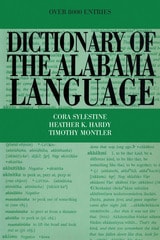
Dictionary of the Alabama Language
By Cora Sylestine, Heather K. Hardy and Timothy Montler
University of Texas Press, 1993
The Alabama language, a member of the Muskogean language family, is spoken today by the several hundred inhabitants of the Alabama-Coushatta Indian Reservation in Polk County, Texas. This dictionary of Alabama was begun over fifty years ago by tribe member Cora Sylestine. She was aided after 1980 by linguists Heather K. Hardy and Timothy Montler, who completed work on the dictionary after her death.
This state-of-the-art analytical dictionary contains over 8,000 entries of roots, stems, and compounds in the Alabama-English section. Each entry contains precise definitions, full grammatical analyses, agreement and other part-of-speech classifications, variant pronunciations, example sentences, and extensive cross-references to stem entries. The Alabama-English section is followed by a thorough English-Alabama finder list that functions as a full index to the definitions in the Alabama-English section.
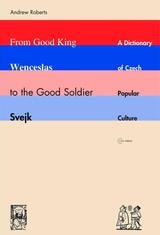
From Good King Wenceslas to the Good Soldier Švejk
A Dictionary of Czech Popular CultureAndrew Roberts
Central European University Press, 2005
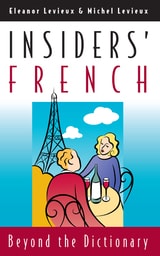
Insiders' French
Beyond the DictionaryEleanor Levieux and Michel Levieux
University of Chicago Press, 1999
This "new France" is a country poised to experience the European single currency but uncertain about being part of Europe. It is hooked on fast food but ambivalent about the country where it originated. France today has record unemployment and an increasingly controversial immigrant population. Clearly, given the rapidly changing conditions and lifestyles, conventional French dictionaries alone cannot completely inform readers and visitors. Insiders' French offers a solution to the incomprehension, a unique handbook in which you'll find the language of European union, the space program, abortion and women's rights, high-tech industries, and health care, among other topics. Entries proceed by association of ideas and related terms, with extensive cross-referencing, while still being alphabetized for easy reference like a standard dictionary. Cartoons from major French journals add to your understanding and enjoyment.
Insiders' French opens up the secret territory of French politics and culture that is often not understood by visitors or students, and it does so with wit and verve—qualities that remain in the French language despite its recent changes.
Jump-rope Rhymes
A DictionaryEdited by Roger D. Abrahams
University of Texas Press, 1969
I had a little brother.
His name was Tiny Tim.
I put him in the bathtub
To teach him how to swim.
He drank all the water.
He ate all the soap.
He died last night
With a bubble in his throat.
Jump-rope rhymes, chanted to maintain the rhythm of the game, have other, equally entertaining uses:
- You can dispatch bothersome younger siblings instantly—and temporarily.
- You can learn the name of your boyfriend through the magic words "Ice cream soda, Delaware Punch, Tell me the initials of my honey-bunch."
- You can perform the series of tasks set forth in "Teddy Bear, Teddy Bear, turn around" and find out who, really, is the most nimble.
- You can even, with impunity, "conk your teacher on the bean with a rotten tangerine. "
This collection of over six hundred jump-rope rhymes, originally published in 1969, is an introduction into the world of children—their attitudes, their concerns, their humor. Like other children's folklore, the rhymes are both richly inventive and innocently derivative, ranging from on-the-spot improvisations to old standards like "Bluebells, cockleshells," with a generous sprinkling of borrowings from other play activities—nursery rhymes, counting-out rhymes, and taunts. Even adult attitudes of the time are appropriated, but expressed with the artless candor of the child:
Eeny, meeny, miny, moe.
Catch Castro by the toe.
If he hollers make him say
"I surrender, U.S.A."
Though aware that children's play serves social and psychological functions, folklorists had long neglected analytical study of children's lore because primary data was not available in organized form. Roger Abraham's Dictionary has provided such a bibliographical tool for one category of children's lore and a model for future compendia in other areas. The alphabetically arranged rhymes are accompanied by notes on sources, provenience, variants, and connection with other play activities.
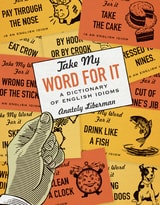
Take My Word for It
A Dictionary of English IdiomsAnatoly Liberman
University of Minnesota Press, 2022
Three centuries of English idioms—their unusual origins and unexpected interpretations
To pay through the nose. Raining cats and dogs. By hook or by crook. Curry favor. Drink like a fish. Eat crow. We hear such phrases every day, but this book is the first truly all-encompassing etymological guide to both their meanings and origins. Spanning more than three centuries, Take My Word for It is a fascinating, one-of-a-kind window into the surprisingly short history of idioms in English. Widely known for his studies of word origins, Anatoly Liberman explains more than one thousand idioms, both popular and obscure, occurring in both American and British standard English and including many regional expressions.
The origins, and even the precise meaning, of most idioms are often obscure and lost in history. Based on a critical analysis of countless conjectures, with exact, in-depth references (rare in the literature on the subject), Take My Word for It provides not only a large corpus of idiomatic phrases but also a vast bibliography. Detailed indexes and a thesaurus make the content accessible at a glance, and Liberman’s introduction and conclusion add historical dimensions. The result of decades of research by a leading authority, this book is both instructive and absorbing for scholars and general readers, who won’t find another resource as comparable in scope or based on data even remotely as exhaustive.

The Dictionary of Nineteenth-Century British Scientists
Edited by Bernard Lightman
University of Chicago Press, 2004
While the Dictionary of Nineteenth-Century British Scientists covers those working in traditional scientific areas such as physics, astronomy, chemistry, mathematics, and biology, it also acknowledges those working in the human sciences such as anthropology, sociology, psychology, and medicine. In addition, areas often overlooked by historians of science—such as phrenology, mesmerism, spiritualism, scientific illustration, scientific journalism and publishing, instrument making, and government policy—are included here, as are the important roles of neglected "amateurs," such as women and members of the working class. By including those who worked in nontraditional areas and by considering the social and cultural context in which they lived, the dictionary reflects a richer picture of nineteenth-century science than has ever been seen before.
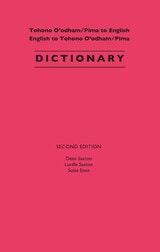
Tohono O'odham/Pima to English, English to Tohono O'odham/Pima Dictionary
Dean Saxton, Lucille Saxton, and Susie Enos
University of Arizona Press, 1983