Results by title
5 books match the query 'Digital Capitalism'
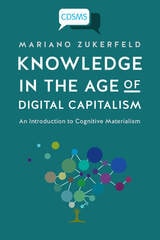
Knowledge in the Age of Digital Capitalism
An Introduction to Cognitive MaterialismMariano Zukerfeld
University of Westminster Press, 2017
Author Mariano Zukerfeld was awarded the best book prize by The Association ESOCITE (Asociación Latinamericana de Estudios Sociales de la Cience y la Tecnología).
“the book is a refreshing, dynamic approach leading back into discussions which have been neglected during the last 20 years.” -https://www.triple-c.at/index.php/tripleC/article/view/971
Knowledge in the Age of Digital Capitalism proposes a new critical theory concerning the functioning of capitalism and how we consider knowledge and information. This ambitious book systematically and lucidly introduces contemporary phenomena into the framework of cognitive materialism to address some of the great themes of the social sciences: knowledge, exploitation and social class in an account of capitalism's totality in the present day. Author Mariano Zukerfeld reinvigorates materialist study of communications, presenting a typology of knowledge to explain the underlying material forms of information, intellectual property and cognitive work in contemporary societies. Using current examples the book also examines concerns such as free labour and the pivotal role of intellectual property. The book offers nothing less than an introduction to the theory of cognitive materialism and an account of the entirety of the digital (or knowledge) capitalism of our time.
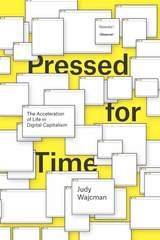
Pressed for Time
The Acceleration of Life in Digital CapitalismJudy Wajcman
University of Chicago Press, 2014
In Pressed for Time, Judy Wajcman explains why we immediately interpret our experiences with digital technology as inexorably accelerating everyday life. She argues that we are not mere hostages to communication devices, and the sense of always being rushed is the result of the priorities and parameters we ourselves set rather than the machines that help us set them. Indeed, being busy and having action-packed lives has become valorized by our productivity driven culture. Wajcman offers a bracing historical perspective, exploring the commodification of clock time, and how the speed of the industrial age became identified with progress. She also delves into the ways time-use differs for diverse groups in modern societies, showing how changes in work patterns, family arrangements, and parenting all affect time stress. Bringing together empirical research on time use and theoretical debates about dramatic digital developments, this accessible and engaging book will leave readers better versed in how to use technology to navigate life's fast lane.
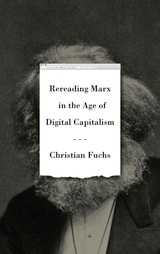
Rereading Marx in the Age of Digital Capitalism
Christian Fuchs
Pluto Press, 2019
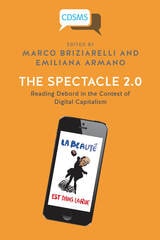
The Spectacle 2.0
Reading Debord in the Context of Digital CapitalismMarco Briziarelli and Emiliana Armano
University of Westminster Press, 2017
“Necessary reading for scholars interested in theorising the spectacle's relation to the labour theory of value, commodity fetishism and subjectivity under post-Fordism.” - https://www.triple-c.at/index.php/tripleC/article/view/1015/1176
Spectacle 2.0 recasts Debord's theory of spectacle within the frame of 21st century digital capitalism. It offers a reassessment of Debord’s original notion of Spectacle from the late 1960s, of its posterior revisitation in the 1990s, and it presents a reinterpretation of the concept within the scenario of contemporary informational capitalism and more specifically of digital and media labour. It is argued that the Spectacle 2.0 form operates as the interactive network that links through one singular (but contradictory) language and various imaginaries, uniting diverse productive contexts such as logistics, finance, new media and urbanism. Spectacle 2.0 thus colonizes most spheres of social life by processes of commodification, exploitation and reification. Diverse contributors consider the topic within the book’s two main sections: Part I conceptualizes and historicizes the Spectacle in the context of informational capitalism; contributions in Part II offer empirical cases that historicise the Spectacle in relation to the present (and recent past) showing how a Spectacle 2.0 approach can illuminate and deconstruct specific aspects of contemporary social reality. All contributions included in this book rework the category of the Spectacle to present a stimulating compendium of theoretical critical literature in the fields of media and labour studies. In the era of the gig-economy, highly mediated content and President Trump, Debord’s concept is arguably more relevant than ever.
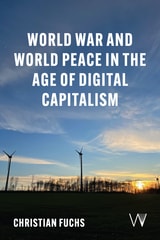
World War and World Peace in the Age of Digital Capitalism
By Christian Fuchs
University of Westminster Press, 2025
In World War and World Peace in the Age of Digital Capitalism, Christian Fuchs asks: how do violence and war manifest themselves in global digital capitalism? How do digital capitalism and digital technologies manifest themselves in violence and warfare? What are the prospects for world peace today?
To prevent world war and advance world peace we need a better understanding of war and violence and their contexts and causes. We need to ask what war is, what violence is, what war and peace look like today and how they have changed in the 21st century. This book addresses these urgent questions and provides possible answers.