Results by title
2 books match the query 'Digital Cultures'
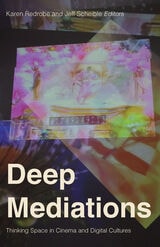
Deep Mediations
Thinking Space in Cinema and Digital CulturesKaren Redrobe
University of Minnesota Press, 2021
The preoccupation with “depth” and its relevance to cinema and media studies
For decades the concept of depth has been central to critical thinking in numerous humanities-based disciplines, legitimizing certain modes of inquiry over others. Deep Mediations examines why and how this is, as scholars today navigate the legacy of depth models of thought and vision, particularly in light of the “surface turn” and as these models impinge on the realms of cinema and media studies.
The collection’s eighteen essays seek to understand the decisive but evolving fixation on depth by considering the term’s use across a range of conversations as well as its status in relation to critical methodologies and the current mediascape. Engaging contemporary debates about new computing technologies, the environment, history, identity, affect, audio/visual culture, and the limits and politics of human perception, Deep Mediations is a timely interrogation of depth’s ongoing importance within the humanities.
Contributors: Laurel Ahnert; Taylor Arnold, U of Richmond; Erika Balsom, King’s College London; Brooke Belisle, Stony Brook University; Jinhee Choi, King’s College London; Jennifer Fay, Vanderbilt U; Lisa Han, UC Santa Barbara; Jean Ma, Stanford U; Shaka McGlotten, Purchase College-SUNY; Susanna Paasonen, U of Turku, Finland; Jussi Parikka, U of Southampton; Alessandra Raengo, Georgia State U; Pooja Rangan, Amherst College; Katherine Rochester, VIA Art Fund in Boston; Karl Schoonover, University of Warwick (UK); Jordan Schonig, Michigan State U; John Paul Stadler, North Carolina State U; Nicole Starosielski, New York U; Lauren Tilton, U of Richmond.
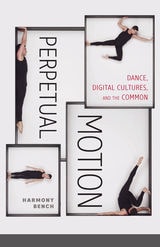
Perpetual Motion
Dance, Digital Cultures, and the CommonHarmony Bench
University of Minnesota Press, 2020
A new exploration of how digital media assert the relevance of dance in a wired world
How has the Internet changed dance? Dance performances can now be seen anywhere, can be looped endlessly at user whim, and can integrate crowds in unprecedented ways. Dance practices are evolving to explore these new possibilities. In Perpetual Motion, Harmony Bench argues that dance is a vital part of civil society and a means for building participation and community. She looks at how, after 9/11, it became a crucial way of recuperating the common character of public spaces. She explores how crowdsourcing dance contributes to the project of performing a common world, as well as the social relationships forged when we look at dance as a gift in the era of globalization. Throughout, she asks how dance brings people together in digital spaces and what dance’s digital travels might mean for how we experience and express community.
From original research on dance today to political economies of digital media to the philosophy of dance, Perpetual Motion provides an ambitious, invigorating look at a commonly shared practice.