Results by title
42 books match the query 'Digital Humanities'
Big Digital Humanities
Imagining a Meeting Place for the Humanities and the DigitalPatrik Svensson
University of Michigan Press, 2016
Svensson’s own unique perspective and special stake in the Digital Humanities conversation comes from his role as director of the HUMlab at Umeå University. HUMlab is a unique collaborative space and Digital Humanities center, which officially opened its doors in 2000. According to its own official description, the HUMlab is an open, creative studio environment where “students, researchers, artists, entrepreneurs and international guests come together to engage in dialogue, experiment with technology, take on challenges and move scholarship forward.” It is this last element “moving scholarship forward” that Svensson argues is the real opportunity in what he terms the “big digital humanities,” or digital humanities as practiced in collaborative spaces like the HUMlab, and he is uniquely positioned to take an account of this evolving dimension of Digital Humanities practice.
Bodies of Information
Intersectional Feminism and the Digital HumanitiesElizabeth Losh
University of Minnesota Press, 2018
A wide-ranging, interconnected anthology presents a diversity of feminist contributions to digital humanities
In recent years, the digital humanities has been shaken by important debates about inclusivity and scope—but what change will these conversations ultimately bring about? Can the digital humanities complicate the basic assumptions of tech culture, or will this body of scholarship and practices simply reinforce preexisting biases? Bodies of Information addresses this crucial question by assembling a varied group of leading voices, showcasing feminist contributions to a panoply of topics, including ubiquitous computing, game studies, new materialisms, and cultural phenomena like hashtag activism, hacktivism, and campaigns against online misogyny.
Taking intersectional feminism as the starting point for doing digital humanities, Bodies of Information is diverse in discipline, identity, location, and method. Helpfully organized around keywords of materiality, values, embodiment, affect, labor, and situatedness, this comprehensive volume is ideal for classrooms. And with its multiplicity of viewpoints and arguments, it’s also an important addition to the evolving conversations around one of the fastest growing fields in the academy.
Contributors: Babalola Titilola Aiyegbusi, U of Lethbridge; Moya Bailey, Northeastern U; Bridget Blodgett, U of Baltimore; Barbara Bordalejo, KU Leuven; Jason Boyd, Ryerson U; Christina Boyles, Trinity College; Susan Brown, U of Guelph; Lisa Brundage, CUNY; micha cárdenas, U of Washington Bothell; Marcia Chatelain, Georgetown U; Danielle Cole; Beth Coleman, U of Waterloo; T. L. Cowan, U of Toronto; Constance Crompton, U of Ottawa; Amy E. Earhart, Texas A&M; Nickoal Eichmann-Kalwara, U of Colorado Boulder; Julia Flanders, Northeastern U Library; Sandra Gabriele, Concordia U; Brian Getnick; Karen Gregory, U of Edinburgh; Alison Hedley, Ryerson U; Kathryn Holland, MacEwan U; James Howe, Rutgers U; Jeana Jorgensen, Indiana U; Alexandra Juhasz, Brooklyn College, CUNY; Dorothy Kim, Vassar College; Kimberly Knight, U of Texas, Dallas; Lorraine Janzen Kooistra, Ryerson U; Sharon M. Leon, Michigan State; Izetta Autumn Mobley, U of Maryland; Padmini Ray Murray, Srishti Institute of Art, Design, and Technology; Veronica Paredes, U of Illinois; Roopika Risam, Salem State; Bonnie Ruberg, U of California, Irvine; Laila Shereen Sakr (VJ Um Amel), U of California, Santa Barbara; Anastasia Salter, U of Central Florida; Michelle Schwartz, Ryerson U; Emily Sherwood, U of Rochester; Deb Verhoeven, U of Technology, Sydney; Scott B. Weingart, Carnegie Mellon U.
Code
From Information Theory to French TheoryBernard Dionysius Geoghegan
Duke University Press, 2022
Computational Humanities
Jessica Marie Johnson
University of Minnesota Press, 2024
The first book to intervene in debates on computation in the digital humanities
Bringing together leading experts from across North America and Europe, Computational Humanities redirects debates around computation and humanities digital scholarship from dualistic arguments to nuanced discourse centered around theories of knowledge and power. This volume is organized around four questions: Why or why not pursue computational humanities? How do we engage in computational humanities? What can we study using these methods? Who are the stakeholders?
Recent advances in technologies for image and sound processing have expanded computational approaches to cultural forms beyond text, and new forms of data, from listservs and code repositories to tweets and other social media content, have enlivened debates about what counts as digital humanities scholarship. Providing case studies of collaborations between humanities-centered and computation-centered researchers, this volume highlights both opportunities and frictions, showing that data and computation are as much about power, prestige, and precarity as they are about p-values.
Contributors: Mark Algee-Hewitt, Stanford U; David Bamman, U of California, Berkeley; Kaspar Beelen, U of London; Peter Bell, Philipps U of Marburg; Tobias Blanke, U of Amsterdam; Julia Damerow, Arizona State U; Quinn Dombrowski, Stanford U; Crystal Nicole Eddins, U of Pittsburgh; Abraham Gibson, U of Texas at San Antonio; Tassie Gniady; Crystal Hall, Bowdoin College; Vanessa M. Holden, U of Kentucky; David Kloster, Indiana U; Manfred D. Laubichler, Arizona State U; Katherine McDonough, Lancaster U; Barbara McGillivray, King’s College London; Megan Meredith-Lobay, Simon Fraser U; Federico Nanni, Alan Turing Institute; Fabian Offert, U of California, Santa Barbara; Hannah Ringler, Illinois Institute of Technology; Roopika Risam, Dartmouth College; Joshua D. Rothman, U of Alabama; Benjamin M. Schmidt; Lisa Tagliaferri, Rutgers U; Jeffrey Tharsen, U of Chicago; Marieke van Erp, Royal Netherlands Academy of Arts and Sciences; Lee Zickel, Case Western Reserve U.
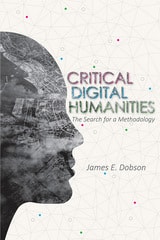
Critical Digital Humanities
The Search for a MethodologyJames E. Dobson
University of Illinois Press, 2019
Critical Infrastructure Studies and Digital Humanities
Alan Liu
University of Minnesota Press, 2026
How digital humanities can shape and be shaped by the infrastructures that sustain our world
Critical Infrastructure Studies and Digital Humanities reimagines the digital humanities (DH) through the expanding field of critical infrastructure studies. Featuring voices from around the globe, this volume explores how DH builds on and extends theories and technologies of infrastructure that affect society, culture, and knowledge in different national and regional contexts. Examining DH’s own infrastructural genealogy, the contributors offer readers critical reflections and bold visions for the future as they address issues of environmentalism, decolonization, Indigenous sovereignty, multilingualism, labor justice, feminism, national development, and beyond from a variety of disciplinary perspectives embedded in concrete digital systems. Including innovative “infrastructure manifests,” the essays in this book illuminate how DH can both study and shape the systems that sustain culture, scholarship, and connection.
Contributors: Anne Beaulieu, U of Groningen; Kyle Booten, U of Connecticut; Ann Borda, U of Melbourne; Susan Brown, U of Guelph; Toby Burrows, U of Western Australia; Ashley Caranto Morford, Weber State U; Javier Cha, U of Hong Kong; Jing Chen, Nanjing U; Arianna Ciula, King’s College London; Maya Dodd, FLAME U, Pune, India; Martin Paul Eve, Birkbeck, U of London; Allan Gomez, Philly Community Wireless; Matthew N. Hannah, Purdue U; Matthew Hockenberry, Fordham U; Arun Jacob, U of Toronto; Mike Jones, U of Tasmania; Lucie Kolb, Basel Academy of Art and Design FHNW; Ian M. Miller, St. John’s U, New York; Sylvia K. Miller, Duke U; Sarah Montoya, Mellon Humanities Postdoctoral Fellow; Saumyaa Naidu, independent researcher; Sharika Parmar, FLAME U, Pune, India; Kush Patel, Srishti Manipal Academy of Higher Education, Bengaluru; Miriam Posner, UCLA; Puthiya Purayil Sneha, International Institute of Information Technology, Hyderabad; Paul Spence, King’s College London; Lik Hang Tsui, City U of Hong Kong; Deb Verhoeven, U of Alberta; Miguel Vieira, King’s College London; Devren Washington, Philly Community Wireless; Alex Wermer-Colan, Temple U and Philly Community Wireless; Darren Wershler, Concordia U; Grant Wythoff, Princeton U and Philly Community Wireless.
Retail e-book files for this title are screen-reader friendly with images accompanied by short alt text and/or extended descriptions.

DIGITAL RESOURCES
FRANCES CONDRON
West Virginia University Press, 2001
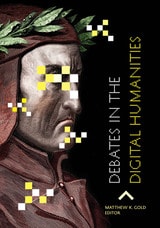
Debates in the Digital Humanities
Matthew K. Gold
University of Minnesota Press, 2012
Encompassing new technologies, research methods, and opportunities for collaborative scholarship and open-source peer review, as well as innovative ways of sharing knowledge and teaching, the digital humanities promises to transform the liberal arts—and perhaps the university itself. Indeed, at a time when many academic institutions are facing austerity budgets, digital humanities programs have been able to hire new faculty, establish new centers and initiatives, and attract multimillion-dollar grants.
Clearly the digital humanities has reached a significant moment in its brief history. But what sort of moment is it? Debates in the Digital Humanities brings together leading figures in the field to explore its theories, methods, and practices and to clarify its multiple possibilities and tensions. From defining what a digital humanist is and determining whether the field has (or needs) theoretical grounding, to discussions of coding as scholarship and trends in data-driven research, this cutting-edge volume delineates the current state of the digital humanities and envisions potential futures and challenges. At the same time, several essays aim pointed critiques at the field for its lack of attention to race, gender, class, and sexuality; the inadequate level of diversity among its practitioners; its absence of political commitment; and its preference for research over teaching.
Together, the essays in Debates in the Digital Humanities—which will be published both as a printed book and later as an ongoing, open-access website—suggest that the digital humanities is uniquely positioned to contribute to the revival of the humanities and academic life.
Contributors: Bryan Alexander, National Institute for Technology in Liberal Education; Rafael Alvarado, U of Virginia; Jamie “Skye” Bianco, U of Pittsburgh; Ian Bogost, Georgia Institute of Technology; Stephen Brier, CUNY Graduate Center; Daniel J. Cohen, George Mason U; Cathy N. Davidson, Duke U; Rebecca Frost Davis, National Institute for Technology in Liberal Education; Johanna Drucker, U of California, Los Angeles; Amy E. Earhart, Texas A&M U; Charlie Edwards; Kathleen Fitzpatrick, Pomona College; Julia Flanders, Brown U; Neil Fraistat, U of Maryland; Paul Fyfe, Florida State U; Michael Gavin, Rice U; David Greetham, CUNY Graduate Center; Jim Groom, U of Mary Washington; Gary Hall, Coventry U, UK; Mills Kelly, George Mason U; Matthew Kirschenbaum, U of Maryland; Alan Liu, U of California, Santa Barbara; Elizabeth Losh, U of California, San Diego; Lev Manovich, U of California, San Diego; Willard McCarty, King’s College London; Tara McPherson, U of Southern California; Bethany Nowviskie, U of Virginia; Trevor Owens, Library of Congress; William Pannapacker, Hope College; Dave Parry, U of Texas at Dallas; Stephen Ramsay, U of Nebraska, Lincoln; Alexander Reid, SUNY at Buffalo; Geoffrey Rockwell, Canadian Institute for Research Computing in the Arts; Mark L. Sample, George Mason U; Tom Scheinfeldt, George Mason U; Kathleen Marie Smith; Lisa Spiro, National Institute for Technology in Liberal Education; Patrik Svensson, Umeå U; Luke Waltzer, Baruch College; Matthew Wilkens, U of Notre Dame; George H. Williams, U of South Carolina Upstate; Michael Witmore, Folger Shakespeare Library.
Digital Critical Editions
Edited by Daniel Apollon, Claire Belisle, and Philippe Regnier
University of Illinois Press, 2014
Provocative yet sober, Digital Critical Editions examines how transitioning from print to a digital milieu deeply affects how scholars deal with the work of editing critical texts. On one hand, forces like changing technology and evolving reader expectations lead to the development of specific editorial products, while on the other hand, they threaten traditional forms of knowledge and methods of textual scholarship.
Using the experiences of philologists, text critics, text encoders, scientific editors, and media analysts, Digital Critical Editions ranges from philology in ancient Alexandria to the vision of user-supported online critical editing, from peer-directed texts distributed to a few to community-edited products shaped by the many. The authors discuss the production and accessibility of documents, the emergence of tools used in scholarly work, new editing regimes, and how the readers' expectations evolve as they navigate digital texts. The goal: exploring questions such as, What kind of text is produced? Why is it produced in this particular way?
Digital Critical Editions provides digital editors, researchers, readers, and technological actors with insights for addressing disruptions that arise from the clash of traditional and digital cultures, while also offering a practical roadmap for processing traditional texts and collections with today's state-of-the-art editing and research techniques thus addressing readers' new emerging reading habits.
Digital Futures of Graduate Study in the Humanities
Gabriel Hankins
University of Minnesota Press, 2024
A resource for planning, reimagining, and participating in the digital transformation of graduate study in the humanities
How are the humanities adapting to the rise of digital technologies, and what are some of the tried and tested ways that postsecondary institutions are proving the importance of humanities training at the graduate level? Bringing together a diverse group of scholars and students, Digital Futures of Graduate Study in the Humanities invites a reimagining of current models of graduate education to address ongoing challenges to the humanities and to create sustainable and humane pedagogies, classes, and institutions.
The essays cover a wide range of topics, including the skills required to learn and practice digital methods, the resources needed to support students and faculty in this enterprise, the lack of meaningful credit for undertaking this time-intensive work, and the diminished employment possibilities within academia for graduate students who emerge with these skills. Mapping the broad terrain through which to address and intervene in these particular issues and beyond, this book offers deep insights into the digital futures of graduate studies in the humanities.
Contributors: Maria José Afanador-Llach, U de los Andes, Bogotá; Maria K. Alberto, U of Utah; Agnieszka Backman; Travis M. Bartley, CUNY Graduate Center; Peggy Bockwinkel, U Stuttgart; Alison Booth, U of Virginia; Donna Alfano Bussell, U of Illinois Springfield; Joshua Casmir Catalano, Clemson U; Laura Crossley, George Mason U; Quinn Dombrowski, Stanford U; Stuart Dunn, King’s College London; Jennifer Edmond, Trinity College Dublin; Natalia Ermolaev, Princeton U; Laura Estill, St. Francis Xavier U; Malte Gäckle-Heckelen; Vicky Garnett, Trinity College Dublin; Daniel Gorman Jr., U of Rochester; Sabrina T. Grimberg, Stanford U; Tena L. Helton, U of Illinois Springfield; Jeanelle Horcasitas; Melissa A. Hosek, Stanford U; Hoyeol Kim; Brady Krien, U of Iowa; Benjamin Charles Germain Lee, U of Washington; Pamela E. Mack, Clemson U; Meredith Martin, Princeton U; Germán Camilo Martínez Peñaloza, U de los Andes, Bogotá; E. L. Meszaros, Brown U; Sara Mohr, Hamilton College; Sethunya Mokoko, U of Virginia; Rebecca Munson; Erin Francisco Opalich; Olivia Quintanilla, MiraCosta College; Cecily Raynor, McGill U; Amanda E. Regan, Clemson U; Heather Richards-Rissetto, U of Nebraska–Lincoln; Jacob D. Richter, George Washington U; Stephen Robertson, George Mason U; Katina L. Rogers; Claus-Michael Schlesinger, Humboldt U Berlin; Douglas Seefeldt, Clemson U; Kayla Shipp, Yale Digital Humanities Lab; Serenity Sutherland, SUNY Oswego; Toma Tasovac, Belgrade Center for Digital Humanities; Hannah Taylor, Duke U; Manfred Thaller, U of Cologne; Madeline Ullrich, U of Rochester; Ted Underwood, U of Illinois Urbana-Champaign; Gabriel Viehhauser, U Stuttgart; Brandon Walsh, U of Virginia Library; Sean Weidman, Lycoming College; Alex Wermer-Colan, Temple U; Adrian S. Wisnicki, U of Nebraska–Lincoln; Alexander J. Zawacki, U Göttingen.
Retail e-book files for this title are screen-reader friendly with images accompanied by short alt text and/or extended descriptions.

Digital Humanities In The Library
Challenges AndAdrianne Hartsell-Gundy
Assoc of College & Research Libraries, 2015
Digital Humanities in the Library, Second Edition
Arianne Hartsell-Gundy
Assoc of College & Research Libraries, 2024
This revised and expanded edition of 2015’s Digital Humanities in the Library includes key reprints from the first edition and new chapters that explore digital humanities and diversity, inclusion, and equity; issues of labor, precarity, and infrastructure; scholarly communication and taxonomies of credit; long-term sustainability; and library digital humanities in the age of institutional austerity.
Divided into sections on theory and practice, chapter authors work in a variety of institution types in many different roles and offer ideas and strategies for cross-institutional collaborations and new approaches to the digital humanities work being done. As Paige Morgan says in the foreword, “Any digital humanist who can enthuse about data can also tell you that computers alone cannot do the work—you need the thoughtfulness of a human expert to find the way forward. This collection can help us do that.”
Digital Humanities in the Library
Challenges and Opportunities for Subject SpecialistsArianne Hartsell-Gundy
Assoc of College & Research Libraries, 2015
Digital Pedagogy in Early Modern Studies
Method and PraxisEdited by Andie Silva and Scott Schofield
Iter Press, 2023
This collection of essays focuses on teaching at the intersection of early modern literature, book history, and digital media. It considers how teaching different fields and methods of study can be enhanced and facilitated by digital technologies. The volume provides a snapshot of current thinking on digital pedagogy as practiced by leading scholars in the field and offers a series of models that may be adapted, personalized, and repurposed by future teachers seeking to bring digital methodologies to their classrooms. Supplementary materials for this title are available on the Iter Press website (iterpress.org): see under Books/Supplementary Materials.
Digital Sound Studies
Mary Caton Lingold, Darren Mueller, and Whitney Trettien, editors
Duke University Press, 2018
Contributors. Myron M. Beasley, Regina N. Bradley, Steph Ceraso, Tanya Clement, Rebecca Dowd Geoffroy-Schwinden, W. F. Umi Hsu, Michael J. Kramer, Mary Caton Lingold, Darren Mueller, Richard Cullen Rath, Liana M. Silva, Jonathan Sterne, Jennifer Stoever, Jonathan W. Stone, Joanna Swafford, Aaron Trammell, Whitney Trettien

Distant Horizons
Digital Evidence and Literary ChangeTed Underwood
University of Chicago Press, 2019

Early Modern Studies after the Digital Turn
Edited by Laura Estill, Diane K. Jakacki, Michael Ullyot
Iter Press, 2016
Enumerations
Data and Literary StudyAndrew Piper
University of Chicago Press, 2018
In Enumerations, Andrew Piper answers that question across a variety of domains fundamental to the study of literature. He focuses on the elementary particles of literature, from the role of punctuation in poetry, the matter of plot in novels, the study of topoi, and the behavior of characters, to the nature of fictional language and the shape of a poet’s career. How does quantity affect our understanding of these categories? What happens when we look at 3,388,230 punctuation marks, 1.4 billion words, or 650,000 fictional characters? Does this change how we think about poetry, the novel, fictionality, character, the commonplace, or the writer’s career? In the course of answering such questions, Piper introduces readers to the analytical building blocks of computational text analysis and brings them to bear on fundamental concerns of literary scholarship. This book will be essential reading for anyone interested in Digital Humanities and the future of literary study.
Feminist Digital Humanities
Intersections in PracticeEdited by Lisa Marie Rhody and Susan Schreibman
University of Illinois Press, 2025
The editors divide the works into three categories. In the first section, contributors offer readings that demonstrate how feminist thought can be put into operation through digital practice or via analytical approaches, methodologies, and interpretations. A second section structured around infrastructure considers how technologies of knowledge creation, publication, access, and sharing can be formed or reformed through feminist values. The final section focuses on pedagogies and proposes feminist strategies for preparing students to become critical and confident readers with and against technologies.
Aimed at readers in and out of the classroom, Feminist Digital Humanities reveals the many ways scholars have pushed beyond critique to practice digital humanities in new ways.
Contributors: Daniela Agostinho, Monika Barget, Jenny Bergenmar, Susan Brown, Tanya E Clement, Katrine Dirckinck-Holmfeld, Jaime Lee Kirtz, Cecilia Lindhé, Laura Mandell, Lisa Marie Rhody, Mark Sample, Susan Schreibman, Andie Silva, Nikki L. Stevens, Ravynn K. Stringfield, Dhanashree Thorat, Nanna Bonde Thylstrup, Kristin Veel, Astrid von Rosen, and Jacqueline Wernimont
Futures of Digital Scholarly Editing
Matt Cohen
University of Minnesota Press, 2025
Exploring technology, ethics, and culture to unlock digital scholarship’s future
Futures of Digital Scholarly Editing navigates the ever-shifting terrain of digital academia, examining practical and ethical considerations as technology continues to evolve. In this indispensable collection, digital humanities practitioners and scholars work with a wide range of archival materials to confront key challenges surrounding the adaptation and sustainability of digital editorial projects as well as their societal impact.
Broaching essential questions at the nexus of technology and culture, Futures of Digital Scholarly Editing is organized around three principal frameworks: access, sustainability, and interoperability; ethics and community involvement; and the evolution of textual scholarship. From addressing outdated technical infrastructures to fostering new collaborations, this volume serves as a beacon guiding scholars and institutions through the complexities of digital editing in an era of profound technological and societal transformation.
Contributors: Stephanie P. Browner, The New School; Julia Flanders, Northeastern U; Ed Folsom, U of Iowa; Nicole Gray, U of Nebraska–Lincoln; Cassidy Holahan, U of Nevada, Las Vegas; Fotis Jannidis, U of Würzburg; Aylin Malcolm, U of Guelph; Sarah Lynn Patterson, U of Massachusetts Amherst; Elena Pierazzo, U of Tours; K.J. Rawson, Northeastern U; Whitney Trettien, U of Pennsylvania; John Unsworth, U of Virginia; Dirk Van Hulle, U of Oxford; Robert Warrior, U of Kansas; Marta L. Werner, Loyola U Chicago.
Retail e-book files for this title are screen-reader friendly with images accompanied by short alt text and/or extended descriptions.
Global Debates in the Digital Humanities
Domenico Fiormonte
University of Minnesota Press, 2022
A necessary volume of essays working to decolonize the digital humanities
Often conceived of as an all-inclusive “big tent,” digital humanities has in fact been troubled by a lack of perspectives beyond Westernized and Anglophone contexts and assumptions. This latest collection in the Debates in the Digital Humanities series seeks to address this deficit in the field. Focused on thought and work that has been underappreciated for linguistic, cultural, or geopolitical reasons, contributors showcase alternative histories and perspectives that detail the rise of the digital humanities in the Global South and other “invisible” contexts and explore the implications of a globally diverse digital humanities.
Advancing a vision of the digital humanities as a space where we can reimagine basic questions about our cultural and historical development, this volume challenges the field to undertake innovation and reform.
Contributors: Maria José Afanador-Llach, U de los Andes, Bogotá; Maira E. Álvarez, U of Houston; Purbasha Auddy, Jadavpur U; Diana Barreto Ávila, U of British Columbia; Deepti Bharthur, IT for Change; Sayan Bhattacharyya, Singapore U of Technology and Design; Anastasia Bonch-Osmolovskaya, National Research U Higher School of Economics; Jing Chen, Nanjing U; Carlton Clark, Kazimieras Simonavičius U, Vilnius; Carolina Dalla Chiesa, Erasmus U, Rotterdam; Gimena del Rio Riande, Institute of Bibliographic Research and Textual Criticism; Leonardo Foletto, U of São Paulo; Rahul K. Gairola, Murdoch U; Sofia Gavrilova, Leibniz Institute for Regional Geography; Andre Goodrich, North-West U; Anita Gurumurthy, IT for Change; Aliz Horvath, Eötvös Loránd U; Igor Kim, Russian Academy of Sciences; Inna Kizhner, Siberian Federal U; Cédric Leterme, Tricontinental Center; Andres Lombana-Bermudez, Pontificia, U Javeriana, Bogotá; Lev Manovich, City U of New York; Itay Marienberg-Milikowsky, Ben-Gurion U of the Negev; Maciej Maryl, Polish Academy of Sciences; Nirmala Menon, Indian Institute of Technology, Indore; Boris Orekhov, National Research U Higher School of Economics; Ernesto Priego, U of London; Sylvia Fernández Quintanilla, U of Kansas; Nuria Rodríguez-Ortega, U of Málaga; Steffen Roth, U of Turku; Dibyadyuti Roy, Indian Institute of Technology, Jodhpur; Maxim Rumyantsev, Siberian Federal U; Puthiya Purayil Sneha, Centre for Internet and Society, Bengaluru; Juan Steyn, South African Centre for Digital Language Resources; Melissa Terras, U of Edinburgh; Ernesto Miranda Trigueros, U of the Cloister of Sor Juana; Lik Hang Tsui, City U of Hong Kong; Tim Unwin, U of London; Lei Zhang, U of Wisconsin–La Crosse.
Guerrilla Theory
Political Concepts, Critical Digital HumanitiesMatthew Applegate
Northwestern University Press, 2019
In this penetrating study, Matthew Applegate uses the guerrilla to connect popular iterations of digital humanities’ practice to its political rhetoric and infrastructure. By doing so, he reorients DH’s conceptual lexicon around practices of collective becoming, mediated by claims to conflict, antagonism, and democratic will.
Applegate traces Michael Hardt and Antonio Negri’s radical democratic ingresses into network theory, the guerrilla’s role in its discourse, and concerns for the digital humanities’ own invocation of the figure. The book also connects post- and decolonial, feminist, and Marxist iterations of DH praxis to the aesthetic histories of movements such as Latin American Third Cinema and the documentary cinema of the Black Panther Party. Concluding with a meditation on contemporary political modalities inherent in DH’s disciplinary expansion, Guerrilla Theory challenges the current political scope of the digital humanities and thus its future institutional impact.
Hacking the Academy
New Approaches to Scholarship and Teaching from Digital HumanitiesDaniel J. Cohen and Tom Scheinfeldt, Editors
University of Michigan Press, 2013
On May 21, 2010, Daniel J. Cohen and Tom Scheinfeldt posted the following provocative questions online:
“Can an algorithm edit a journal? Can a library exist without books? Can students build and manage their own learning management platforms? Can a conference be held without a program? Can Twitter replace a scholarly society?”
As recently as the mid-2000s, questions like these would have been unthinkable. But today serious scholars are asking whether the institutions of the academy as they have existed for decades, even centuries, aren’t becoming obsolete. Every aspect of scholarly infrastructure is being questioned, and even more importantly, being hacked. Sympathetic scholars of traditionally disparate disciplines are canceling their association memberships and building their own networks on Facebook and Twitter. Journals are being compiled automatically from self-published blog posts. Newly minted PhDs are forgoing the tenure track for alternative academic careers that blur the lines between research, teaching, and service. Graduate students are looking beyond the categories of the traditional CV and building expansive professional identities and popular followings through social media. Educational technologists are “punking” established technology vendors by rolling out their own open source infrastructure.
Here, in Hacking the Academy, Daniel J. Cohen and Tom Scheinfeldt have gathered a sampling of the answers to their initial questions from scores of engaged academics who care deeply about higher education. These are the responses from a wide array of scholars, presenting their thoughts and approaches with a vibrant intensity, as they explore and contribute to ongoing efforts to rebuild scholarly infrastructure for a new millennium.
In the Shadows of the Digital Humanities, Volume 25
Elizabeth Weed and Ellen Rooney
Duke University Press, 0
Contributors: Fiona M. Barnett, Wendy Hui Kyong Chun, Michael Dieter, Alexander R. Galloway, David Golumbia, Richard Grusin, Patrick Jagoda, Matthew Kirschenbaum, Adeline Koh, Brian Lennon, Tara McPherson, Rita Raley, Lisa Marie Rhody
Interdisciplining Digital Humanities
Boundary Work in an Emerging FieldJulie Thompson Klein
University of Michigan Press, 2015
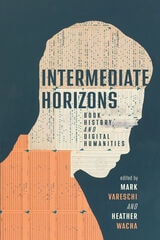
Intermediate Horizons
Book History and Digital HumanitiesEdited by Mark Vareschi and Heather Wacha
University of Wisconsin Press, 2024
Integrating intermedial practices and assessments, the editors and contributors explore issues surrounding the access to and materiality of digitized materials, and the challenge of balancing preservation of traditional archival materials with access. They offer an assessment in our present moment of the early visions of book history and DH projects. In revisiting these projects, they ask us to shift our thinking on the promises and perils of archival and creative work in different media. Taken together, this volume reconsiders the historical intersections of book history and DH and charts a path for future scholarship across disciplinary boundaries.
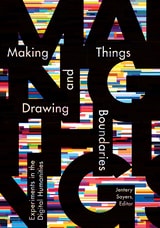
Making Things and Drawing Boundaries
Experiments in the Digital HumanitiesJentery Sayers
University of Minnesota Press, 2017
In Making Things and Drawing Boundaries, critical theory and cultural practice meet creativity, collaboration, and experimentation with physical materials as never before. Foregrounding the interdisciplinary character of experimental methods and hands-on research, this collection asks what it means to “make” things in the humanities. How is humanities research manifested in hand and on screen alongside the essay and monograph? And, importantly, how does experimentation with physical materials correspond with social justice and responsibility? Comprising almost forty chapters from ninety practitioners across twenty disciplines, Making Things and Drawing Boundaries speaks directly and extensively to how humanities research engages a growing interest in “maker” culture, however “making” may be defined.
Contributors: Erin R. Anderson; Joanne Bernardi; Yana Boeva; Jeremy Boggs; Duncan A. Buell; Amy Burek; Trisha N. Campbell; Debbie Chachra; Beth Compton; Heidi Rae Cooley; Nora Dimmock; Devon Elliott; Bill Endres; Katherine Faull; Alexander Flamenco; Emily Alden Foster; Sarah Fox; Chelsea A. M. Gardner; Susan Garfinkel; Lee Hannigan; Sara Hendren; Ryan Hunt; John Hunter; Diane Jakacki; Janelle Jenstad; Edward Jones-Imhotep; Julie Thompson Klein; Aaron D. Knochel; J. K. Purdom Lindblad; Kim Martin; Gwynaeth McIntyre; Aurelio Meza; Shezan Muhammedi; Angel David Nieves; Marcel O’Gorman; Amy Papaelias; Matt Ratto; Isaac Record; Jennifer Reed; Gabby Resch; Jennifer Roberts-Smith; Melissa Rogers; Daniela K. Rosner; Stan Ruecker; Roxanne Shirazi; James Smithies; P. P. Sneha; Lisa M. Snyder; Kaitlyn Solberg; Dan Southwick; David Staley; Elaine Sullivan; Joseph Takeda; Ezra Teboul; William J. Turkel; Lisa Tweten.
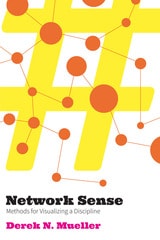
Network Sense
Methods for Visualizing a DisciplineDerek N. Mueller
University Press of Colorado, 2018
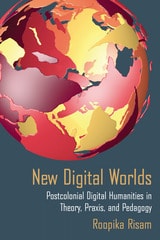
New Digital Worlds
Postcolonial Digital Humanities in Theory, Praxis, and PedagogyRoopika Risam
Northwestern University Press, 2019
New Digital Worlds traces the formation of postcolonial studies and digital humanities as fields, identifying how they can intervene in knowledge production in the digital age. Roopika Risam examines the role of colonial violence in the development of digital archives and the possibilities of postcolonial digital archives for resisting this violence. Offering a reading of the colonialist dimensions of global organizations for digital humanities research, she explores efforts to decenter these institutions by emphasizing the local practices that subtend global formations and pedagogical approaches that support this decentering. Last, Risam attends to human futures in new digital worlds, evaluating both how algorithms and natural language processing software used in digital humanities projects produce universalist notions of the "human" and also how to resist this phenomenon.

New Technologies and Renaissance Studies IV
The Changing Shape of Digital Early Modern StudiesEdited by Randa El Khatib and Caroline Winter
Iter Press, 2025
A collection of essays engaging with digital scholarship and new technologies.
Contributors to this volume engage with digital scholarship in several ways: by creating digital projects, often in multidisciplinary, collaborative environments; by applying digital methodologies and tools to explore research questions; and by speculating about the potential directions that digital scholarship can take to tackle existing research areas that could benefit from new perspectives. Together, the chapters demonstrate how various digital approaches—from network analysis to web mapping, VR and AR technologies, digital editions, databases, and archives—are all contributing in creative and effective ways to expand our knowledge of the past, to help ask and answer questions at a scale that was unimaginable before the digital turn, and to reshape early modern studies in the twenty-first century.
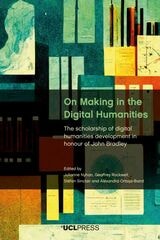
On Making in the Digital Humanities
The Scholarship of Digital Humanities Development in Honour of John BradleyEdited by Julianne Nyhan, Geoffrey Rockwell, Stéfan Sinclair, and Alexandra Ortolja-Baird
University College London, 2023
On Making in the Digital Humanities fills a gap in our understanding of digital humanities projects and craft by exploring the processes of making as much as the products that arise from it. Focusing on the interwoven layers of human and technological textures that constitute digital humanities scholarship, it assembles a group of well-known, experienced, and emerging scholars in the digital humanities to reflect on various forms of making. The chapters gathered here are individually important, but together provide a very human view of what it is to do the digital humanities, in the past, present, and future. This book will accordingly be of interest to researchers, teachers, and students of the digital humanities; creative humanities, including maker spaces and culture; information studies; the history of computing and technology; and the history of science and the humanities.
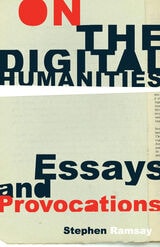
On the Digital Humanities
Essays and ProvocationsStephen Ramsay
University of Minnesota Press, 2023
A witty and incisive exploration of the philosophical conundrums that animate the digital humanities
Since its inception, the digital humanities has been repeatedly attacked as a threat to the humanities: warnings from literary and cultural theorists of technology overtaking English departments and the mechanization of teaching have peppered popular media. Stephen Ramsay’s On the Digital Humanities, a collection of essays spanning the personal to the polemic, is a spirited defense of the field of digital humanities.
A founding figure in what was once known as “humanities computing,” Ramsay has a well-known and contentious relationship with what is now called the digital humanities (DH). Here Ramsay collects and updates his most influential and notorious essays and speeches from the past fifteen years, considering DH from an array of practical and theoretical perspectives. The essays pursue a broad variety of themes, including the nature of data and its place in more conventional notions of text and interpretation, the relationship between the constraints of computation and the more open-ended nature of the humanities, the positioning of practical skills and infrastructures in both research and pedagogical contexts, the status of DH as a program for political and social action, and personal reflections on the author’s journey into the field as both a theorist and a technologist.
These wide-ranging essays all center around one idea: that DH not forsake its connection to the humanities. While “digital humanities” may sound like an entirely new form of engagement with the artifacts of human culture, Ramsay argues that the field well reveals what is most essential to humanistic inquiry.
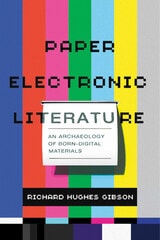
Paper Electronic Literature
An Archaeology of Born-Digital MaterialsRichard Hughes Gibson
University of Massachusetts Press, 2021
Paper Electronic Literature attests that digital literature's old media elements have much to teach us about the cultural and physical conditions in which we compute; the creativity that new media artists have shown in their dealings with old media; and the distinctively electronic issues that confront digital artists. Moving between avant-garde works and popular ones, fiction writing and poetry generation, Richard Hughes Gibson reveals the diverse ways in which paper has served as a component within electronic literature, particularly in facilitating interactive experiences for users. This important study develops a new critical paradigm for appreciating the multifaceted material innovation that has long marked digital literature.
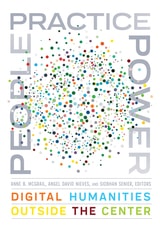
People, Practice, Power
Digital Humanities outside the CenterAnne B. McGrail
University of Minnesota Press, 2021
An illuminating volume of critical essays charting the diverse territory of digital humanities scholarship
The digital humanities have traditionally been considered to be the domain of only a small number of prominent and well-funded institutions. However, through a diverse range of critical essays, this volume serves to challenge and enlarge existing notions of how digital humanities research is being undertaken while also serving as a kind of alternative guide for how it can thrive within a wide variety of institutional spaces.
Focusing on the complex infrastructure that undergirds the field of digital humanities, People, Practice, Power examines the various economic, social, and political factors that shape such academic endeavors. The multitude of perspectives comprising this collection offers both a much-needed critique of the existing structures for digital scholarship and the means to generate broader representation within the field.
This collection provides a vital contribution to the realm of digital scholarly research and pedagogy in acknowledging the role that small liberal arts colleges, community colleges, historically black colleges and universities, and other underresourced institutions play in its advancement. Gathering together a range of voices both established and emergent, People, Practice, Power offers practitioners a self-reflexive examination of the current conditions under which the digital humanities are evolving, while helping to open up new sustainable pathways for its future.
Contributors: Matthew Applegate, Molloy College; Taylor Arnold, U of Richmond; Eduard Arriaga, U of Indianapolis; Lydia Bello, Seattle U; Kathi Inman Berens, Portland State U; Christina Boyles, Michigan State U; Laura R. Braunstein, Dartmouth College; Abby R. Broughton; Maria Sachiko Cecire, Bard College; Brennan Collins, Georgia State U; Kelsey Corlett-Rivera, U of Maryland; Brittany de Gail, U of Maryland; Madelynn Dickerson, UC Irvine Libraries; Nathan H. Dize, Vanderbilt U; Quinn Dombrowski, Stanford U; Ashley Sanders Garcia, UCLA; Laura Gerlitz; Erin Rose Glass; Kaitlyn Grant; Margaret Hogarth, Claremont Colleges; Maryse Ndilu Kiese, U of Alberta; Pamella R. Lach, San Diego State U; James Malazita, Rensselaer Polytechnic Institute; Susan Merriam, Bard College; Chelsea Miya, U of Alberta; Jamila Moore Pewu, California State U, Fullerton; Urszula Pawlicka-Deger, Aalto U, Finland; Jessica Pressman, San Diego State U; Jana Remy, Chapman U; Roopika Risam, Salem State U; Elizabeth Rodrigues, Grinnell College; Dylan Ruediger, American Historical Association; Rachel Schnepper, Wesleyan U; Anelise Hanson Shrout, Bates College; Margaret Simon, North Carolina State U; Mengchi Sun, U of Alberta; Lauren Tilton, U of Richmond; Michelle R. Warren, Dartmouth College.
Rhetoric and the Digital Humanities
Edited by Jim Ridolfo and William Hart-Davidson
University of Chicago Press, 2015
Rhetoric and the Digital Humanities is a timely, multidisciplinary collection that is the first to bridge scholarship in rhetorical studies and the digital humanities. It offers much-needed guidance on how the theories and methodologies of rhetorical studies can enhance all work in digital humanities, and vice versa. Twenty-three essays over three sections delve into connections, research methodology, and future directions in this field. Jim Ridolfo and William Hart-Davidson have assembled a broad group of more than thirty accomplished scholars. Read together, these essays represent the cutting edge of research, offering guidance that will energize and inspire future collaborations.
Seeing the Past with Computers
Experiments with Augmented Reality and Computer Vision for HistoryKevin Kee and Timothy Compeau, Editors
University of Michigan Press, 2019
Seeing the Past with Computers is a collection of twelve thought-pieces on the current and potential uses of augmented reality and computer vision in historical research, teaching, and presentation. The experts gathered here reflect upon their experiences working with new technologies, share their ideas for best practices, and assess the implications of—and imagine future possibilities for—new methods of historical study. Among the experimental topics they explore are the use of augmented reality that empowers students to challenge the presentation of historical material in their textbooks; the application of seeing computers to unlock unusual cultural knowledge, such as the secrets of vaudevillian stage magic; hacking facial recognition technology to reveal victims of racism in a century-old Australian archive; and rebuilding the soundscape of an Iron Age village with aural augmented reality.
This volume is a valuable resource for scholars and students of history and the digital humanities more broadly. It will inspire them to apply innovative methods to open new paths for conducting and sharing their own research.
Teaching with Digital Humanities
Tools and Methods for Nineteenth-Century American LiteratureJennifer Travis, Jessica DeSpain
University of Illinois Press, 2018
Travis and DeSpain curate conversations on the value of project-based, collaborative learning; examples of real-world assignments where students combine close, collaborative, and computational reading; how digital humanities aids in the consideration of marginal texts; the ways in which an ethics of care can help students organize artifacts; and how an activist approach affects debates central to the study of difference in the nineteenth century.
A supplemental companion website with substantial appendixes of syllabi and assignments is now available for readers of Teaching with Digital Humanities.
The Digital Black Atlantic
Roopika Risam
University of Minnesota Press, 2021
Exploring the intersections of digital humanities and African diaspora studies
How can scholars use digital tools to better understand the African diaspora across time, space, and disciplines? And how can African diaspora studies inform the practices of digital humanities? These questions are at the heart of this timely collection of essays about the relationship between digital humanities and Black Atlantic studies, offering critical insights into race, migration, media, and scholarly knowledge production.
The Digital Black Atlantic spans the African diaspora’s range—from Africa to North America, Europe, and the Caribbean—while its essayists span academic fields—from history and literary studies to musicology, game studies, and library and information studies. This transnational and interdisciplinary breadth is complemented by essays that focus on specific sites and digital humanities projects throughout the Black Atlantic. Covering key debates, The Digital Black Atlantic asks theoretical and practical questions about the ways that researchers and teachers of the African diaspora negotiate digital methods to explore a broad range of cultural forms including social media, open access libraries, digital music production, and video games. The volume further highlights contributions of African diaspora studies to digital humanities, such as politics and representation, power and authorship, the ephemerality of memory, and the vestiges of colonialist ideologies.
Grounded in contemporary theory and praxis, The Digital Black Atlantic puts the digital humanities into conversation with African diaspora studies in crucial ways that advance both.
Contributors: Alexandrina Agloro, Arizona State U; Abdul Alkalimat; Suzan Alteri, U of Florida; Paul Barrett, U of Guelph; Sayan Bhattacharyya, Singapore U of Technology and Design; Agata Błoch, Institute of History of Polish Academy of Sciences; Michał Bojanowski, Kozminski U; Sonya Donaldson, New Jersey City U; Anne Donlon; Laurent Dubois, Duke U; Amy E. Earhart, Texas A&M U; Schuyler Esprit, U of the West Indies; Demival Vasques Filho, U of Auckland, New Zealand; David Kirkland Garner; Alex Gil, Columbia U; Kaiama L. Glover, Barnard College, Columbia U; D. Fox Harrell, MIT; Hélène Huet, U of Florida; Mary Caton Lingold, Virginia Commonwealth U; Angel David Nieves, San Diego State U; Danielle Olson, MIT; Tunde Opeibi (Ope-Davies), U of Lagos, Nigeria; Jamila Moore Pewu, California State U, Fullerton; Anne Rice, Lehman College, CUNY; Sercan Şengün, Northeastern U; Janneken Smucker, West Chester U; Laurie N.Taylor, U of Florida; Toniesha L. Taylor, Texas Southern U.
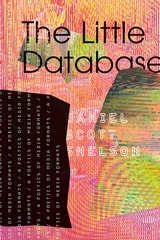
The Little Database
A Poetics of Media FormatsDaniel Scott Snelson
University of Minnesota Press, 2025
A poetics for reading the everyday objects that populate a hard drive
Bespoke online archives like PennSound and Eclipse host an astounding array of “old media” artifacts, posing a handcrafted counterpoint to the immense databases aggregated by digital titans like Google and Facebook. In The Little Database, Daniel Scott Snelson argues for the significance of these comparatively “small” collections, exploring how digital archives dramatically transform the artifacts they host and how they might help us better understand our own private collections in turn.
Examining curated collections such as Textz, UbuWeb, and the Electronic Poetry Center, Snelson explores media-specific works by poets and artists, including William Carlos Williams, Tracie Morris, bill bissett, Nam June Paik, and Vicki Bennett. He develops creative tools and contingent methods for reading cultural data, whether found on the internet or in our own collections of TXT, JPG, MP3, and MOV artifacts, presenting case studies to show how these objects have come to find revised meaning in their digital contexts. Along the way, experimental poetic interludes give readers practical entry points into the creative practice of producing new meanings in any given little database.
Inventive and interdisciplinary, The Little Database grapples with the digitized afterlives of cultural objects, showing how the past is continually reconfigured to shape the present. It invites readers to find playful and personal means for unpacking their own data collections, in the process discovering idiosyncratic ways to explore and connect with digital archives.
Retail e-book files for this title are screen-reader friendly with images accompanied by short alt text and/or extended descriptions.
The Past, Present, and Future of Early Modern Digital Studies
Iter at 25Edited by Laura Estill and Ray Siemens
Iter Press, 2025
Early modern digital studies is a thriving field that draws in strands from publishing, textual studies, digital humanities, and more. Yet it is also rapidly changing. This volume shows that early modern digital studies must be reconsidered from different perspectives as new projects and tools emerge, change, or disappear, and as we make advances into better understanding the past. The chapters in this volume explore how and what we publish (digitally and otherwise), how we value, evaluate, and sustain those publications and digital projects, and how these projects enable us to ask new research questions about early modern literature and culture. This collection does not seek to be a definitive or final state-of-the-field, but rather, a celebration of existing scholarship and an invitation to further scholarship about our ever-evolving practices.

What We Teach When We Teach DH
Digital Humanities in the ClassroomBrian Croxall
University of Minnesota Press, 2023
Exploring how DH shapes and is in turn shaped by the classroom
How has the field of digital humanities (DH) changed as it has moved from the corners of academic research into the classroom? And how has our DH praxis evolved through interactions with our students? This timely volume explores how DH is taught and what that reveals about the field of DH. While institutions are formally integrating DH into the curriculum and granting degrees, many instructors are still almost as new to DH as their students. As colleagues continue to ask what digital humanities is, we have the opportunity to answer them in terms of how we teach DH.
The contributors to What We Teach When We Teach DH represent a wide range of disciplines, including literary and cultural studies, history, art history, philosophy, and library science. Their essays are organized around four critical topics at the heart of DH pedagogy: teachers, students, classrooms, and collaborations. This book highlights how DH can transform learning across a vast array of curricular structures, institutions, and education levels, from high schools and small liberal arts colleges to research-intensive institutions and postgraduate professional development programs.
Contributors: Kathi Inman Berens, Portland State U; Jing Chen, Nanjing U; Lauren Coats, Louisiana State U; Scott Cohen, Stonehill College; Laquana Cooke, West Chester U; Rebecca Frost Davis, St. Edward’s U; Catherine DeRose; Quinn Dombrowski, Stanford U; Andrew Famiglietti, West Chester U; Jonathan D. Fitzgerald, Regis College; Emily Gilliland Grover, Notre Dame de Sion High School; Gabriel Hankins, Clemson U; Katherine D. Harris, San José State U; Jacob Heil, Davidson College; Elizabeth Hopwood, Loyola U Chicago; Hannah L. Jacobs, Duke U; Alix Keener, Stanford U; Alison Langmead, U of Pittsburgh; Sheila Liming, Champlain College; Emily McGinn, Princeton U; Nirmala Menon, Indian Institute of Technology; James O’Sullivan, U College Cork; Harvey Quamen, U of Alberta; Lisa Marie Rhody, CUNY Graduate Center; Kyle Roberts, Congregational Library and Archives; W. Russell Robinson, Alabama State U; Chelcie Juliet Rowell, Tufts U; Dibyadyuti Roy, U of Leeds; Asiel Sepúlveda, Simmons U; Andie Silva, York College, CUNY; Victoria Szabo, Duke U; Lik Hang Tsui, City U of Hong Kong; Annette Vee, U of Pittsburgh; Brandon Walsh, U of Virginia; Kalle Westerling, The British Library; Kathryn Wymer, North Carolina Central U; Claudia E. Zapata, UCLA; Benjun Zhu, Peking U.
Retail e-book files for this title are screen-reader friendly.
Word Toys
Poetry and TechnicsBrian Kim Stefans
University of Alabama Press, 2017
With the ascent of digital culture, new forms of literature and literary production are thriving that include multimedia, networked, conceptual, and other as-yet-unnamed genres while traditional genres and media—the lyric, the novel, the book—have been transformed. Word Toys: Poetry and Technics is an engaging and thought-provoking volume that speculates on a range of poetic, novelistic, and programmed works that lie beyond the language of the literary and which views them instead as technical objects.
Brian Kim Stefans considers the problems that arise when discussing these progressive texts in relation to more traditional print-based poetic texts. He questions the influence of game theory and digital humanities rhetoric on poetic production, and how non-digital works, such as contemporary works of lyric poetry, are influenced by the recent ubiquity of social media, the power of search engines, and the public perceptions of language in a time of nearly universal surveillance.
Word Toys offers new readings of canonical avant-garde writers such as Ezra Pound and Charles Olson, major successors such as Charles Bernstein, Alice Notley, and Wanda Coleman, mixed-genre artists including Caroline Bergvall, Tan Lin, and William Poundstone, and lyric poets such as Harryette Mullen and Ben Lerner. Writers that trouble the poetry/science divide such as Christian Bök, and novelists who have embraced digital technology such as Mark Z. Danielewski and the elusive Toadex Hobogrammathon, anchor reflections on the nature of creativity in a world where authors collaborate, even if unwittingly, with machines and networks. In addition, Stefans names provocative new genres—among them the nearly formless “undigest” and the transpacific “miscegenated script”—arguing by example that interdisciplinary discourse is crucial to the development of scholarship about experimental work.