Results by title
7 books match the query 'Digital divide'
Cyber-Proletariat
Global Labour in the Digital VortexNick Dyer-Witheford
Pluto Press, 2015
Cyber-Proletariat brings Marxist analysis to bear on a range of modern informational technologies. The result is a book indispensable to social theorists and hacktivists alike and essential reading for anyone who wants to understand how Silicon Valley shapes the way we live today.
Data Equals
Democratic Equality and Technological HierarchyColin Koopman
University of Chicago Press, 2025
When we gave algorithms power over our world, we hoped that the apparent neutrality of machine thinking would create a more egalitarian age. Yet we are more divided than ever, staring down threats to democracy itself. In Data Equals, Colin Koopman argues that data technologies fail us so often because we built them around a deficient notion of equality.
It is not enough, Koopman explains, that algorithms engage everyone’s data with the same measuring stick. The data themselves are all too often structured in ways that obscure and exacerbate stratifying distinctions. Koopman contends that we must also work to ensure that those people subject to computational assessment enter data systems on equal terms. Part philosophical argument, part practical guide (replete with case studies from education technology), Data Equals offers novel methods for realizing democratic equality in a digital age.
Digital Divisions
How Schools Create Inequality in the Tech EraMatthew H. Rafalow
University of Chicago Press, 2020
While teachers praise affluent White students for being “innovative” when they bring preexisting and sometimes disruptive tech skills into their classrooms, less affluent students of color do not receive such recognition for the same behavior. Digital skills exhibited by middle class, Asian American students render them “hackers,” while the creative digital skills of working-class, Latinx students are either ignored or earn them labels troublemakers. Rafalow finds in his study of three California middle schools that students of all backgrounds use digital technology with sophistication and creativity, but only the teachers in the school serving predominantly White, affluent students help translate the digital skills students develop through their digital play into educational capital. Digital Divisions provides an in-depth look at how teachers operate as gatekeepers for students’ potential, reacting differently according to the race and class of their student body. As a result, Rafalow shows us that the digital divide is much more than a matter of access: it’s about how schools perceive the value of digital technology and then use them day-to-day.
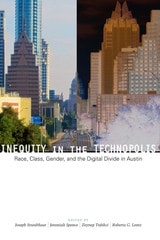
Inequity in the Technopolis
Race, Class, Gender, and the Digital Divide in AustinEdited by Joseph Straubhaar, Jeremiah Spence, Zeynep Tufekci, and Roberta G. Lentz
University of Texas Press, 2012
Over the past few decades, Austin, Texas, has made a concerted effort to develop into a “technopolis,” becoming home to companies such as Dell and numerous start-ups in the 1990s. It has been a model for other cities across the nation that wish to become high-tech centers while still retaining the livability to attract residents. Nevertheless, this expansion and boom left poorer residents behind, many of them African American or Latino, despite local and federal efforts to increase lower-income and minority access to technology.
This book was born of a ten-year longitudinal study of the digital divide in Austin—a study that gradually evolved into a broader inquiry into Austin’s history as a segregated city, its turn toward becoming a technopolis, what the city and various groups did to address the digital divide, and how the most disadvantaged groups and individuals were affected by those programs.
The editors examine the impact of national and statewide digital inclusion programs created in the 1990s, as well as what happened when those programs were gradually cut back by conservative administrations after 2000. They also examine how the city of Austin persisted in its own efforts for digital inclusion by working with its public libraries and a number of local nonprofits, and the positive impact those programs had.
The Digitally Disposed
Racial Capitalism and the Informatics of ValueSeb Franklin
University of Minnesota Press, 2021
Locates the deep history of digitality in the development of racial capitalism
Seb Franklin sets out a media theory of racial capitalism to examine digitality’s racial-capitalist foundations. The Digitally Disposed shows how the promises of boundless connection, flexibility, and prosperity that are often associated with digital technologies are grounded in racialized histories of dispossession and exploitation. Reading archival and published material from the cybernetic sciences alongside nineteenth-century accounts of intellectual labor, twentieth-century sociometric experiments, and a range of literary and visual works, The Digitally Disposed locates the deep history of digitality in the development of racial capitalism.
Franklin makes the groundbreaking argument that capital’s apparently spontaneous synthesis of so-called free individuals into productive circuits represents an “informatics of value.” On the one hand, understanding value as an informatic relation helps to explain why capital was able to graft so seamlessly with digitality at a moment in which it required more granular and distributed control over labor—the moment that is often glossed as the age of logistics. On the other hand, because the informatics of value sort populations into positions of higher and lower capacity, value, and status, understanding their relationship to digitality requires that we see the digital as racialized and gendered in pervasive ways.
Ultimately, The Digitally Disposed questions the universalizing assumptions that are maintained, remade, and intensified by today’s dominant digital technologies. Vital and far-reaching, The Digitally Disposed reshapes such fundamental concepts as cybernetics, informatics, and digitality.
Where the Wires End
Stories from the Digital DivideChristopher Ali
University of Chicago Press, 0
The stories of those without access to broadband services—and an urgent call for their connection.
The average American will spend years of their lives online. For many, the Internet is life, facilitating employment, education, commerce, and connection. But imagine students who only have online access in the early hours of the morning, when the sun is down, and the Internet traffic is low. Imagine living through a pandemic without Internet access because you can’t afford the monthly subscription. Imagine a first responder unable to find a strong enough signal to seek life-saving services. In this eye-opening book, communications scholar Christopher Ali shares such stories—and calls for policymakers, broadband companies, and governments to connect these communities with meaningful, affordable broadband.
It may seem unthinkable that tens of millions of people across the country are unable to access the Internet because of a lack of infrastructure; a computer; affordable broadband subscription options; or training, support, and skills. These people, some who are still using dial-up connections, are part of what is often called “the digital divide.” Where the Wires End brings them into the broadband policy conversation, incorporating interviews, surveys, focus groups, and field visits with individuals, communities, and organizations across the country, from inner-city Pittsburgh to the Hoopa Valley Indian Reservation in California. Ali focuses on the stories of those without access to broadband and those who work to get them attention and connection. He then links these stories to ongoing policy issues, demonstrating how we all benefit from a more empathetic approach to broadband policy that is digitally equitable, inclusive, and ultimately, more successful.
Wired Wisdom
How to Age Better OnlineEszter Hargittai and John Palfrey
University of Chicago Press, 2025
Many popular accounts say the older you are, the greater your tech struggles. And it’s worrying to think of loved ones emailing cringe-worthy misinformation, falling for phishing attacks, or becoming lonelier with increasing time spent online.
But in their eye-opening book on the internet’s fastest-growing demographic, researchers Eszter Hargittai and John Palfrey offer a more nuanced picture—debunking common myths about older adults’ internet use to offer hope and a necessary call to action. Incorporating original interviews and survey results from thousands of people sixty and over, Wired Wisdom shows that many, in fact, use technology in ways that put younger peers to shame. Over-sixties are often nimble online and quicker to abandon social media platforms that don’t meet their needs. Despite being targeted more often, they also may be less likely to fall for scams than younger peers. And fake news actually fools fewer people over sixty, who have far more experience evaluating sources and detecting propaganda. Still, there are unseen risks and missed opportunities for this group. Hargittai and Palfrey offer practical advice and show that our stereotypes can be hurdles that keep us from building intergenerational support communities, helping loved ones adopt new technology that may improve their lives, and thriving together online.