Results by title
117 books match the query 'Digital media' and 5 start with a
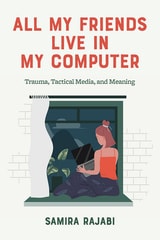
All My Friends Live in My Computer
Trauma, Tactical Media, and MeaningSamira Rajabi
Rutgers University Press, 2021
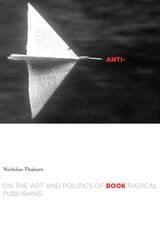
Anti-Book
On the Art and Politics of Radical PublishingNicholas Thoburn
University of Minnesota Press, 2016
No, Anti-Book is not a book about books. Not exactly. And yet it is a must for anyone interested in the future of the book. Presenting what he terms “a communism of textual matter,” Nicholas Thoburn explores the encounter between political thought and experimental writing and publishing, shifting the politics of text from an exclusive concern with content and meaning to the media forms and social relations by which text is produced and consumed. Taking a “post-digital” approach in considering a wide array of textual media forms, Thoburn invites us to challenge the commodity form of books—to stop imagining books as transcendent intellectual, moral, and aesthetic goods unsullied by commerce. His critique is, instead, one immersed in the many materialities of text.
Anti-Book engages with an array of writing and publishing projects, including Antonin Artaud’s paper gris-gris, Valerie Solanas’s SCUM Manifesto, Guy Debord’s sandpaper-bound Mémoires, the collective novelist Wu Ming, and the digital/print hybrid of Mute magazine. Empirically grounded, it is also a major achievement in expressing a political philosophy of writing and publishing, where the materiality of text is interlaced with conceptual production. Each chapter investigates a different form of textual media in concert with a particular concept: the small-press pamphlet as “communist object,” the magazine as “diagrammatic publishing,” political books in the modes of “root” and “rhizome,” the “multiple single” of anonymous authorship, and myth as “unidentified narrative object.”
An absorbingly written contribution to contemporary media theory in all its manifestations, Anti-Book will enrich current debates about radical publishing, artists’ books and other new genre and media forms in alternative media, art publishing, media studies, cultural studies, critical theory, and social and political theory.

Architectures of Illusion
From Motion Picutres to Navigable Interactuve EnvironmentsEdited by François Penz and Maureen Thomas
Intellect Books, 2003
This profile of the work of the Cambridge University Moving Image Studio (CUMIS), presents a strong argument that new developments in digital media are absolutely dependent on an understanding of traditional excellence. The book stands alone in placing equal emphasis on theoretical and practical aspects of its subject matter and avoids jargon so as to be easily understood by the general reader as well as the specialist.
Chapters discuss:
• animation • navigable architectural environments • moving image narrativity
• questions of truth and representation • virtuality/reality • synthetic imaging
• interactivity
This broad analysis of current research, teaching and media production contains essential information for all those working or studying in the areas of multimedia, architecture, film and television.
The book is designed as a core text for the Cambridge University 1 year MPhil Degree in Architecture and the Moving Image.
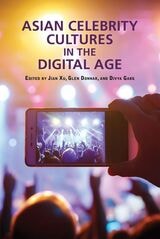
Asian Celebrity Cultures in the Digital Age
Edited by Jian Xu, Glen Donnar, and Divya Garg
Hong Kong University Press, 2025
Asian Celebrity Cultures in the Digital Age represents the first comprehensive study on the transformations of celebrity cultures in increasingly globalized and digitalized Asian societies. It discusses relations between Asian celebrities and digital media across emerging phenomena in celebrity practices, cultures, politics, fandom, and economies. Highlighting original case studies from prominent Asian societies, including India, China, Hong Kong, the Philippines, Singapore, Vietnam, Indonesia, Thailand, South Korea, and Japan, this book sheds much-needed light on the de-Westernization and internationalization of celebrity studies and is essential reading for scholars and students in celebrity, fandom, digital media and communication, and cultural studies.
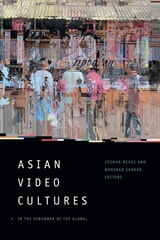
Asian Video Cultures
In the Penumbra of the GlobalJoshua Neves and Bhaskar Sarkar, editors
Duke University Press, 2017
Contributors. Conerly Casey, Jenny Chio, Michelle Cho, Kay Dickinson, Bishnupriya Ghosh, Feng-Mei Heberer, Tzu-hui Celina Hung, Rahul Mukherjee, Joshua Neves, Bhaskar Sarkar, Nishant Shah, Abhigyan Singh, SV Srinivas, Marc Steinberg, Chia-chi Wu, Patricia Zimmerman