Results by title
16 books match the query 'Digital techniques'

Amplifying Soundwriting Pedagogies
Integrating Sound into Rhetoric and WritingMichael J. Faris
University Press of Colorado, 2022

Architectures of Illusion
From Motion Picutres to Navigable Interactuve EnvironmentsEdited by François Penz and Maureen Thomas
Intellect Books, 2003
This profile of the work of the Cambridge University Moving Image Studio (CUMIS), presents a strong argument that new developments in digital media are absolutely dependent on an understanding of traditional excellence. The book stands alone in placing equal emphasis on theoretical and practical aspects of its subject matter and avoids jargon so as to be easily understood by the general reader as well as the specialist.
Chapters discuss:
• animation • navigable architectural environments • moving image narrativity
• questions of truth and representation • virtuality/reality • synthetic imaging
• interactivity
This broad analysis of current research, teaching and media production contains essential information for all those working or studying in the areas of multimedia, architecture, film and television.
The book is designed as a core text for the Cambridge University 1 year MPhil Degree in Architecture and the Moving Image.

Common-Channel Signalling
Richard J. Manterfield
The Institution of Engineering and Technology, 1991

Contemporary Carioca
Technologies of Mixing in a Brazilian Music SceneFrederick Moehn
Duke University Press, 2012
Digital Signal Filtering, Analysis and Restoration
Jiří Jan
The Institution of Engineering and Technology, 2000
Digital Signal Processing
Principles, devices and applicationsN.B. Jones
The Institution of Engineering and Technology, 1990
Digital Sound Studies
Mary Caton Lingold, Darren Mueller, and Whitney Trettien, editors
Duke University Press, 2018
Contributors. Myron M. Beasley, Regina N. Bradley, Steph Ceraso, Tanya Clement, Rebecca Dowd Geoffroy-Schwinden, W. F. Umi Hsu, Michael J. Kramer, Mary Caton Lingold, Darren Mueller, Richard Cullen Rath, Liana M. Silva, Jonathan Sterne, Jennifer Stoever, Jonathan W. Stone, Joanna Swafford, Aaron Trammell, Whitney Trettien
Digital Techniques for Wideband Receivers
James B. Tsui
The Institution of Engineering and Technology, 2004

Food Instagram
Identity, Influence, and NegotiationEdited by Emily J. H. Contois and Zenia Kish
University of Illinois Press, 2022
Image by image and hashtag by hashtag, Instagram has redefined the ways we relate to food. Emily J. H. Contois and Zenia Kish edit contributions that explore the massively popular social media platform as a space for self-identification, influence, transformation, and resistance. Artists and journalists join a wide range of scholars to look at food’s connection to Instagram from vantage points as diverse as Hong Kong’s camera-centric foodie culture, the platform’s long history with feminist eateries, and the photography of Australia’s livestock producers. What emerges is a portrait of an arena where people do more than build identities and influence. Users negotiate cultural, social, and economic practices in a place that, for all its democratic potential, reinforces entrenched dynamics of power.
Interdisciplinary in approach and transnational in scope, Food Instagram offers general readers and experts alike new perspectives on an important social media space and its impact on a fundamental area of our lives.
Contributors: Laurence Allard, Joceline Andersen, Emily Buddle, Robin Caldwell, Emily J. H. Contois, Sarah E. Cramer, Gaby David, Deborah A. Harris, KC Hysmith, Alex Ketchum, Katherine Kirkwood, Zenia Kish, Stinne Gunder Strøm Krogager, Jonathan Leer, Yue-Chiu Bonni Leung, Yi-Chieh Jessica Lin, Michael Z. Newman, Tsugumi Okabe, Rachel Phillips, Sarah Garcia Santamaria, Tara J. Schuwerk, Sarah E. Tracy, Emily Truman, Dawn Woolley, and Zara Worth

Foundations of Digital Signal Processing
Theory, algorithms and hardware designPatrick Gaydecki
The Institution of Engineering and Technology, 2004

Frontiers in Securing IP Cores
Forensic detective control and obfuscation techniquesAnirban Sengupta
The Institution of Engineering and Technology, 2020
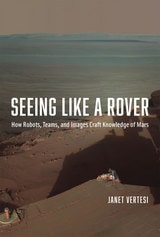
Seeing Like a Rover
How Robots, Teams, and Images Craft Knowledge of MarsJanet Vertesi
University of Chicago Press, 2015
With Seeing Like a Rover, Janet Vertesi takes us behind the scenes to reveal the work that goes into creating our knowledge of Mars. Every photograph that the Rovers take, she shows, must be processed, manipulated, and interpreted—and all that comes after team members negotiate with each other about what they should even be taking photographs of in the first place. Vertesi’s account of the inspiringly successful Rover project reveals science in action, a world where digital processing uncovers scientific truths, where images are used to craft consensus, and where team members develop an uncanny intimacy with the sensory apparatus of a robot that is millions of miles away. Ultimately, Vertesi shows, every image taken by the Mars Rovers is not merely a picture of Mars—it’s a portrait of the whole Rover team, as well.
SpecLab
Digital Aesthetics and Projects in Speculative ComputingJohanna Drucker
University of Chicago Press, 2009
Nearly a decade ago, Johanna Drucker cofounded the University of Virginia’s SpecLab, a digital humanities laboratory dedicated to risky projects with serious aims. In SpecLab she explores the implications of these radical efforts to use critical practices and aesthetic principles against the authority of technology based on analytic models of knowledge.
Inspired by the imaginative frontiers of graphic arts and experimental literature and the technical possibilities of computation and information management, the projects Drucker engages range from Subjective Meteorology to Artists’ Books Online to the as yet unrealized ’Patacritical Demon, an interactive tool for exposing the structures that underlie our interpretations of text. Illuminating the kind of future such experiments could enable, SpecLab functions as more than a set of case studies at the intersection of computers and humanistic inquiry. It also exemplifies Drucker’s contention that humanists must play a role in designing models of knowledge for the digital age—models that will determine how our culture will function in years to come.
Switched Currents
An analogue technique for digital technologyC. Toumazou
The Institution of Engineering and Technology, 1993

The Color of Loss
An Intimate Portrait of New Orleans after KatrinaPhotographs and introduction by Dan Burkholder
University of Texas Press, 2008
The devastation of New Orleans after Hurricane Katrina has been imprinted in our collective visual memory by thousands of images in the media and books of dramatic photographs by Robert Polidori, Larry Towell, Chris Jordan, Debbie Fleming Caffrey, and others. New Orleanians want the world to see and respond to the destruction of their city and the suffering of its people—and yet so many images of so much destruction threaten a visual and emotional overload that would tempt us to avert our eyes and become numb.
In The Color of Loss, Dan Burkholder presents a powerful new way of seeing the ravaged homes, churches, schools, and businesses of New Orleans. Using an innovative digital photographic technology called high dynamic range (HDR) imaging, in which multiple exposures are artistically blended to bring out details in the shadows and highlights that would be hidden in conventional photographs, he creates images that are almost like paintings in their richness of color and profusion of detail. Far more intense and poetic than purely documentary photographs, Burkholder's images lure viewers to linger over the artifacts of people's lives—a child's red wagon abandoned in a mud-caked room, a molding picture of Jesus—to fully understand the havoc thrust upon the people of New Orleans.
In the deserted, sinisterly beautiful rooms of The Color of Loss, we see how much of the splendor and texture of New Orleans washed away in the flood. This is the hidden truth of Katrina that Dan Burkholder has revealed.
Weibull Radar Clutter
Matsuo Sekine
The Institution of Engineering and Technology, 1990