Results by title
6 books match the query 'Digital video'
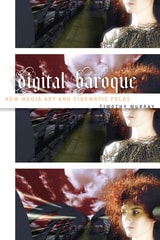
Digital Baroque
New Media Art and Cinematic FoldsTimothy Murray
University of Minnesota Press, 2008
A surprising and original application of theories of new media art
In this intellectually groundbreaking work, Timothy Murray investigates a paradox embodied in the book’s title: What is the relationship between digital, in the form of new media art, and baroque, a highly developed early modern philosophy of art? Making an exquisite and unexpected connection between the old and the new, Digital Baroque analyzes the philosophical paradigms that inform contemporary screen arts.
Examining a wide range of art forms, Murray reflects on the rhetorical, emotive, and social forces inherent in the screen arts’ dialogue with early modern concepts. Among the works discussed are digitally oriented films by Peter Greenaway, Jean-Luc Godard, and Chris Marker; video installations by Thierry Kuntzel, Keith Piper, and Renate Ferro; and interactive media works by Toni Dove, David Rokeby, and Jill Scott. Sophisticated readings reveal the electronic psychosocial webs and digital representations that link text, film, and computer. Murray puts forth an innovative Deleuzian psychophilosophical approach—one that argues that understanding new media art requires a fundamental conceptual shift from linear visual projection to nonlinear temporal folds intrinsic to the digital form.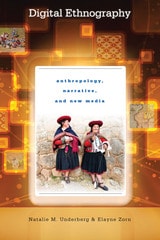
Digital Ethnography
Anthropology, Narrative, and New MediaBy Natalie M. Underberg and Elayne Zorn
University of Texas Press, 2013
Digital ethnography can be understood as a method for representing real-life cultures through storytelling in digital media. Enabling audiences to go beyond absorbing facts, computer-based storytelling allows for immersion in the experience of another culture. A guide for anyone in the social sciences who seeks to enrich ethnographic techniques, Digital Ethnography offers a groundbreaking approach that utilizes interactive components to simulate cultural narratives.
Integrating insights from cultural anthropology, folklore, digital humanities, and digital heritage studies, this work brims with case studies that provide in-depth discussions of applied projects. Web links to multimedia examples are included as well, including projects, design documents, and other relevant materials related to the planning and execution of digital ethnography projects. In addition, new media tools such as database development and XML coding are explored and explained, bridging the literature on cyber-ethnography with inspiring examples such as blending cultural heritage with computer games.
One of the few books in its field to address the digital divide among researchers, Digital Ethnography guides readers through the extraordinary potential for enrichment offered by technological resources, far from restricting research to quantitative methods usually associated with technology. The authors powerfully remind us that the study of culture is as much about affective traits of feeling and sensing as it is about cognition—an approach facilitated (not hindered) by the digital age.
Law and the Visible
Edited by Austin Sarat, Lawrence Douglas, and Martha Merrill Umphrey
University of Massachusetts Press, 2021
Individual essays discuss the culpability of those who record violence, the history of racialized violence as it streams through police bodycams, the idea of digital images as objective or neutral, the logics of surveillance and transparency, and a defense of anonymity in the digital age.
Contributors include Benjamin J. Goold, Torin Monahan, Kelli Moore, Eden Osucha, Jennifer Peterson, and Carrie A. Rentschler.
Standard Codecs
Image compression to advanced video codingMohammed Ghanbari
The Institution of Engineering and Technology, 2003
Standard Codecs
Image compression to advanced video codingMohammed Ghanbari
The Institution of Engineering and Technology, 2011
The Future of Memory
A History of Lossless Format Standards in the Moving Image ArchiveJimi Jones and Marek Jancovic
University of Illinois Press, 2025
Drawing on interviews with archivists and developers, Jones and Jancovic reveal the archive as a dynamic space where deeply entrenched social practices produce disagreements but also resourceful collaborations. They contrast the unprecedented rise of archivist-driven standardization and controversies around non-standard technology with the historical dominance of the film and broadcast industries. Throughout, the authors clarify the role of tech companies, software developers, film pirates, hackers, and other players with poorly understood roles in the process.
A timely look at the state of audiovisual preservation, The Future of Memory provides a history of recent innovations alongside a snapshot of a field in the midst of profound technological change.