Results by title
9 books match the query 'Dinosaurs'
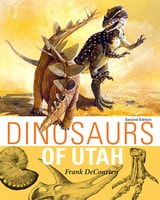
Dinosaurs Of Utah
Second EditionFrank DeCourten
University of Utah Press, 2013
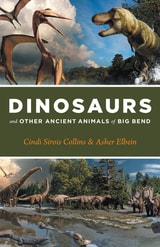
Dinosaurs and Other Ancient Animals of Big Bend
Cindi Sirois Collins and Asher Elbein
University of Texas Press, 2023
A time-traveling field guide to the ancient version of Big Bend National Park.
The sheer beauty of Big Bend National Park, along the shores of the Rio Grande in west Texas, never fails to astonish. Yet what lies beneath this natural treasure may be even more extraordinary than what meets the eye. Hidden in the rocks of Big Bend are the remains of giants: toothy sea lizards, enormous flying reptiles, and dinosaurs.
Dinosaurs and Other Ancient Animals of Big Bend is a field guide to what once was. Inspired by the latest research, Cindi Sirois Collins and Asher Elbein imagine what it was like to walk among the plants and animals whose fossil remains tell the story of evolution and geological transformation in this singular landscape. We glimpse the drama of Big Bend’s rugged landscape in creation—the desert’s emergence from retreating oceans and volcanic eruptions. Immersive vignettes introduce dinosaurs, giant fish, and saber-toothed cats. And the history of discovery in the park proves a gripping tale, as paleontologists sifted major scientific insights from the soils, rocks, and riverbeds. Complete with vivid illustrations, this is a wholly original sensory and narrative experience that will deepen any reader’s knowledge and sense of wonder.
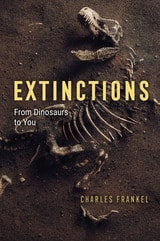
Extinctions
From Dinosaurs to YouCharles Frankel
University of Chicago Press, 2024
On its face, the story of mass extinction on Earth is one of unavoidable disaster. Asteroid smashes into planet; goodbye dinosaurs. Planetwide crises seem to be beyond our ability to affect or evade. Extinctions argues that geological history tells an instructive story, one that offers important signs for us to consider. When the asteroid struck, Charles Frankel explains, it set off a wave of cataclysms that wore away at the global ecosystem until it all fell apart. What if there had been a way to slow or even turn back these tides? Frankel believes that the answer to this question holds the key to human survival.
Human history, from the massacre of Ice Age megafauna to today’s industrial climate change, has brought the planet through another series of cataclysmic events. But the history of mass extinction together with the latest climate research, Frankel maintains, shows us a way out. If we curb our destructive habits, particularly our drive to kill and consume other species, and work instead to conserve what biodiversity remains, the Earth might yet recover. Rather than await decisive disaster, Frankel argues that we must instead take action to reimagine what it means to be human. As he eloquently explains, geological history reminds us that life is not eternal; we can disappear, or we can become something new and continue our evolutionary adventure.
Of Whales and Dinosaurs
The Story of Singapore's Natural History MuseumKevin Y. L. Tan
National University of Singapore Press, 2015

The Last Dinosaur Book
The Life and Times of a Cultural IconW. J. T. Mitchell
University of Chicago Press, 1998
Mitchell aims to trace the cultural family tree of the dinosaur, and what he discovers is a creature of striking flexibility, linked to dragons and mammoths, skyscrapers and steam engines, cowboys and Indians. In the vast territory between the cunning predators of Jurassic Park and the mawkishly sweet Barney, from political leviathans to corporate icons, from paleontology to Barnum and Bailey, Mitchell finds a cultural symbol whose plurality of meaning and often contradictory nature is emblematic of modern society itself. As a scientific entity, the dinosaur endured a near-eclipse for over a century, but as an image it is enjoying its widest circulation. And it endures, according to Mitchell, because it is uniquely malleable, a figure of both innovation and obsolescence, massive power and pathetic failure—the totem animal of modernity.
Drawing unforeseen and unusual connections at every turn between dinosaurs real and imagined, The Last Dinosaur Book is the first to delve so deeply, so insightfully, and so enjoyably into our modern dino-obsession.
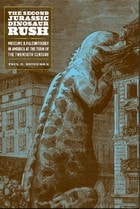
The Second Jurassic Dinosaur Rush
Museums and Paleontology in America at the Turn of the Twentieth CenturyPaul D. Brinkman
University of Chicago Press, 2010
The so-called “Bone Wars” of the 1880s, which pitted Edward Drinker Cope against Othniel Charles Marsh in a frenzy of fossil collection and discovery, may have marked the introduction of dinosaurs to the American public, but the second Jurassic dinosaur rush, which took place around the turn of the twentieth century, brought the prehistoric beasts back to life. These later expeditions—which involved new competitors hailing from leading natural history museums in New York, Chicago, and Pittsburgh—yielded specimens that would be reconstructed into the colossal skeletons that thrill visitors today in museum halls across the country.
Reconsidering the fossil speculation, the museum displays, and the media frenzy that ushered dinosaurs into the American public consciousness, Paul Brinkman takes us back to the birth of dinomania, the modern obsession with all things Jurassic. Featuring engaging and colorful personalities and motivations both altruistic and ignoble, The Second Jurassic Dinosaur Rush shows that these later expeditions were just as foundational—if not more so—to the establishment of paleontology and the budding collections of museums than the more famous Cope and Marsh treks. With adventure, intrigue, and rivalry, this is science at its most swashbuckling.
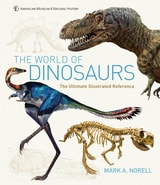
The World of Dinosaurs
An Illustrated TourMark A. Norell
University of Chicago Press, 2019
“Perhaps the easiest way to glimpse . . . all this new knowledge is to leaf through Norell’s The World of Dinosaurs. . . . One of the principal paleontologists of our time."—New York Review of Books
“A delight.”—Open Letters Review
“Possibly the best general audience dinosaur book of 2019.”—Paleoaerie
Dinosaurs have held sway over our imaginations since the discovery of their bones first shocked the world in the nineteenth century. From the monstrous beasts stalking Jurassic Park to the curiosities of the natural history museum, dinosaurs are creatures that unite young and old in awestruck wonder. Digging ever deeper into dinosaurs’ ancient past, science continues to unearth new knowledge about them and the world they inhabited, a fantastic time when the footprints of these behemoths marked the Earth that we humans now walk.
Who better to guide us through this ancient world than paleontologist Mark A. Norell? A world-renowned expert in paleontology, with a knowledge of dinosaurs as deep as the buried fossils they left behind, Norell is in charge of what is perhaps America’s most popular collection of dinosaur bones and fossils, the beloved displays at the American Museum of Natural History in New York. In The World of Dinosaurs, he leads readers through a richly illustrated collection detailing the evolution of these ancient creatures. From the horns of the Protoceratops to the wings of the Archaeopteryx, readers are invited to explore profiles of dinosaurs along with hundreds of color photographs, sketches, maps, and other materials—all rooted in the latest scientific discoveries—sure to both capture the imagination and satisfy a prehistoric curiosity. The World of Dinosaurs presents an astonishing collection of knowledge in an immersive visual journey that will fascinate any fan of Earth’s ancient inhabitants.
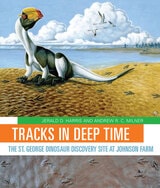
Tracks in Deep Time
The St. George Dinosaur Discovery Site at Johnson FarmJerald D. Harris and Andrew R. Milner
University of Utah Press, 2015
Tracks in Deep Time presents, for the first time, an engaging, thoroughly readable account of the history, geology, and paleontology of this important site. Two hundred million years ago, Lake Dixie covered the site. Within its waters and along its shores, a diverse ecosystem of dinosaurs, early crocodylians, fishes, plants, and other organisms thrived, leaving behind thousands of footprints and other fossils preserved in layers of rock. Unusual fossils found here include the world’s largest collection of tracks left by swimming dinosaurs and one of only six traces known to have been made by a sitting, meat-eating dinosaur. With approachable text and lavish, full-color photographs and illustrations, Jerald Harris and Andrew Milner describe how geologists and paleontologists have painstakingly reconstructed a vivid “snapshot” of life from the Early Jurassic epoch.
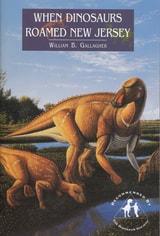
When Dinosaurs Roamed New Jersey
William B. Gallagher
Rutgers University Press, 1997
Did you know that Benjamin Franklin examined the first dinosaur bone in America from Woodbury, Gloucester County, in 1787--decades before the word dinosaur was even coined? Or that when the first reasonably complete dinosaur skeleton in the world was unearthed in Haddonfield, Camden County, in 1858, it was a major scientific breakthrough which forced paleontologists to completely revise their picture of dinosaur anatomy? Few people know that New Jersey is the nursery of American vertebrate paleontology!
When Dinosaurs Roamed New Jersey provides a succinct and readable history of the geology and paleontology of New Jersey from the time the region was covered by Cambrian seas, 543 million years ago, to the Pleistocene Ice Age only 10-15,000 years ago. William Gallagher tells the stories of professional and amateur fossil hunters, their discoveries, and their impact on the history of paleontological thought. He points out places in New Jersey and nearby where specimens characteristic of each era were found. He shows how fossil evidence found in the state is helping paleontologists uncover the ecological interactions and behavior of dinosaurs, and discusses such ongoing scientific controversies as the reason for the extinction of the dinosaurs.
From tracking dinosaur footprints across the Newark basin, to digging for the last dinosaurs in the greensands of South Jersey, to finding a mushroom in ancient amber in East Brunswick, this book is the ideal introduction to the Garden State's fossils and prehistory.