Results by title
3 books match the query 'Diplomatic negotiations in international disputes'
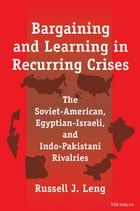
Bargaining and Learning in Recurring Crises
The Soviet-American, Egyptian-Israeli, and Indo-Pakistani RivalriesRussell J. Leng
University of Michigan Press, 2000
The rivalries between the Soviet Union and the United States, Egypt and Israel, and India and Pakistan produced twelve major crises and seven wars during the quarter-century following World War II. A disproportionate share of international crises and wars occur between long-term rivals. Why could not the leaders of these states learn to manage their disputes without severe crises or war? Russell J. Leng finds that the lessons leaders of those states drew from their experiences most often led to bargaining tactics that only increased the level of hostility and the likelihood of war in subsequent disputes.
The author uses theoretical work on learning and the role of belief systems on foreign policy-making as the basis to explore the history of each rivalry. Detailed narrative accounts of each of the crises are augmented by tables and figures describing the escalation of each crisis and the behavior of participant states. The approach allows for comparisons of behavior and learning across the three rivalries, as well as a consideration of the influence that the Soviet-American rivalry exerted on the Middle East and South Asian rivalries. The concluding chapter illustrates how the influence of realpolitik beliefs on learning across the three rivalries predisposed policymakers to draw lessons from their crisis experience that weakened conflict management in subsequent crises. The author also shows how superpower mediation in Middle East and South Asian crises and wars had the perverse effect of encouraging greater risk-taking by the participant states in subsequent crises.
The book will be of particular interest to political scientists and historians who study international relations, as well as those interested in decision-making and learning by policymakers.
Russell J. Leng is Professor of Political Science, Middlebury College, and the author of Interstate Crisis Behavior 1816-1980: Realism versus Reciprocity and numerous articles.
[more]
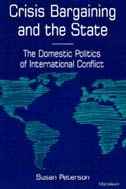
Crisis Bargaining and the State
The Domestic Politics of International ConflictSusan Peterson
University of Michigan Press, 1996
The first book to systematically explore the importance of domestic institutions to crisis bargaining, Crisis Bargaining and the State argues that the influence of a state's bargaining behavior on its opponents foreign policy depends on the nature of the opposing government--its institutional structures and the strategic beliefs of its leaders. The author shows in three detailed case studies--the Crimean War crisis, the Fashoda crisis, and the Berlin crisis--the significance of domestic factors to questions of war and peace.
Peterson offers a comprehensive analysis of the domestic politics of crisis bargaining. She uses differences in state structure to explain variations in foreign policy processes and outcomes. By introducing domestic structure as a crucial intervening variable between the international environment and a state's foreign policy during an acute conflict, Peterson shows how existing cognitive and bureaucratic approaches provide complementary, not competing, explanations of crisis bargaining.
Crisis Bargaining and the State: The Domestic Politics of International Conflict applies recent research in the field of international political economy on the relationship between ideas, institutions, and the international environment to the issue of crisis bargaining. It will appeal to students, scholars, and policymakers interested in crisis bargaining, international security, and international relations.
Susan Peterson is Assistant Professor, Department of Government, The College of William & Mary.
[more]
Power and Negotiation
I. William Zartman and Jeffrey Z. Rubin, Editors
University of Michigan Press, 2002
The editors to this volume begin their introduction with an age-old puzzle in negotiation: “How can weaker parties negotiate with stronger parties and still get something?” Addressing this and other paradoxes, Power and Negotiation produces new findings about the concept of power and about its applications in negotiations between countries. Rejecting the notions of power as a resource and power as an ability, the work defines power as an act that is designed to cause another party to move in a desired direction, thus separating the concept both from its source and from its effects and leaving it open to much more detailed analysis.Using this new definition of the concept of power, this book examines the relations between parties in symmetrical and asymmetrical negotiations. I. William Zartman and Jeffrey Z. Rubin argue that negotiations between countries that are not equal in power tend to be more efficient and effective than symmetrical negotiations, as weaker and stronger parties negotiating together know their roles and are able to get appropriate benefits to each side in a negotiated agreement. In cases of symmetry or near symmetry the countries, whether they are equally weak or equally strong, tend to spend most of their time maintaining their status and waste inordinate amounts of time before they ever come to an agreement. At the same time, Power and Negotiation also examines perceived power on the basis of which symmetries and asymmetries in the relations between parties can be identified. It then looks at six cases of clear asymmetry, two cases of symmetry, and one mixed situation. The book ends with a careful examination of lessons for practice and lessons for theory. The book will appeal to students of negotiation strategy and international relations.
[more]