Results by title

33 books match the query 'Disability studies'
cover of Authoring Autism: On Rhetoric and Neurological Queerness

Authoring Autism

On Rhetoric and Neurological Queerness

M. Remi Yergeau

Duke University Press, 2018

In Authoring Autism M. Remi Yergeau defines neurodivergence as an identity—neuroqueerness—rather than an impairment. Using a queer theory framework, Yergeau notes the stereotypes that deny autistic people their humanity and the chance to define themselves while also challenging cognitive studies scholarship and its reification of the neurological passivity of autistics. They also critique early intensive behavioral interventions—which have much in common with gay conversion therapy—and questions the ableist privileging of intentionality and diplomacy in rhetorical traditions. Using storying as their method, they present an alternative view of autistic rhetoricity by foregrounding the cunning rhetorical abilities of autistics and by framing autism as a narrative condition wherein autistics are the best-equipped people to define their experience. Contending that autism represents a queer way of being that simultaneously embraces and rejects the rhetorical, Yergeau shows how autistic people queer the lines of rhetoric, humanity, and agency. In so doing, they demonstrate how an autistic rhetoric requires the reconceptualization of rhetoric’s very essence.
[more]
cover of Beautiful Mystery: Living in a Wordless World

Beautiful Mystery

Living in a Wordless World

Danilyn Rutherford

Duke University Press, 2025

When Danilyn Rutherford and her husband Craig noticed that their six-month-old daughter Millie wasn’t making eye contact, they took her to their pediatrician. And an optometrist. Then a neurologist. Later, to a team of physical and occupational therapists. None of the doctors could give Millie a diagnosis, but it was clear that her brain was not developing at the rate it should. At an age when some children take their first steps, Millie had the cognitive ability and motor skills of a three-month-old. Three years later, Craig died suddenly of a heart attack and Danilyn found herself on the precipice of her anthropology career as a widow and single mother, still trying to solve the puzzle posed by Millie’s inaccessible mind.

Now in her twenties, Millie has never been able to express herself verbally, but she has a thriving social environment rooted in the people around her and in things her companions and family can see, hear, smell, and feel. Life in Millie’s world is far richer than might be immediately evident to those who think and communicate in conventional ways.

Beautiful Mystery explores what it means to be a person in the spaces between what we can and cannot say, and how we can fight to care for those we love when they don’t have the language to fight for themselves. Through her unique lens as a mother and an anthropologist, Rutherford tells the story of arriving in Millie’s world, what she found there, and how Millie showed her that words aren’t always what makes us human. Enlightening and deeply felt, Beautiful Mystery proves that you don’t have to understand someone to love them—a lesson that, if we all learned it, might allow us to live together in a fractured world.
[more]
cover of Black Disability Politics

Black Disability Politics

Sami Schalk

Duke University Press, 2022
In Black Disability Politics Sami Schalk explores how issues of disability have been and continue to be central to Black activism from the 1970s to the present. Schalk shows how Black people have long engaged with disability as a political issue deeply tied to race and racism. She points out that this work has not been recognized as part of the legacy of disability justice and liberation because Black disability politics differ in language and approach from the mainstream white-dominant disability rights movement. Drawing on the archives of the Black Panther Party and the National Black Women’s Health Project alongside interviews with contemporary Black disabled cultural workers, Schalk identifies common qualities of Black disability politics, including the need to ground public health initiatives in the experience and expertise of marginalized disabled people so that they can work in antiracist, feminist, and anti-ableist ways. Prioritizing an understanding of disability within the context of white supremacy, Schalk demonstrates that the work of Black disability politics not only exists but is essential to the future of Black liberation movements.
[more]
cover of Black Madness :: Mad Blackness

Black Madness

: Mad Blackness

Therí Alyce Pickens

Duke University Press, 2019

In Black Madness :: Mad Blackness Therí Alyce Pickens rethinks the relationship between Blackness and disability, unsettling the common theorization that they are mutually constitutive. Pickens shows how Black speculative and science fiction authors such as Octavia Butler, Nalo Hopkinson, and Tananarive Due craft new worlds that reimagine the intersection of Blackness and madness. These creative writer-theorists formulate new parameters for thinking through Blackness and madness. Pickens considers Butler's Fledgling as an archive of Black madness that demonstrates how race and ability shape subjectivity while constructing the building blocks for antiracist and anti-ableist futures. She examines how Hopkinson's Midnight Robber theorizes mad Blackness and how Due's African Immortals series contests dominant definitions of the human. The theorizations of race and disability that emerge from these works, Pickens demonstrates, challenge the paradigms of subjectivity that white supremacy and ableism enforce, thereby pointing to the potential for new forms of radical politics.
[more]
cover of Crip Genealogies

Crip Genealogies

Mel Y. Chen, Alison Kafer, Eunjung Kim, and Julie A. Minich, editors

Duke University Press, 2023

The contributors to Crip Genealogies reorient the field of disability studies by centering the work of transnational feminism, queer of color critique, and trans scholarship and activism. They challenge the white, Western, and Northern rights-based genealogy of disability studies, showing how a single coherent narrative of the field is a mode of exclusion that relies on logics of whiteness and imperialism. The contributors examine how disability justice activists work in concert with other social justice projects, explore crip environments, create alternate disciplinary genealogies, and reject notions of the model minority. Throughout, they demonstrate how the mandate for a single genealogy of the discipline whitewashes disability and continues forms of violence. By cripping disability studies, the contributors allow for divergent histories, the coexistence of anti-ableist and antiracist theorizing, and a radically just and capacious understanding of disability.

Contributors. Suzanne Bost, Mel Y. Chen, Sony Coráñez Bolton, Natalia Duong, Lezlie Frye, Magda García, Alison Kafer, Eunjung Kim, Yoo-suk Kim, Kateřina Kolářová, James Kyung-Jin Lee, Stacey Park Milbern, Julie Avril Minich, Tari Young-Jung Na, Therí A. Pickens, Leah Lakshmi Piepzna-Samarasinha, Jasbir K. Puar, Sami Schalk, Faith Njahîra Wangarî

[more]
cover of Crip Spacetime: Access, Failure, and Accountability in Academic Life

Crip Spacetime

Access, Failure, and Accountability in Academic Life

Margaret Price

Duke University Press, 2024
In Crip Spacetime, Margaret Price intervenes in the competitive, productivity-focused realm of academia by sharing the everyday experiences of disabled academics. Drawing on more than three hundred interviews and survey responses, Price demonstrates that individual accommodations—the primary way universities address accessibility—actually impede access rather than enhance it. She argues that the pains and injustices encountered by academia’s disabled workers result in their living and working in realities different from nondisabled colleagues: a unique experience of space, time, and being that Price theorizes as “crip spacetime.” She explores how disability factors into the exclusionary practices found in universities, with multiply marginalized academics facing the greatest harms. Highlighting the knowledge that disabled academics already possess about how to achieve sustainable forms of access, Price boldly calls for the university to move away from individualized models of accommodation and toward a new system of collective accountability and care.
[more]
cover of Cripping the Archive: Disability, History, and Power

Cripping the Archive

Disability, History, and Power

Edited by Jenifer L. Barclay and Stefanie Hunt-Kennedy Foreword by Jaipreet Virdi

University of Illinois Press, 2025

How do we explain the conspicuous absence of disability from the histories we write? What forces and factors create this dynamic? How can disability be everywhere and nowhere, present and absent, and obvious and overlooked in both the historical record and historians’ interpretations of the past?

Jenifer L. Barclay and Stefanie Hunt-Kennedy edit a collection of interdisciplinary essays that consider how and why physical, sensory, intellectual, and psychological disabilities are underrepresented, erased, or distorted in the historical record. The contributors draw on the methodology and practice of cripping to uncover disability in contested archives and explore ways to build inclusive archives accountable to, and centered on, disabled people and disability justice. Throughout, they show ableness informing the politics of the archive as a physical space, a discriminatory record, and a collection of silences.

An essential contribution to research methods and disability justice, Cripping the Archive offers a blueprint for intersectional and interdisciplinary approaches that bridge disability studies, history, and archival studies.
[more]
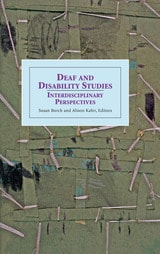
cover of Deaf and Disability Studies: Interdisciplinary Perspectives

Deaf and Disability Studies

Interdisciplinary Perspectives

Susan Burch

Gallaudet University Press, 2010

This collection presents 14 essays by renowned scholars on Deaf people, Deafhood, Deaf histories, and Deaf identity, but from different points of view on the Deaf/Disability compass. Editors Susan Burch and Alison Kafer have divided these works around three themes. The first, Identities and Locations, explores Deaf identity in different contexts. Topics range from a history of activism shaped by the ableism of Deaf elites in the United States from 1880–1920, to a discussion of the roles that economics, location, race, and culture play in the experiences of a Deaf woman from northern Nigeria now living in Washington, D.C.

     Alliances and Activism showcases activism organized across differences. Studies include a feminist analysis of how deaf and hearing women working together share responsibility, and an examination of how intra-cultural variations in New York City and Quebec affect deaf-focus HIV/AIDS programs. The third theme, Boundaries and Overlaps, explicitly addresses the relationships between Deaf Studies and Disability Studies. Interviews with scholars from both disciplines help define these relationships. Another contributor calls for hearing/not-deaf people with disabilities to support their Deaf peers in gaining langue access to the United Nations. Deaf and Disability Studies: Interdisciplinary Perspectives reveals that different questions often lead to contrary conclusions among their authors, who still recognize that they all have a stake in this partnership.


[more]
cover of Defects: Engendering the Modern Body

Defects

Engendering the Modern Body

Helen Deutsch and Felicity Nussbaum, Editors

University of Michigan Press, 2000

Defects brings together essays on the emergence of the concept of monstrosity in the eighteenth century and the ways it paralleled the emergence of notions of sexual difference. Women, declared a mid-eighteenth-century vindication, have been regarded since Aristotle as deformed amphibious things, "neither more or less than Monsters" (Beauty's Triumph 1758). This alliance of monstrosity with misogyny, along with the definition of sexual difference as aberration, is the starting point for this volume's investigation of monstrosity's cultural work in the eighteenth century and its simultaneous mapping and troubling of the range of differences. This collection investigates the conceptual and geographical mapping of early modern and Enlightenment ideas of monstrosity onto a range of differences that contested established categories. The essays consider the representations and material dimensions of phenomena as diverse as femininity and disfigurement, the material imagination and monstrous birth, ugliness as an aesthetic category, deafness and theories of sign language, and the exotic, racialized deformed. Collectively, they demonstrate that the emergence of sexual difference is inextricably intertwined with the emergence of a category of the human that is imagined and deformed, monstrous, and ugly.
[more]
cover of Deprived of Sense and Intellect: Insanity, Possession, and Diagnosis in Medieval Europe

Deprived of Sense and Intellect

Insanity, Possession, and Diagnosis in Medieval Europe

Leigh Ann Craig

University of Michigan Press, 2026

Medieval saints were thought to be able to provide miraculous cures for a wide variety of illnesses, and about one tenth of their miracles involved the restoration of sanity to those who had lost their minds. Deprived of Sense and Intellect explores 460 of these stories written across Latin Christendom between 1240 and 1500. The study uses the lens of critical disability studies to bridge the gap between discussions of demonic possession and naturally arising somatic conditions, treating all these narratives about disability and miraculous healing not as documentation of changes to the function of an individual person, but instead as evidence of substantial and intrusive interpersonal tensions in medieval communities.

While medieval communities assigned these tensions to a malfunction of consciousness in a single person, medieval miracle texts also reveal how the function and malfunction of consciousness was named and classified. In studying these texts, Leigh Ann Craig explores the terminology and rhetoric used to diagnose a loss of mind as either from natural causes or as an effect of demonic predation, tracing the use of Latin vocabulary in medical compendia, law, and theology. Deprived of Sense and Intellect finds that since diagnoses were difficult and frequently subject to doubt, they varied based on regional cultures of disability in northern and southern Europe, the influences on the development of community consensus in Latin Europe in the Middle Ages, and assumptions based on gender, material evidence, and self-diagnosis.
[more]
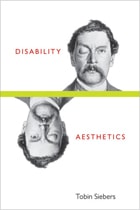
cover of Disability Aesthetics

Disability Aesthetics

Tobin Siebers

University of Michigan Press, 2010

"Disability Aesthetics ambitiously redefines both 'disability' and 'aesthetics,' showing us that disability is central not only to modern art but also to the way we apprehend (and interact with) bodies and buildings. Along the way, Tobin Siebers revisits the beautiful and the sublime, 'degenerate' art and 'disqualified' bodies, culture wars and condemned neighborhoods, the art of Marc Quinn and the fiction of Junot Díaz---and much, much more. Disability Aesthetics is a stunning achievement, a must-read for anyone interested in how to understand the world we half create and half perceive."
---Michael Bérubé, Paterno Family Professor in Literature, Pennsylvania State University

"Rich with examples of the disabled body in both historical and modern art, Tobin Siebers's new book explores how disability problematizes commonly accepted ideas about aesthetics and beauty. For Siebers, disability is not a pejorative condition as much as it is a form of embodied difference. He is as comfortable discussing the Venus de Milo as he is discussing Andy Warhol. Disability Aesthetics is a prescient and much-needed contribution to visual & critical studies."
---Joseph Grigely, Professor of Visual and Critical Studies, The School of the Art Institute of Chicago

Disability Aesthetics is the first attempt to theorize the representation of disability in modern art and visual culture. It claims that the modern in art is perceived as disability, and that disability is evolving into an aesthetic value in itself. It argues that the essential arguments at the heart of the American culture wars in the late twentieth century involved the rejection of disability both by targeting certain artworks as "sick" and by characterizing these artworks as representative of a sick culture. The book also tracks the seminal role of National Socialism in perceiving the powerful connection between modern art and disability. It probes a variety of central aesthetic questions, producing a new understanding of art vandalism, an argument about the centrality of wounded bodies to global communication, and a systematic reading of the use put to aesthetics to justify the oppression of disabled people. In this richly illustrated and accessibly written book, Tobin Siebers masterfully demonstrates the crucial roles that the disabled mind and disabled body have played in the evolution of modern aesthetics, unveiling disability as a unique resource discovered by modern art and then embraced by it as a defining concept.

Tobin Siebers is V. L. Parrington Collegiate Professor of English Language and Literature and Art and Design at the University of Michigan. His many books include Disability Theory and The Subject and Other Subjects: On Ethical, Aesthetic, and Political Identity.

A volume in the series Corporealities: Discourses of Disability

[more]
cover of Disability Theory

Disability Theory

Tobin Siebers

University of Michigan Press, 2008

"Disability Theory is just the book we've been waiting for. Clear, cogent, compelling analyses of the tension between the 'social model' of disability and the material details of impairment; of identity politics and unstable identities; of capability rights and human interdependence; of disability and law, disability as masquerade, disability and sexuality, disability and democracy---they're all here, in beautifully crafted and intellectually startling essays. Disability Theory is a field-defining book: and if you're curious about what 'disability' has to do with 'theory,' it's just the book you've been waiting for, too."
---Michael Bérubé, Pennsylvania State University

"Disability Theory is magisterially written, thoroughly researched, and polemically powerful. It will be controversial in a number of areas and will probably ruffle feathers both in disability studies as well as in realms of cultural theory. And that's all to the good."
---Michael Davidson, University of California, San Diego

"Not only is Disability Theory a groundbreaking contribution to disability studies, it is also a bold, ambitious and much needed revision to a number of adjacent and overlapping fields including cultural studies, literary theory, queer theory, and critical race studies. Siebers has written a powerful manifesto that calls theory to account and forces readers to think beyond our comfort zones."
---Helen Deutsch, University of California, Los Angeles

Intelligent, provocative, and challenging, Disability Theory revolutionizes the terrain of theory by providing indisputable evidence of the value and utility that a disability studies perspective can bring to key critical and cultural questions. Tobin Siebers persuasively argues that disability studies transfigures basic assumptions about identity, ideology, language, politics, social oppression, and the body. At the same time, he advances the emerging field of disability studies by putting its core issues into contact with signal thinkers in cultural studies, literary theory, queer theory, gender studies, and critical race theory.

Tobin Siebers is V. L. Parrington Collegiate Professor, Professor of English Language and Literature, and Professor of Art and Design at the University of Michigan.

A volume in the series Corporealities: Discourses of Disability

Illustration: Pattern by Riva Lehrer, acrylic on panel, 18" X 24", 1995
[more]
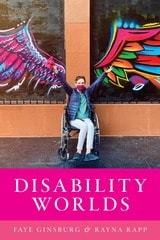
cover of Disability Worlds

Disability Worlds

Faye Ginsburg and Rayna Rapp

Duke University Press, 2024
In Disability Worlds, Faye Ginsburg and Rayna Rapp chronicle and theorize two decades of immersion in New York City’s wide-ranging disability worlds as parents, activists, anthropologists, and disability studies scholars. They situate their disabled children’s lives among the experiences of advocates, families, experts, activists, and artists in larger struggles for recognition and rights. Disability consciousness, they show, emerges in everyday politics, practices, and frictions. Chapters consider dilemmas of genetic testing and neuroscientific research, reimagining kinship and community, the challenges of “special education,” and the perils of transitioning from high school. They also highlight the vitality of neurodiversity activism, disability arts, politics, and public culture. Disability Worlds reflects the authors’ anthropological commitments to recognizing the significance of this fundamental form of human difference. Ginsburg and Rapp’s conversations with diverse New Yorkers reveal the bureaucratic constraints and paradoxes established in response to the disability rights movement, as well as the remarkable creativity of disabled people and their allies who are opening pathways into both disability justice and disability futures.
[more]
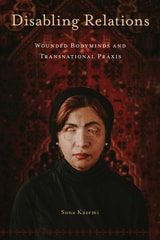
cover of Disabling Relations: Wounded Bodyminds and Transnational Praxis

Disabling Relations

Wounded Bodyminds and Transnational Praxis

Sona Kazemi

Temple University Press, 2026

How do we learn to defetishize disability in our everyday lives? In Disabling Relations, Sona Kazemi probes this and other questions that consider how processes and relations of patriarchy, imperialism, and religious fundamentalism, as well as class and ideology, rework the dialectics of disability in transnational contexts.
 
Kazemi focuses on the disabled dissidents who were incarcerated and tortured by the Islamic regime in the aftermath of the 1979 revolution in Iran, the disabled veterans and civilians wounded during and after  the Iran–Iraq War, the disabled survivors of state-sanctioned punitive limb amputation, and the disabled women survivors of acid attacks as a form of gender-based violence. Disabling Relations explains how disabled bodyminds are produced and sustained through the violence of patriarchal, capitalist-imperialist, nationalist, and theocratic social relations. Kazemi uses the theoretical concept of “wounding” as a historical process of becoming and remaining disabled mediated by unequal power relations and “disability consciousness” to show how these survivors come to terms with their disability.

Thinking about critical disability theory in a new way, Kazemi investigates how disability is produced transnationally and the impact that this new theorization can make globally.

In the series Dis/color
[more]
cover of Foucault and Feminist Philosophy of Disability

Foucault and Feminist Philosophy of Disability

Shelley L. Tremain

University of Michigan Press, 2017
Foucault and Feminist Philosophy of Disability is a distinctive contribution to growing discussions about how power operates within the academic field of philosophy. By combining the work of Michel Foucault, the insights of philosophy of disability and feminist philosophy, and data derived from empirical research, Shelley L. Tremain compellingly argues that the conception of disability that currently predominates in the discipline of philosophy, according to which disability is a natural disadvantage or personal misfortune, is inextricably intertwined with the underrepresentation of disabled philosophers in the profession of philosophy. Against the understanding of disability that prevails in subfields of philosophy such as bioethics, cognitive science, ethics, and political philosophy, Tremain elaborates a new conception of disability as a historically specifi c and culturally relative apparatus of power. Although the book zeros in on the demographics of and biases embedded in academic philosophy, it will be invaluable to everyone who is concerned about the social, economic, institutional, and political subordination of disabled people.
[more]
cover of Foucault and the Government of Disability

Foucault and the Government of Disability

Shelley Tremain, Editor

University of Michigan Press, 2005


Foucault and the Government of Disability is the first book-length investigation of the relevance and importance of the ideas of Michel Foucault to the field of disability studies-and vice versa. Over the last thirty years, politicized conceptions of disability have precipitated significant social change, including the landmark Americans with Disabilities Act in 1990, the redesign of urban landscapes, the appearance of closed-captioning on televisions, and the growing recognition that disabled people constitute a marginalized and disenfranchised constituency.

The provocative essays in this volume respond to Foucault's call to question what is regarded as natural, inevitable, ethical, and liberating, while they challenge established understandings of Foucault's analyses and offer fresh approaches to his work. The book's roster of distinguished international contributors represents a broad range of disciplines and perspectives, making this a timely and necessary addition to the burgeoning field of disability studies.
 
[more]
cover of Foucault and the Government of Disability

Foucault and the Government of Disability

Shelley Tremain, Editor

University of Michigan Press, 2005

Foucault and the Government of Disability considers the continued relevance of Foucault to disability studies, as well as the growing significance of disability studies to understandings of Foucault. A decade ago, this international collection provocatively responded to Foucault’s call to question what is regarded as natural, inevitable, ethical, and liberating. The book’s contributors draw on Foucault to scrutinize a range of widely endorsed practices and ideas surrounding disability, including rehabilitation, community care, impairment, normality and abnormality, inclusion, prevention, accommodation, and special education. In this revised and expanded edition, four new essays extend and elaborate the lines of inquiry by problematizing (to use Foucault’s term) the epistemological, political, and ethical character of the supercrip, the racialized war on autism, the performativity of intellectual disability, and the potent mixture of neoliberalism and biopolitics in the context of physician-assisted suicide.

“[A]n important, prescient, and necessary contribution…a kind of litmus test for the efficacy of Foucault’s concepts in the study of disability, concepts that lead to a refusal of the biological essentialism implied in the disability/impairment binary.”
—Foucault Studies

“Tremain has done an exceptional job at organizing and procuring important, rigorously argued, and entertaining essays…. This book should be a mandatory read for anyone interested in contemporary philosophical debates surrounding the experience of disability."
—Essays in Philosophy

“A beautiful exploration of how Foucault’s analytics of power and genealogies of discursive knowledges can open up new avenues for thinking critically about phenomena that many of us take to be inevitable and thus new ways of resisting and possibly at times redirecting the forces that shape our lives. Every scholar, every person with an interest in Foucault or in political theory generally, needs to read this book.”
—Ladelle McWhorter, University of Richmond  


[more]
cover of Interface Frictions: How Digital Debility Reshapes Our Bodies

Interface Frictions

How Digital Debility Reshapes Our Bodies

Neta Alexander

Duke University Press, 2025

In Interface Frictions, Neta Alexander explores how ubiquitous design features in digital platforms reshape, condition, and break our bodies. She shows that while features such as refresh, playback speed, autoplay, and night mode are convenient, they can lead to “digital debility”—the slow and often invisible ways that technologies may harm human bodies. These features all assume an able-bodied user and at the same time push users to ignore their bodily limitations like the need for rest, nourishment, or movement. Building on the lived experiences of people with disabilities, Alexander explores alternative design solutions that arise from a multisensorial approach to communication. She demonstrates what can be gained from centering the nonaverage user, such as blind people who pioneered ways to control the playback speed of media, and Netflix subscribers with invisible disabilities like PTSD who successfully pushed the company to redesign its previews autoplay feature. Drawing on artworks, video games, and creative hacking by users with disabilities, Alexander challenges our understanding of media consumption, the attention economy, and the digital interface.
[more]
cover of Intoxicated: Race, Disability, and Chemical Intimacy across Empire

Intoxicated

Race, Disability, and Chemical Intimacy across Empire

Mel Y. Chen

Duke University Press, 2023
In Intoxicated Mel Y. Chen explores the ongoing imperial relationship between race, sexuality, and disability. They focus on nineteenth-century biopolitical archives in England and Australia to show how mutual entanglements of race and disability take form through toxicity. Examining English scientist John Langdon Down’s characterization of white intellectual disability as Asian interiority and Queensland’s racialization and targeting of Aboriginal peoples through its ostensible concern with black opium, Chen explores how the colonial administration of race and disability gives rise to “intoxicated” subjects often shadowed by slowness. Chen charts the ongoing reverberations of these chemical entanglements in art and contemporary moments of political and economic conflict or agitation. Although intoxicated subjects may be affected by ongoing pollution or discredited as agents of failure, Chen affirmatively identifies queer/crip forms of unlearning and worldmaking under imperialism. Exemplifying an undisciplined thinking that resists linear or accretive methods of inquiry, Chen unsettles conventional understandings of slowness and agitation, intellectual method, and the toxic ordinary.
[more]
cover of Learning from the High Priestess: Affect, Femme Care, and Somatic Practice

Learning from the High Priestess

Affect, Femme Care, and Somatic Practice

Ann Cvetkovich

Duke University Press, 2026
In Learning from the High Priestess, Ann Cvetkovich integrates theory and somatic practice to assemble a survival guide for artists, academics, and activists in search of new strategies for social justice in times of trouble. Building on her previous work on why feelings matter to political action and intellectual inquiry, Cvetkovich shows how experiments in writing can be a form of affective and somatic practice. She uses four key themes—care, disability and madness, trauma and somatics, and breath—as launch points for reframing discourses of mental health in the direction of practices for decolonizing bodyminds and for the sensory experience of freedom. Engaging with writer-practitioners from Alexis Pauline Gumbs and Alison Bechdel to Leah Lakshmi Piepzna-Samarasinha, Staci Haines, and Kai Cheng Thom, with particular emphasis on Black feminisms, Cvetkovich places femme care and embodied practice at the center of movements for social transformation.
[more]
cover of Music, Disability, and Society

Music, Disability, and Society

Authored by Alex Lubet

Temple University Press, 2010

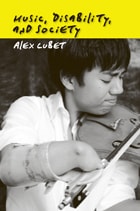
Musical talent in Western culture is regarded as an extraordinary combination of technical proficiency and interpretative sensitivity. In Music, Disability, and Society, Alex Lubet challenges the rigid view of technical skill and writes about music in relation to disability studies. He addresses the ways in which people with disabilities are denied the opportunity to participate in music.

Elaborating on the theory of "social confluence," Lubet provides a variety of encounters between disability and music to observe radical transformations of identity. Considering hand-injured and one-handed pianists; the impairments of jazz luminaries Django Reinhardt, Horace Parlan, and "Little" Jimmy Scott; and the "Blind Orchestra" of Cairo, he shows how the cultural world of classical music contrasts sharply with that of jazz and how musicality itself is regarded a disability in some religious contexts. Music, Disability, and Society also explains how language difference can become a disability for Asian students in American schools of music, limiting their education and careers.

Lubet offers pungent criticism of the biases in music education and the music profession, going so far as to say that culture disables some performers by adhering to rigid notions of what a musician must look like, how music must be played, who may play it, and what (if any) is the legitimate place of music in society. In Music, Disability, and Society, he convincingly argues that where music is concerned, disability is a matter of culture, not physical impairment.
[more]
cover of On Living with Television

On Living with Television

Amy Holdsworth

Duke University Press, 2021
In On Living with Television, Amy Holdsworth examines the characteristics of intimacy, familiarity, repetition, and duration that have come to exemplify the medium of television. Drawing on feminist television studies, queer theory, and disability studies as well as autobiographical life-writing practices, Holdsworth shows how television shapes everyday activities, from eating and sleeping to driving and homemaking. Recounting her own life with television, she offers a sense of the joys and pleasures Disney videos brought to her disabled sister, traces how bedtime television becomes part of a daily routine between child and caregiver, explores her own relationship to binge-eating and binge-viewing, and considers the idea of home through the BBC family drama Last Tango in Halifax. By foregrounding the ways in which television structures our relationships, daily routines, and sense of time, Holdsworth demonstrates how television emerges as a potent vehicle for writing about life.
[more]
cover of Pain in Relation: On Causality, Chronicity, and (Crip) Evidence

Pain in Relation

On Causality, Chronicity, and (Crip) Evidence

Alyson Patsavas

University of Michigan Press, 2026

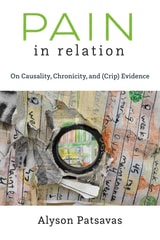
Pain in Relation: On Causality, Chronicity, and (Crip) Evidence argues that the dominant stories circulating within contemporary US culture are marked by seemingly contradictory certainties: pain is at once subjective yet universal; that pain makes life unlivable and can be overcome with perseverance. These certainties graft onto pained people as impossible imperatives: the imperatives to live “despite” our pain and to defend the value of lives imagined to be compromised “because of” it. Alyson Patsavas outlines the harm these imperatives cause and draws on feminist, queer, and disability theory to offer alternative frameworks for making sense of and relating to pain.

The study fleshes out “crip autotheory” and experiments with evidencing practices, using anecdotes, journal entries, personal reflections, list-making, and photography to map “cripistemologies of pain,” or critical, disability-informed experiential ways of knowing pain. Equal parts cultural critique, intimate portrait of pained life, and commentary, Pain in Relation invites readers to challenge what they think they know about pain and explore new ways of relating to pain, pained life, and the futures we imagine for pained people.
[more]
cover of Points of Contact: Disability, Art, and Culture

Points of Contact

Disability, Art, and Culture

Susan Crutchfield and Marcy Epstein, Editors

University of Michigan Press, 2000
Points of Contact brings together contributions by leading writers, artists, scholars, and critics to provide a remarkably broad and consistently engaging look at the intersection of disability and the arts. The contributions include essays and memoirs by a wide range of disabled and nondisabled writers, including Bell Gale Chevigny, Sandra Gilbert, Joseph Grigely, Georgina Kleege, Victoria Ann Lewis, Carol Poore, Tobin Siebers, and Rosemarie Garland Thomson among others; poetry by Brooke Horvath, Joan Seliger Sidney, William Stafford, and others; fiction by Stephen Dixon, Michael Downs, Georgina Kleege, Dallas Wiebe, and others. The collection covers a broad range of subjects and concerns that lie at the intersection of disability and the arts, including fetal alcohol syndrome, education, and identity; representations of disability in the visual arts and the complicated position of the disabled spectator; the impact of cancer on the patient and the caregiver; the similarities between beauty pageants and freak shows; Alzheimer's disease; prosthetic devices; the mechanized disabled body; disability and performance; and profiles of Helen Keller and Annie Sullivan, Christopher Reeve, Franklin Roosevelt, and sado-masochistic performance artist Bob Flanagan. Points of Contact: Disability, Art, and Culture was originally published as a special double issue of the well regarded literary magazine, the Michigan Quarterly Review. Now available in a single, convenient paperback volume, its broad range of perspectives on disability and its entertaining and engaging selections will appeal to general readers, scholars, and students alike.
[more]
cover of Sex and Disability

Sex and Disability

Robert McRuer and Anna Mollow, eds.

Duke University Press, 2012

The title of this collection of essays, Sex and Disability, unites two terms that the popular imagination often regards as incongruous. The major texts in sexuality studies, including queer theory, rarely mention disability, and foundational texts in disability studies do not discuss sex in much detail. What if "sex" and "disability" were understood as intimately related concepts? And what if disabled people were seen as both subjects and objects of a range of erotic desires and practices? These are among the questions that this collection's contributors engage. From multiple perspectives—including literary analysis, ethnography, and autobiography—they consider how sex and disability come together and how disabled people negotiate sex and sexual identities in ableist and heteronormative culture. Queering disability studies, while also expanding the purview of queer and sexuality studies, these essays shake up notions about who and what is sexy and sexualizable, what counts as sex, and what desire is. At the same time, they challenge conceptions of disability in the dominant culture, queer studies, and disability studies.

Contributors
. Chris Bell, Michael Davidson, Lennard J. Davis, Michel Desjardins, Lezlie Frye, Rachael Groner, Kristen Harmon, Michelle Jarman, Alison Kafer, Riva Lehrer, Nicole Markotić, Robert McRuer, Anna Mollow, Rachel O’Connell, Russell Shuttleworth, David Serlin, Tobin Siebers, Abby L. Wilkerson
[more]
cover of Sex, Identity, Aesthetics: The Work of Tobin Siebers and Disability Studies

Sex, Identity, Aesthetics

The Work of Tobin Siebers and Disability Studies

Jina B. Kim, Joshua Kupetz, Crystal Yin Lie, and Cynthia Wu, Editors

University of Michigan Press, 2021
The late Tobin Siebers was a pioneer of, and one of the most prominent thinkers in, the field of disability studies.  His scholarship on sexual and intimate affiliations, the connections between structural location and coalitional politics, and the creative arts has shaped disability studies and continues to be widely cited.  Sex, Identity, Aesthetics: The Work of Tobin Siebers and Disability Studies uses Siebers’ work as a launchpad for thinking about contemporary disability studies.  The editors provide an overview of Siebers’ research to show how it has contributed to humanistic understandings of ability and disability along three key axes: sex, identity, and aesthetics.  The first section of the book explores how disability provides a way for scholars to theorize a wider range of intimacies and relationalities, arguing that disabled people seek sexual access and revolution in ways that transgress heteronormative dictates on sexual propriety.  The second part of the book works outward from Siebers’ work to looks at how disability broadens our concepts of social location and political affiliations.  The final section examines how disability challenges traditional notions of artistic beauty and agency.  Rather than being a strictly commemorative collection meant to mark the end of a major scholar’s career, this collection shows how Siebers’ foundational work in disability studies remains central to and continues to inspire scholars in the field today.   
[more]
cover of Sexuality, Disability, and Aging: Queer Temporalities of the Phallus

Sexuality, Disability, and Aging

Queer Temporalities of the Phallus

Jane Gallop

Duke University Press, 2019

Drawing on her own experiences with late-onset disability and its impact on her sex life, along with her expertise as a cultural critic, Jane Gallop explores how disability and aging work to undermine one's sense of self. She challenges common conceptions that equate the decline of bodily potential and ability with a permanent and irretrievable loss, arguing that such a loss can be both temporary and positively transformative. With Sexuality, Disability, and Aging, Gallop explores and celebrates how sexuality transforms and becomes more queer in the lives of the no longer young and the no longer able while at the same time demonstrating how disability can generate new forms of sexual fantasy and erotic possibility.
[more]
cover of Sick Work: Exhaustion, Labor, and Invisible Illness

Sick Work

Exhaustion, Labor, and Invisible Illness

Emily Lim Rogers

Duke University Press, 2026
In Sick Work, Emily Lim Rogers shows the unpaid labor it takes to be recognized as sick in the United States. Through a historical and ethnographic account of myalgic encephalomyelitis / chronic fatigue syndrome (ME/CFS)—a disease defined by disproportionate exhaustion after any form of exertion, which has no cure or treatment—she reveals how changing formations of labor decide what counts as disability and what does not. Sickness, she writes, is not work’s opposite. Rather, the frequent dismissal of their disease leaves people with ME/CFS to do their own labor of disease advocacy, or “sick work,” even as their symptoms prevent many from working paid jobs. Rogers presents a history of the discursive construction of chronic fatigue and demonstrates its development alongside capitalism since the dawn of industrial management science in the late nineteenth century. These histories, she argues, echo through to the present day, shaping the denial of me/cfs and the stigma that surrounds it. Examining the everyday lives of people with ME/CFS and their activist movements, Sick Work describes how they swim upstream against strong tides of disbelief and demands a radical transformation of how work is defined and valued.
[more]
cover of Stumbling Blocks Before the Blind: Medieval Constructions of a Disability

Stumbling Blocks Before the Blind

Medieval Constructions of a Disability

Edward Wheatley

University of Michigan Press, 2010

"Bold, deeply learned, and important, offering a provocative thesis that is worked out through legal and archival materials and in subtle and original readings of literary texts. Absolutely new in content and significantly innovative in methodology and argument, Stumbling Blocks Before the Blind offers a cultural geography of medieval blindness that invites us to be more discriminating about how we think of geographies of disability today."
---Christopher Baswell, Columbia University

"A challenging, interesting, and timely book that is also very well written . . . Wheatley has researched and brought together a leitmotiv that I never would have guessed was so pervasive, so intriguing, so worthy of a book."
---Jody Enders, University of California, Santa Barbara

Stumbling Blocks Before the Blind presents the first comprehensive exploration of a disability in the Middle Ages, drawing on the literature, history, art history, and religious discourse of England and France. It relates current theories of disability to the cultural and institutional constructions of blindness in the eleventh through fifteenth centuries, examining the surprising differences in the treatment of blind people and the responses to blindness in these two countries. The book shows that pernicious attitudes about blindness were partially offset by innovations and ameliorations---social; literary; and, to an extent, medical---that began to foster a fuller understanding and acceptance of blindness.

A number of practices and institutions in France, both positive and negative---blinding as punishment, the foundation of hospices for the blind, and some medical treatment---resulted in not only attitudes that commodified human sight but also inhumane satire against the blind in French literature, both secular and religious. Anglo-Saxon and later medieval England differed markedly in all three of these areas, and the less prominent position of blind people in society resulted in noticeably fewer cruel representations in literature.

This book will interest students of literature, history, art history, and religion because it will provide clear contexts for considering any medieval artifact relating to blindness---a literary text, a historical document, a theological treatise, or a work of art. For some readers, the book will serve as an introduction to the field of disability studies, an area of increasing interest both within and outside of the academy.

Edward Wheatley is Surtz Professor of Medieval Literature at Loyola University, Chicago.
[more]
cover of The Biopolitics of Disability: Neoliberalism, Ablenationalism, and Peripheral Embodiment

The Biopolitics of Disability

Neoliberalism, Ablenationalism, and Peripheral Embodiment

David T. Mitchell with Sharon L. Snyder

University of Michigan Press, 2015
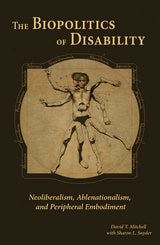
In the neoliberal era, when human worth is measured by its relative utility within global consumer culture, selected disabled people have been able to gain entrance into late capitalist culture. The Biopolitics of Disability terms this phenomenon “ablenationalism” and asserts that “inclusion” becomes meaningful only if disability is recognized as providing modes of living that are alternatives to governing norms of productivity and independence. Thus, the book pushes beyond questions of impairment to explore how disability subjectivities create new forms of embodied knowledge and collective consciousness. The focus is on the emergence of new crip/queer subjectivities at work in disability arts, disability studies pedagogy, independent and mainstream disability cinema (e.g., Midnight Cowboy), internet-based medical user groups, anti-normative novels of embodiment (e.g., Richard Powers’s The Echo-Maker) and, finally, the labor of living in “non-productive” bodies within late capitalism.
[more]
cover of The Crip Linguistics Reader

The Crip Linguistics Reader

Octavian Robinson

Gallaudet University Press, 2025
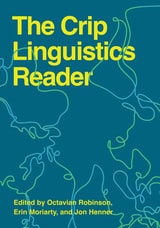
How you language is who you are; language shapes your identity, relationships, and experiences. The Crip Linguistics Reader is a wide-ranging and groundbreaking collection that challenges normative ideas about what is considered “good language.” This volume draws on the expertise of contributors across a variety of fields in the humanities, social sciences, and the arts; these writers bring an interdisciplinary and critical disability perspective to languaging by challenging dominant paradigms in linguistic inquiry. Essays include a wide range of topics, such as examining the relationship between disability and race in the context of language, investigating the compulsory nature of specific forms of language education, elucidating forms of linguistic care, and exploring the transmission of ableist ideologies about language. An essential read for scholars and educators, this collection showcases Crip Linguistics as an analytical framework that will transform ideological boundaries of language and communication along with our understanding of what languaging can be.
[more]
cover of The Political Economy of Stigma: HIV, Memoir, Medicine, and Crip Positionalities

The Political Economy of Stigma

HIV, Memoir, Medicine, and Crip Positionalities

Ally Day

The Ohio State University Press, 2021

Winner, 2022 Alison Piepmeier Prize from the National Women’s Studies Association

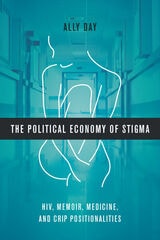
In The Political Economy of Stigma, Ally Day offers a compelling critique of neoliberal medical practices in the US by coupling an analysis of HIV memoir with a critical examination of narrative medicine practice. Using insights from feminist disability studies and crip theory, Day argues that stories of illness and disability—such as HIV memoirs—operate within a political economy of stigma, which she defines as the formal and informal circulation of personal illness and disability narratives that benefits some while hindering others. On the one hand, this system decreases access to appropriate medical care for those with chronic conditions by producing narratives of personal illness that frame one’s relationship to structural inequality as a result of personal failure. On the other hand, the political economy of stigma rewards those who procure such narratives and circulate them for public consumption.

The political economy of stigma is theorized from three primary research sites: a reading group with women living with HIV, a reading group with AIDS service workers, and participant observation research and critical close reading of practices in narrative medicine. Ultimately, it is the women living with HIV who provide an alternative way to understand disability and illness narratives, a practice of differential reading that can challenge stigmatizing tropes and reconceptualize the creation, reception, and circulation of patient memoir.
 
[more]
cover of The Terrible We: Thinking with Trans Maladjustment

The Terrible We

Thinking with Trans Maladjustment

Cameron Awkward-Rich

Duke University Press, 2022

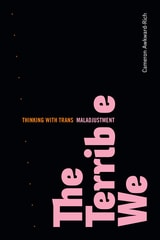
In The Terrible We Cameron Awkward-Rich thinks with the bad feelings and mad habits of thought that persist in both transphobic discourse and trans cultural production. Observing that trans studies was founded on a split from and disavowal of madness, illness, and disability, Awkward-Rich argues for and models a trans criticism that works against this disavowal. By tracing the coproduction of the categories of disabled and transgender in the United States at the turn of the twentieth century and analyzing transmasculine literature and theory by Eli Clare, Elliott DeLine, Dylan Scholinski, and others, Awkward-Rich suggests that thinking with maladjustment might provide new perspectives on the impasses arising from the conflicted relationships among trans, feminist, and queer. In so doing, he demonstrates that rather than only impeding or confining trans life, thought, and creativity, forms of maladjustment have also been and will continue to be central to their development.

Duke University Press Scholars of Color First Book Award recipient
[more]