Results by title
138 books match the query 'Discovery and exploration' and 20 start with a
A Big History of North America
From Montezuma to MonroeKevin Jon Fernlund
University of Missouri Press, 2023
Nevertheless, the three-century journey to get to this point had been anything but predictable. The United States’ rise as a regional power was very much conditioned by constantly shifting transcontinental, transpacific, and above all transatlantic factors, all of which influenced North America’s three interactive cultural spheres: the Indigenous, the Hispano, and the Anglo. And while the United States profoundly shaped the history of Canada and Mexico, so, too, did these two transcontinental countries likewise shape the course of U.S. history.
In this ground-breaking work, Kevin Fernlund shows us that any society’s social development is directly related to its own social power and, just as crucially, to the protective extension or destructive intrusion of the social power of other societies.
A Canyon Voyage
The Narrative of the Second Powell Expedition down the Green-Colorado River from Wyoming, and the Explorations on Land, in the Years 1871 and 1872Frederick S. Dellenbaugh
University of Arizona Press, 1980
"One of the seminal books on western history . . . The author was only 17 when he began the expedition, and he honestly hero-worshipped Powell all his life. Yet this bright, sharp account is so detailed and truthful that the reader can see through his enthusiasm to discover Powell's mean spirit and sometimes reckless nature. It's also a great river-running book." —Deseret News
"It was decidedly worth writing, this detailed record: a more absorbing, and at times stirring, story of adventure has not seen the light in a long time, and the author's unadorned, yet vivid, style enables the reader to share all the emotions of the explorers:" —The Nation
"In these later years (1909) when amateur travel in the west is frequent, a detailed record of this kind will be of value to seekers after adventure." —Science
A Green River Reader
Alan Blackstock
University of Utah Press, 2005
"There is something ominous about a swift river, and something thrilling about a river of any kind."—from Beyond the Hundredth Meridian by Wallace Stegner
Beginning above Flaming Gorge Dam in southwestern Wyoming, the Green River traverses the complete variety of terrain on the Colorado Plateau before joining the Colorado River above Cataract Canyon in southeastern Utah. Like its more famous cousin, the Colorado, the Green has captivated, capsized, and cajoled all types of characters with challenges and beauty to match its geologic variety.
In A Green River Reader editor Alan Blackstock brings this mysterious, magnificent, thrilling river to the reader with an interpretive guide that will inform both river novices and river veterans. Assembled here is every significant written testament to this "awesome ditch," from Domínguez-Escalante to Kit Carson and John C. Frémont; to contemporary American naturalists and writers including Wallace Stegner, Bernard DeVoto, David Brower, Ann Zwinger, Ellen Melloy, and Edward Abbey. Those with a story to tell—those who trapped the Green’s beavers, endured its wild rapids, were humbled by its imposing canyon walls, fought for its beautiful landscapes, or whose "pulse was hurried" by the "lofty chasms, walled in by precipices of red rock"—are collected here.
If you’re headed down the Green, make sure that your dry bag or ammo can has room for just one more thing, your copy of A Green River Reader.

A Guide to Oregon South Coast History
Traveling the Jedediah Smith TrailNathan Douthit
Oregon State University Press, 1999
A History of America in 100 Maps
Susan Schulten
University of Chicago Press, 2018
In this book Susan Schulten uses maps to explore five centuries of American history, from the voyages of European discovery to the digital age. With stunning visual clarity, A History of America in 100 Maps showcases the power of cartography to illuminate and complicate our understanding of the past.
Gathered primarily from the British Library’s incomparable archives and compiled into nine chronological chapters, these one hundred full-color maps range from the iconic to the unfamiliar. Each is discussed in terms of its specific features as well as its larger historical significance in a way that conveys a fresh perspective on the past. Some of these maps were made by established cartographers, while others were made by unknown individuals such as Cherokee tribal leaders, soldiers on the front, and the first generation of girls to be formally educated. Some were tools of statecraft and diplomacy, and others were instruments of social reform or even advertising and entertainment. But when considered together, they demonstrate the many ways that maps both reflect and influence historical change.
Audacious in scope and charming in execution, this collection of one hundred full-color maps offers an imaginative and visually engaging tour of American history that will show readers a new way of navigating their own worlds.

A Tale of Two Colonies
What Really Happened in Virginia and Bermuda?Virginia Bernhard
University of Missouri Press, 2011
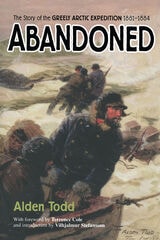
Abandoned
The Story of the Greely Arctic Expedition 1881-1884Alden Todd
University of Alaska Press, 2001
Abandoned is the gripping account of men battling for survival as they are pitted against the elements and each other. It is also the most complete and authentic account of the controversial Greely Expedition ever published, an exemplar of the best in chronicles of polar exploration.
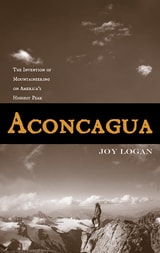
Aconcagua
The Invention of Mountaineering on America’s Highest PeakJoy Logan
University of Arizona Press, 2011
Having done fieldwork on Aconcagua for six years, Logan offers keen insights into how the invention of mountaineering in the nineteenth century—and adventure tourism a century later—have both shaped and been shaped by local and global cultural narratives. She examines the roles and functions of mountain guides, especially in regard to notions of gender and nation; re-reads the mountaineering stories forged by explorers, scientists, tourism officials, and the gear industry; and considers the distinctions between foreign and Argentine climbers (some of whom are celebrities in their own right).
In Logan’s revealing analysis, Aconcagua is emblematic of the tensions produced by modernity, nation-building, tourism development, and re-ethnification. The evolution of mountain climbing on Aconcagua registers seismic shifts in attitudes toward adventure, the national, and the global. With an eye for detail and a flair for description, Logan invites her readers onto the mountain and into the lives it supports.
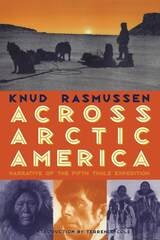
Across Arctic America
Narrative of the Fifth Thule ExpeditionKnud Rasmussen
University of Alaska Press, 1999
It was the people who most captivated the Greenland-born Rasmussen, who had become a virtual adopted son to the Eskimos of the far northern district still known by the name of the trading post he established there, Thule. His first four Thule Expeditions extended the limits of the known world in Greenland solely, but Rasmussen’s Fifth Thule Expedition demonstrated the unity of the Eskimo world from the Atlantic Ocean to the Chukchi Sea, proving the people all shared the same basic language and culture. As historian Terrence Cole notes in his introductory biography, “The intellectual and spiritual life of the people themselves were his primary interest, not simply geographical discovery, and thus even when following the tracks of previous explorers, he found uncharted territory. His basic principle was to first earn the trust of the local people by showing understanding and patience: living with the people and not apart from them, sharing their work and their food….” That was how Rasmussen approached the entire Arctic: he did not live apart from it, skimming over its surface like the fame-seeking polar explorers of the time such as Peary and Cook, but immersed himself in it—so successfully that a Canadian Inuit elder once marveled that he was “the first white man [he had ever seen] who was also an Eskimo.”
Of most significance to readers today, though, is that Rasmussen was also a noted writer. He wanted to share not just the observations he made but the feelings he experienced, and so in Across Arctic America offered what fellow arctic explorer Vilhjalmur Stefansson described as “not only a work of literary charm but also one of the deepest and soundest interpretations” of Eskimo life ever put into a book.
This volume, published in commemoration of the 75th anniversary of the completion of the Fifth Thule Expedition, includes an introduction by Classic Reprint Series editor Terrance Cole and an index.
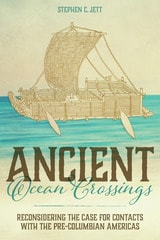
Ancient Ocean Crossings
Reconsidering the Case for Contacts with the Pre-Columbian AmericasStephen C. Jett
University of Alabama Press, 2017
In Ancient Ocean Crossings: Reconsidering the Case for Contacts with the Pre-Columbian Americas, Stephen Jett encourages readers to reevaluate the common belief that there was no significant interchange between the chiefdoms and civilizations of Eurasia and Africa and peoples who occupied the alleged terra incognita beyond the great oceans.
More than a hundred centuries separate the time that Ice Age hunters are conventionally thought to have crossed a land bridge from Asia into North America and the arrival of Columbus in the Bahamas in 1492. Traditional belief has long held that earth’s two hemispheres were essentially cut off from one another as a result of the post-Pleistocene meltwater-fed rising oceans that covered that bridge. The oceans, along with arctic climates and daunting terrestrial distances, formed impermeable barriers to interhemispheric communication. This viewpoint implies that the cultures of the Old World and those of the Americas developed independently.
Drawing on abundant and concrete evidence to support his theory for significant pre-Columbian contacts, Jett suggests that many ancient peoples had both the seafaring capabilities and the motives to cross the oceans and, in fact, did so repeatedly and with great impact. His deep and broad work synthesizes information and ideas from archaeology, geography, linguistics, climatology, oceanography, ethnobotany, genetics, medicine, and the history of navigation and seafaring, making an innovative and persuasive multidisciplinary case for a new understanding of human societies and their diffuse but interconnected development.
Another Face of Empire
Bartolomé de Las Casas, Indigenous Rights, and Ecclesiastical ImperialismDaniel Castro
Duke University Press, 2007
Separating historical reality from myth, Daniel Castro provides a nuanced, revisionist assessment of the friar’s career, writings, and political activities. Castro argues that Las Casas was very much an imperialist. Intent on converting the Indians to Christianity, the religion of the colonizers, Las Casas simply offered the natives another face of empire: a paternalistic, ecclesiastical imperialism. Castro contends that while the friar was a skilled political manipulator, influential at what was arguably the world’s most powerful sixteenth-century imperial court, his advocacy on behalf of the natives had little impact on their lives. Analyzing Las Casas’s extensive writings, Castro points out that in his many years in the Americas, Las Casas spent very little time among the indigenous people he professed to love, and he made virtually no effort to learn their languages. He saw himself as an emissary from a superior culture with a divine mandate to impose a set of ideas and beliefs on the colonized. He differed from his compatriots primarily in his antipathy to violence as the means for achieving conversion.
Arctic Madness
The Anthropology of a DelusionPierre Déléage
HAU, 2020
Arkansas Travelers
Geographies of Exploration and Perception, 1804-1834Andrew J. Milson
University of Arkansas Press, 2023
“I reckon stranger you have not been used much to traveling in the woods,” a hunter remarked to Henry Rowe Schoolcraft as he trekked through the Ozark backcountry in late 1818. The ensuing exchange is one of many compelling encounters between Arkansas travelers and settlers depicted in Arkansas Travelers: Geographies of Exploration and Perception, 1804–1834. This book is the first to integrate the stories of four travelers who explored Arkansas during the transformative period between the Louisiana Purchase of 1803 and statehood in 1836: William Dunbar, Thomas Nuttall, Henry Rowe Schoolcraft, and George William Featherstonhaugh.
In addition to gathering their tales of treacherous rivers, drunken scoundrels, and repulsive food, historian and geographer Andrew J. Milson explores the impact such travel narratives have had on geographical understandings of Arkansas places. Using the language in each traveler’s narrative, Milson suggests, and the book includes, new maps that trace these perceptions, illustrating not just the lands traversed, but the way travelers experienced and perceived place. By taking a geographical approach to the history of these spaces, Arkansas Travelers offers a deeper understanding—a deeper map—of Arkansas.
Asia in the Making of Europe, Volume I
The Century of Discovery. Book 1.Donald F. Lach
University of Chicago Press, 1994
Volume I: The Century of Discovery brings together "everything that a European could know of India, Southeast Asia, China, and Japan, from printed books, missionary reports, traders' accounts and maps" (The New York Review of Books). Volume II: A Century of Wonder examines the influence of that vast new body of information about Asia on the arts, institutions, literatures, and ideas of sixteenth-century Europe.
Asia in the Making of Europe, Volume I
The Century of Discovery. Book 2.Donald F. Lach
University of Chicago Press, 1994
Volume I: The Century of Discovery brings together "everything that a European could know of India, Southeast Asia, China, and Japan, from printed books, missionary reports, traders' accounts and maps" (The New York Review of Books). Volume II: A Century of Wonder examines the influence of that vast new body of information about Asia on the arts, institutions, literatures, and ideas of sixteenth-century Europe.
Asia in the Making of Europe, Volume II
A Century of Wonder. Book 1: The Visual ArtsDonald F. Lach
University of Chicago Press, 1970
The rise to world dominance of the Western nations in modern times and the rapid industrial growth of the West, which outpaced the East in technical and military achievements, have led to a historical eclipse of the ancient and brilliant cultures of Asia.
Historican Donald F. Lach, in his influential scholarly work, Asia in the Making of Europe, points out that an eclipse is never permanent, that this one was never total, and that there was a period in early modern times when Asia and Europe were close rivals in brilliance and mutual influence.
Asia in the Making of Europe, Volume II
A Century of Wonder. Book 2: The Literary ArtsDonald F. Lach
University of Chicago Press, 1994
Volume I: The Century of Discovery brings together "everything that a European could know of India, Southeast Asia, China, and Japan, from printed books, missionary reports, traders' accounts and maps" (The New York Review of Books). Volume II: A Century of Wonder examines the influence of that vast new body of information about Asia on the arts, institutions, literatures, and ideas of sixteenth-century Europe.
Asia in the Making of Europe, Volume II
A Century of Wonder. Book 3: The Scholarly DisciplinesDonald F. Lach
University of Chicago Press, 1994
Volume I: The Century of Discovery brings together "everything that a European could know of India, Southeast Asia, China, and Japan, from printed books, missionary reports, traders' accounts and maps" (The New York Review of Books). Volume II: A Century of Wonder examines the influence of that vast new body of information about Asia on the arts, institutions, literatures, and ideas of sixteenth-century Europe.
Asia in the Making of Europe, Volume III
A Century of Advance. Book 2, South AsiaDonald F. Lach and Edwin J. Van Kley
University of Chicago Press, 1993
In Volume III: A Century of Advance, the authors have researched seventeenth-century European writings on Asia in an effort to understand how contemporaries saw Asian societies and peoples.

At the Moon's Inn
Andrew Lytle
University of Alabama Press, 2009
At the Moon’s Inn, first published in 1941, provides a fictional account of De Soto’s famous Spanish expedition to La Florida and through the southeastern United States between 1539 and 1543. The novel begins in Spain in 1538, where De Soto and his chief lieutenants, veterans of the campaigns in South America, pledge themselves to a new enterprise to explore and exploit La Florida. The narrative follows them on their voyage to Cuba, where they rest and obtain additional supplies, then set sail for the area now known as Tampa Bay. Lytle’s brilliant historical novel takes the readers with the conquistadores through the hot, humid land, where despite their advantage in military technology they found they must rely on the Indians for food. The author explores the cultural confrontation that seriously weakened the Indians, while the Spaniards’ dreams of gold gradually turned to hopes of survival in the hostile environment.
Drawing his facts from the 1939 United States De Soto Commission Report and from the surviving historical chronicles of the expedition, Lytle weaves a fascinating tale that brings to life the history of Spanish efforts to establish a controlling presence in the New World during the first half of the 16th century.
In his introduction, Douglas Jones places At the Moon’s Inn within the context of the documentary record, as well as within the framework of its distinguished author’s career.