Results by title
16 books match the query 'Discrimination against people with disabilities'
Academic Ableism
Disability and Higher EducationJay Timothy Dolmage
University of Michigan Press, 2017
Academic Ableism
Disability and Higher EducationJay Timothy Dolmage
University of Michigan Press, 2017
Activist Affordances
How Disabled People Improvise More Habitable WorldsArseli Dokumaci
Duke University Press, 2023

Black Madness
: Mad BlacknessTherí Alyce Pickens
Duke University Press, 2019

Cripping Labor-Based Grading for More Equity in Literacy Courses
Asao B. Inoue
University Press of Colorado, 2024
Cripping the Archive
Disability, History, and PowerEdited by Jenifer L. Barclay and Stefanie Hunt-Kennedy Foreword by Jaipreet Virdi
University of Illinois Press, 2025
Jenifer L. Barclay and Stefanie Hunt-Kennedy edit a collection of interdisciplinary essays that consider how and why physical, sensory, intellectual, and psychological disabilities are underrepresented, erased, or distorted in the historical record. The contributors draw on the methodology and practice of cripping to uncover disability in contested archives and explore ways to build inclusive archives accountable to, and centered on, disabled people and disability justice. Throughout, they show ableness informing the politics of the archive as a physical space, a discriminatory record, and a collection of silences.
An essential contribution to research methods and disability justice, Cripping the Archive offers a blueprint for intersectional and interdisciplinary approaches that bridge disability studies, history, and archival studies.
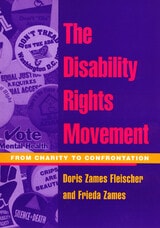
Disability Rights Movement
From Charity to ConfrontationDoris Fleischer
Temple University Press, 2000
Referring to the Americans with Disabilities Act as "every American's insurance policy," the authors recount the genesis of this civil rights approach to disability, from the almost forgotten disability activism of the 1930s to the independent living movement of the 1970s to the call for disability pride of the 1990s. Like other civil rights struggles, the disability rights movement took place in the streets and in the courts as activists fought for change in the schools, the workplace, and in the legal system. They continue to fight for effective access to the necessities of everyday life -- to telephones, buses, planes, public buildings, restaurants, and toilets.
The history of disability rights mirrors the history of the country. Both World Wars sparked changes in disability policy and changes in medical technology as veterans without without limbs and with other disabilities return home. The empowerment of people with disabilities has become another chapter in the struggles over identity politics that began in the 1960s. Today, with the expanding ability of people with disabilities to enter the workforce, and a growing elderly population increasingly significant at a time when HMOs are trying to contain healthcare expenditures.
Disability and Passing
Blurring the Lines of IdentityJeffrey A Brune
Temple University Press, 2013
Passing—an act usually associated with disguising race—also relates to disability. Whether a person classified as mentally ill struggles to suppress aberrant behavior to appear "normal" or a person falsely claims a disability to gain some advantage, passing is a pervasive and much discussed phenomenon. Nevertheless, Disability and Passing is the first anthology to examine this issue.
The editors and contributors to this volume explore the intersections of disability, race, gender, and sexuality as these various aspects of identity influence each other and make identity fluid. They argue that the line between disability and normality is blurred, discussing disability as an individual identity and as a social category. And they discuss the role of stigma in decisions about whether or not to pass.
Focusing on the United States from the nineteenth century to the present, the essays in Disability and Passing speak to the complexity of individual decisions about passing and open the conversation for broader discussion.
Contributors include: Dea Boster, Allison Carey, Peta Cox, Kristen Harmon, David Linton, Michael Rembis, and the editors.
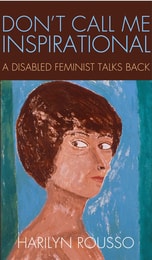
Don't Call Me Inspirational
A Disabled Feminist Talks BackHarilyn Rousso
Temple University Press, 2013
For psychotherapist, painter, feminist, filmmaker, writer, and disability activist Harilyn Rousso, hearing well-intentioned people tell her, "You're so inspirational!" is patronizing, not complimentary.
In her empowering and at times confrontational memoir, Don't Call Me Inspirational, Rousso, who has cerebral palsy, describes overcoming the prejudice against disability--not overcoming disability. She addresses the often absurd and ignorant attitudes of strangers, friends, and family.Rousso also examines her own prejudice toward her disabled body, and portrays the healing effects of intimacy and creativity, as well as her involvement with the disability rights community. She intimately reveals herself with honesty and humor and measures her personal growth as she goes from "passing" to embracing and claiming her disability as a source of pride, positive identity, and rebellion.
A collage of images about her life, rather than a formal portrait, Don't Call Me Inspirational celebrates Rousso's wise, witty, productive, outrageous life, disability and all.
Radical Health
Unwellness, Care, and Latinx Expressive CultureJulie Avril Minich
Duke University Press, 2023
Rights of Inclusion
Law and Identity in the Life Stories of Americans with DisabilitiesDavid M. Engel and Frank W. Munger
University of Chicago Press, 2003
Although all sixty interviewees had experienced discrimination, none had filed a formal protest or lawsuit. Nevertheless, civil rights played a crucial role in their lives. Rights improved their self-image, enhanced their career aspirations, and altered the perceptions and assumptions of their employers and coworkers-in effect producing more inclusive institutional arrangements. Focusing on these long-term life histories, Engel and Munger incisively show how rights and identity affect one another over time and how that interaction ultimately determines the success of laws such as the ADA.
The Disability Rights Movement
From Charity to ConfrontationDoris Fleischer
Temple University Press, 2011
In this updated edition, Doris Zames Fleischer and Frieda Zames expand their encyclopedic history of the struggle for disability rights in the United States, to include the past ten years of disability rights activism.The book includes a new chapter on the evolving impact of the Americans with Disabilities Act, the continuing struggle for cross-disability civil and human rights, and the changing perceptions of disability.
The authors provide a probing analysis of such topics as deinstitutionalization, housing, health care, assisted suicide, employment, education, new technologies, disabled veterans, and disability culture.
Based on interviews with over one hundred activists, The Disability Rights Movement tells a complex and compelling story of an ongoing movement that seeks to create an equitable and diverse society, inclusive of people with disabilities.
The Disabled Child
Memoirs of a Normal FutureAmanda Apgar
University of Michigan Press, 2023
The Life Worth Living
Disability, Pain, and MoralityJoel Michael Reynolds
University of Minnesota Press, 2022
A philosophical challenge to the ableist conflation of disability and pain
More than 2,000 years ago, Aristotle said: “let there be a law that no deformed child shall live.” This idea is alive and well today. During the past century, Supreme Court Justice Oliver Wendell Holmes Jr. argued that the United States can forcibly sterilize intellectually disabled women and philosopher Peter Singer argued for the right of parents to euthanize certain cognitively disabled infants. The Life Worth Living explores how and why such arguments persist by investigating the exclusion of and discrimination against disabled people across the history of Western moral philosophy.
Joel Michael Reynolds argues that this history demonstrates a fundamental mischaracterization of the meaning of disability, thanks to the conflation of lived experiences of disability with those of pain and suffering. Building on decades of activism and scholarship in the field, Reynolds shows how longstanding views of disability are misguided and unjust, and he lays out a vision of what an anti-ableist moral future requires.
The Life Worth Living is the first sustained examination of disability through the lens of the history of moral philosophy and phenomenology, and it demonstrates how lived experiences of disability demand a far richer account of human flourishing, embodiment, community, and politics in philosophical inquiry and beyond.
Accessibility features: Retail e-book files for this title are screen-reader friendly with images accompanied by short alt text and/or extended descriptions.
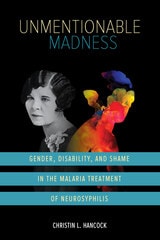
Unmentionable Madness
Gender, Disability, and Shame in the Malaria Treatment of NeurosyphilisChristin L. Hancock
University of Illinois Press, 2025
Christin L. Hancock looks through the lens of feminist disability to examine the popular but ethically suspect treatment and its consequences. As Hancock shows, the treatment’s purported success rate relied on the disabled minds and bodies of people incarcerated in mental hospitals. The backgrounds and identities of these patients reflected and perpetuated attitudes around poverty, gender, race, and disability while betraying authorities’ desire to protect the public from women and men perceived as abnormal, sexually tainted, and unworthy of community life.
Paying special attention to the patients’ voices and experiences, Unmentionable Madness offers a disability history that confronts the ethics of experimentation.
Women with Disabilities
Essays in Psychology, Culture, and Politicsedited by Michelle Fine and Adrienne Asch
Temple University Press, 1989
Women with disabilities are women first, sharing the dreams and disappointments common to women in a male-dominated society. But because society persists in viewing disability as an emblem of passivity and incompetence, disabled women occupy a devalued status in the social hierarchy. This book represents the intersection of the feminist and disability rights perspectives; it analyzes the forces that push disabled women towards the margins of social life, and it considers the resources that enable these women to resist the stereotype.
Drawing on law, social science, folklore, literature, psychoanalytic theory, and political activism, this book describes the experience of women with disabilities. The essays consider the impact of social class, race, the age at which disability occurs, and sexual orientation on the disabled woman's self esteem as well as on her life options. The contributors focus their inquiry on the self perceptions of disabled women and ask: From what sources do these women draw positive self images? How do they resist the culture's power to label them as deviant? The essays describe the ways in which disabled women face discrimination in the workplace and the failure of the mainstream women's movement to address their concerns.
In the series Health, Society, and Policy, edited by Sheryl Ruzek and Irving Kenneth Zola.