Results by title
13 books match the query 'Discrimination in law enforcement'

A Police State
Politics and Public Safety in Minneapolis, 1945–2020Michael J. Lansing
University of Chicago Press, 2027
How the police in Minneapolis used electoral politics to accrue power and avoid accountability.
The 2020 murder of George Floyd made Minneapolis synonymous with unjust policing and the pain and outrage left in its wake. The city became ground zero for police reform in the United States—even though liberal politicians in Minnesota had promised, and delivered, police reforms for decades. Centered on professionalization, these changes inadvertently exacerbated injustice. Better training and higher standards broadened the influence of the police, who then claimed expertise in public safety. They deployed it to bargain for governmental support, even when they treated residents unfairly. Though Black, Indigenous, and gay residents resisted, the political power amassed by the police rendered real change almost impossible.
In A Police State, historian and fourth-generation Minneapolis resident Michael J. Lansing chronicles how the police became a political force in one of the nation’s most liberal cities. Lansing shows how, in the years after World War II, public safety policies that appealed to voters in the overwhelmingly white city protected and expanded police discretion. As union members, administrators, and citizens, officers shaped these policies to shield themselves and their violent actions from scrutiny. They campaigned for better wages, secured legal safeguards, resisted race-neutral policing, and elected one of their own to the mayor’s office. Ultimately, they used democratic institutions to cultivate and sustain a police state that protected white people and harmed people of color. Lansing uncovers this dysfunctional relationship between a city and its cops while illuminating a larger American story about reform, resistance, and democracy.
A significant exploration of policing politics, this book helps us understand the history that led to George Floyd’s murder—and insists that the future of community safety depends on reenvisioning the role of police in our society.
Excited Delirium
Race, Police Violence, and the Invention of a DiseaseAisha M. Beliso-De Jesús
Duke University Press, 2024
How to Lose the Hounds
Maroon Geographies and a World beyond PolicingCeleste Winston
Duke University Press, 2023
In the Wake
On Blackness and BeingChristina Sharpe
Duke University Press, 2016
Legal Plunder
The Predatory Dimensions of Criminal JusticeJoshua Page and Joe Soss
University of Chicago Press, 2025
A searing, historically rich account of how US policing and punishment have been retrofitted over the last four decades to extract public and private revenues from America’s poorest and most vulnerable communities.
Alongside the rise of mass incarceration, a second profound and equally disturbing development has transpired. Since the 1980s, US policing and punishment have been remade into tools for stripping resources from the nation’s most oppressed communities and turning them into public and private revenues. Legal Plunder analyzes this development’s origins, operations, consequences, and the political struggles that it has created.
Drawing on historical and contemporary evidence, including original ethnographic research, Joshua Page and Joe Soss examine the predatory dimensions of criminal legal governance to show how practices that criminalize, police, and punish have been retrofitted to siphon resources from subordinated groups, subsidize governments, and generate corporate profits. As tax burdens have declined for the affluent, this financial extraction—now a core function of the country’s sprawling criminal legal apparatus—further compounds race, class, and gender inequalities and injustices. Legal Plunder shows that we can no longer afford to overlook legal plunder or the efforts to dismantle it.
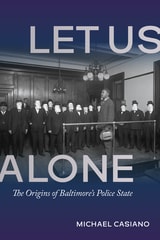
Let Us Alone
The Origins of Baltimore's Police StateMichael Casiano
University of Illinois Press, 2025
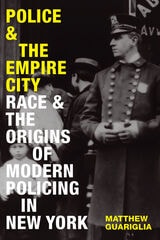
Police and the Empire City
Race and the Origins of Modern Policing in New YorkMatthew Guariglia
Duke University Press, 2023
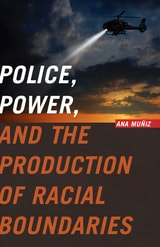
Police, Power, and the Production of Racial Boundaries
Muñiz, Ana
Rutgers University Press, 2015
Muñiz illuminates the degree to which the definitions of “gangs” and “deviants” are politically constructed labels born of public policy and court decisions, offering an innovative look at the process of criminalization and underscoring the ways in which a politically powerful coalition can define deviant behavior. As she does so, Muñiz also highlights the various grassroots challenges to such policies and the efforts to call attention to their racist effects. Muñiz describes the fight over two very different methods of policing: community policing (in which the police and the community work together) and the “broken windows” or “zero tolerance” approach (which aggressively polices minor infractions—such as loitering—to deter more serious crime). Police, Power, and the Production of Racial Boundaries also explores the history of the area to explain how Cadillac-Corning became viewed by outsiders as a “violent neighborhood” and how the city’s first gang injunction—a restraining order aimed at alleged gang members—solidified this negative image. As a result, Muñiz shows, Cadillac-Corning and other sections became a test site for repressive practices that eventually spread to the rest of the city.
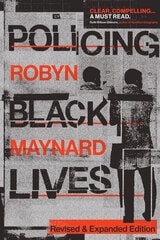
Policing Black Lives
State Violence in Canada from Slavery to the PresentRobyn Maynard
Duke University Press, 2025

The Global Police State
William I Robinson
Pluto Press, 2020
"Karl Marx aspired to a world in which our animal needs would be satisfied and our human needs could be addressed. It is a realistic possibility now, as William Robinson outlines—or the alternative that is taking shape before our eyes: a 'global police state' controlled by narrowly concentrated capital with 'surplus humanity' left to survive somehow on its own. The choice is in our hands."
—Noam Chomsky, author of Who Rules the World?
As the world becomes ever more unequal, people become ever more “disposable.” Today, governments systematically exclude sections of their populations from society through heavy-handed policing. But it doesn't always go to plan.
William I. Robinson exposes the nature and dynamics of this out-of-control system, arguing for the urgency of creating a movement capable of overthrowing it. The global police state uses a variety of ingenious methods of control, including mass incarceration, police violence, US-led wars, the persecution of immigrants and refugees, and the repression of environmental activists.
He writes in his Introduction, “I offer a ‘big picture” of the emerging global police state in a short book that is eminently readable. The pages to follow may startle many readers and make them angry. I trust the work will serve as a warning of the dystopic future that is upon us. More importantly, by exposing the nature and dynamic of this out-of-control system, I hope it will contribute to the struggles to bring about an alternative future based on human freedom and liberation.”
Movements have emerged to combat the increasing militarization, surveillance and social cleansing; however, many of them appeal to a moral sense of social justice rather than addressing its root: global capitalism.
Using shocking data which reveals how far capitalism has become a system of repression, Robinson argues that the emerging megacities of the world are becoming the battlegrounds where the excluded and the oppressed face off against the global police state.
The Horror of Police
Travis Linnemann
University of Minnesota Press, 2022
Unmasks the horrors of a social order reproduced and maintained by the violence of police
Year after year the crisis churns: graft and corruption, violence and murder, riot cops and armored vehicles claim city streets. Despite promises of reform, police operate with impunity, unaccountable to law. In The Horror of Police, Travis Linnemann asks why, with this open record of violence and corruption, policing remains for so many the best, perhaps only means of security in an insecure world.
Drawing on the language and texts of horror fiction, Linnemann recasts the police not only as self-proclaimed “monster fighters” but as monsters themselves, a terrifying force set loose in the world. Purposefully misreading a collection of everyday police stories (TV cop dramas, detective fiction, news media accounts, the direct words of police) not as morality tales of innocence avenged and order restored but as horror, Linnemann reveals the monstrous violence at the heart of liberal social order.
The Horror of Police shows that police violence is not a deviation but rather a deliberate and permanent fixture of U.S. “law and order.” Only when viewed through the refracted motif of horror stories, Linnemann argues, can we begin to reckon the limits of police and imagine a world without them.
The Prescription-to-Prison Pipeline
The Medicalization and Criminalization of PainMichelle Smirnova
Duke University Press, 2023
Warfare in the American Homeland
Policing and Prison in a Penal DemocracyJoy James, ed.
Duke University Press, 2007
Contributors consider the interning or policing of citizens of color, the activism of radicals, structural racism, destruction and death in New Orleans following Hurricane Katrina, and the FBI Counterintelligence Program designed to quash domestic dissent. Among the first-person accounts are an interview with Dhoruba Bin Wahad, a Black Panther and former political prisoner; a portrayal of life in prison by a Plowshares nun jailed for her antinuclear and antiwar activism; a discussion of the Puerto Rican Independence Movement by one of its members, now serving a seventy-year prison sentence for sedition; and an excerpt from a 1970 letter by the Black Panther George Jackson chronicling the abuses of inmates in California’s Soledad Prison. Warfare in the American Homeland also includes the first English translation of an excerpt from a pamphlet by Michel Foucault and others. They argue that the 1971 shooting of George Jackson by prison guards was a murder premeditated in response to human-rights and justice organizing by black and brown prisoners and their supporters.
Contributors. Hishaam Aidi, Dhoruba Bin Wahad (Richard Moore), Marilyn Buck, Marshall Eddie Conway, Susie Day, Daniel Defert, Madeleine Dwertman, Michel Foucault, Carol Gilbert, Sirène Harb, Rose Heyer, George Jackson, Joy James, Manning Marable, William F. Pinar, Oscar Lòpez Rivera, Dylan Rodríguez, Jared Sexton, Catherine vön Bulow, Laura Whitehorn, Frank B. Wilderson III