Results by title
4 books match the query 'Diseases in literature'

Bioinsecurities
Disease Interventions, Empire, and the Government of SpeciesNeel Ahuja
Duke University Press, 2016
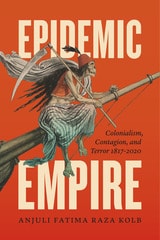
Epidemic Empire
Colonialism, Contagion, and Terror, 1817–2020Anjuli Fatima Raza Kolb
University of Chicago Press, 2021
Terrorism is a cancer, an infection, an epidemic, a plague. For more than a century, this metaphor has figured insurgent violence as contagion in order to contain its political energies. In Epidemic Empire, Anjuli Fatima Raza Kolb shows that this trope began in responses to the Indian Mutiny of 1857 and tracks its tenacious hold through 9/11 and beyond. The result is the first book-length study to approach the global War on Terror from a postcolonial literary perspective.
Raza Kolb assembles a diverse archive from colonial India, imperial Britain, French and independent Algeria, the postcolonial Islamic diaspora, and the neoimperial United States. Anchoring her book are studies of four major writers in the colonial-postcolonial canon: Rudyard Kipling, Bram Stoker, Albert Camus, and Salman Rushdie. Across these sources, she reveals the tendency to imagine anticolonial rebellion, and Muslim insurgency specifically, as a virulent form of social contagion. Exposing the long history of this broken but persistent narrative, Epidemic Empire is a major contribution to the rhetorical history of our present moment.
Literary Diseases
Theme and Metaphor in the Italian NovelBy Gian-Paolo Biasin
University of Texas Press, 1975
Disease—real or imagined, physical or mental—is a common theme in Western literature and is often a symbol of modern alienation. In Literary Diseases, a comprehensive analysis of the metaphorical and symbolic force of disease in modern Italian literature, Gian-Paolo Biasin expands the geography of the discussion of this important theme. Using as a backdrop the perspective of European experiences of the previous hundred years, Biasin analyzes the theme of disease as a reflection of certain sociological and historical phenomena in modern European novels, as a metaphor for the world visions of selected Italian novelists, and especially as a vehicle for understanding the nature and function of fiction itself.
The core of Biasin’s study is found in his discussion of the works of four major Italian writers. In his criticism of the novels of Giovanni Verga, who stood at the center of many complex developments in the nineteenth century, he examines the antecedents of modern Italian prose. He then scrutinizes the works of Italo Svevo and Luigi Pirandello, who together inaugurated the modern novel in Italy. Of particular interest is his exploration of their critical use of psychoanalysis and madness climaxed by apocalyptic visions. He then discusses the prose of Carlo Emilio Gadda, which epitomizes the problems of the avant-garde in its experimentalism and expressionism.
Biasin utilizes a broad spectrum of critical approaches—from sociology, psychoanalysis, and different trends in modern French, American, and Italian literary criticism—in shaping his own methodology, which is a thematic and structural symbolism. He concludes that disease in literature should be considered as a metaphor for writing (écriture) and as a cognitive instrument that calls into question the anthropocentric values of Western culture. The book, with its textual comparisons and unusual supporting examples, constitutes a significant methodological contribution as well as a major survey of modern Italian prose, and will allow the reader to see traditional landmarks in European fiction in a new light.
Plague Writing in Early Modern England
Ernest B. Gilman
University of Chicago Press, 2009
During the seventeenth century, England was beset by three epidemics of the bubonic plague, each outbreak claiming between a quarter and a third of the population of London and other urban centers. Surveying a wide range of responses to these epidemics—sermons, medical tracts, pious exhortations, satirical pamphlets, and political commentary—Plague Writing in Early Modern England brings to life the many and complex ways Londoners made sense of such unspeakable devastation.
Ernest B. Gilman argues that the plague writing of the period attempted unsuccessfully to rationalize the catastrophic and that its failure to account for the plague as an instrument of divine justice fundamentally threatened the core of Christian belief. Gilman also trains his critical eye on the works of Jonson, Donne, Pepys, and Defoe, which, he posits, can be more fully understood when put into the context of this century-long project to “write out” the plague. Ultimately, Plague Writing in Early Modern England is more than a compendium of artifacts of a bygone era; it holds up a distant mirror to reflect our own condition in the age of AIDS, super viruses, multidrug resistant tuberculosis, and the hovering threat of a global flu pandemic.