Results by title

3 books match the query 'Disobedience'
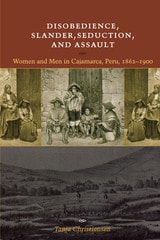
cover of Disobedience, Slander, Seduction, and Assault: Women and Men in Cajamarca, Peru, 1862-1900

Disobedience, Slander, Seduction, and Assault

Women and Men in Cajamarca, Peru, 1862-1900

By Tanja Christiansen

University of Texas Press, 2004

Though the law and courts of nineteenth-century Peru were institutions created by and for the ruling elite, women of all classes used the system to negotiate the complexities of property rights, childrearing, and marriage, and often to defend their very definitions of honor. Drawing on the trial transcripts of Cajamarca, a northern Peruvian province, from more than a century ago, this book shares eye-opening details about life among this community, in which reputation could determine a woman's chances of survival.

Exploring the processes of courtship, seduction, and familial duties revealed in these court records, historian Tanja Christiansen has unearthed a compelling panorama that includes marital strife, slander, disobedience, street brawls, and spousal abuse alongside documents that give evidence of affection and devotion. Her research also yields much new information about the protocols for conflict and cooperation among nineteenth-century Peruvian women from all social strata, and the prevalence of informal unions in an economy driven in large part by migratory male labor. Reviving a little-known aspect of Latin American history, Christiansen's book simultaneously brings to light an important microcosm of women's history during the nineteenth century.
[more]
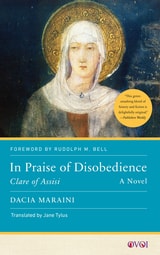
cover of In Praise of Disobedience: Clare of Assisi, A Novel

In Praise of Disobedience

Clare of Assisi, A Novel

Dacia Maraini

Rutgers University Press, 2023
An author receives a mysterious e-mail begging her to tell the story of Clare of Assisi, the thirteenth-century Italian saint. At first annoyed by the request, the author begins to research Saint Clare and becomes captivated by her life. We too are transported into the strange and beautiful world of medieval Italy, witnessing the daily rituals of convent life. At the center of that life is Saint Clare, a subversive and compelling figure full of contradictions: a physically disabled woman who travels widely in her imagination, someone unforgivingly harsh to herself yet infinitely generous to the women she supervises, a practitioner of self-abnegation who nevertheless knows her own worth. A visionary who liberated herself from the chains of materialism and patriarchy, Saint Clare here becomes an inspirational figure for a new generation of readers. 

 
[more]
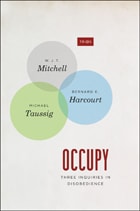
cover of Occupy: Three Inquiries in Disobedience

Occupy

Three Inquiries in Disobedience

W. J. T. Mitchell, Bernard E. Harcourt, and Michael Taussig

University of Chicago Press, 2013

Mic check! Mic check! Lacking amplification in Zuccotti Park, Occupy Wall Street protestors addressed one another by repeating and echoing speeches throughout the crowd. In Occupy, W. J. T. Mitchell, Bernard E. Harcourt, and Michael Taussig take the protestors’ lead and perform their own resonant call-and-response, playing off of each other in three essays that engage the extraordinary Occupy movement that has swept across the world, examining everything from self-immolations in the Middle East to the G8 crackdown in Chicago to the many protest signs still visible worldwide.
 
“You break through the screen like Alice in Wonderland,” Taussig writes in the opening essay, “and now you can’t leave or do without it.” Following Taussig’s artful blend of participatory ethnography and poetic meditation on Zuccotti Park, political and legal scholar Harcourt examines the crucial difference between civil and political disobedience. He shows how by effecting the latter—by rejecting the very discourse and strategy of politics—Occupy Wall Street protestors enacted a radical new form of protest. Finally, media critic and theorist Mitchell surveys the global circulation of Occupy images across mass and social media and looks at contemporary works by artists such as Antony Gormley and how they engage the body politic, ultimately examining the use of empty space itself as a revolutionary monument.
 
Occupy stands not as a primer on or an authoritative account of 2011’s revolutions, but as a snapshot, a second draft of history, beyond journalism and the polemics of the moment—an occupation itself.
[more]