Results by title
13 books match the query 'Disorder'
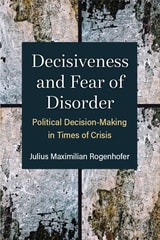
Decisiveness and Fear of Disorder
Political Decision-Making in Times of CrisisJulius Maximilian Rogenhofer
University of Michigan Press, 2024
Rogenhofer shows how his theoretical approach allows us to reinterpret a range of crisis situations beyond the irregular migration context, including democracies’ initial responses to Covid-19, the European Sovereign Debt Crisis, and United States climate politics. These additional case studies help position concerns with decisiveness amid the challenges that populism and technocracy increasingly pose to representative democracies.
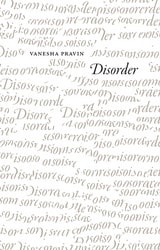
Disorder
Vanesha Pravin
University of Chicago Press, 2015
Cambridge, MA, 2008
Midsummer. Finally, you are used to disappointment.
A baby touches phlox. Many failures, many botched attempts,
A little success in unexpected forms. This is how the rest will go:
The gravel raked, bricks ashen, bees fattened–honey not for babes.
All at once, a rustling, whole trees in shudder, clouds pulled
Westward. You are neither here nor there, neither right nor
Wrong. The world is indifferent, tired of your insistence.
Garter snakes swallow frogs. The earthworms coil.
On your fingers, the residue of red pistils. What have you made?
What have you kept alive? Green, a secret, occult,
Grass veining the hands. Someone’s baby toddling.
And the phlox white. For now. Midsummer.
A remarkable first book, Disorder tells the story, by turns poignant and outrageous, of a family’s dislocation over four continents during the course of a hundred years. In short lyrics and longer narrative poems, Vanesha Pravin takes readers on a kaleidoscopic trek, from Bombay to Uganda, from England to Massachusetts and North Carolina, tracing the path of familial love, obsession, and the passage of time as filtered through the perceptions of family members and a host of supporting characters, including ubiquitous paparazzi, amorous vicars, and a dubious polygamist. We experience throughout a speaker forged by a deep awareness of intergenerational, multicontinental consciousness. At once global and personal, crossing ethnic, linguistic, and national boundaries in ways that few books of poetry do, Disorder bristles with quiet authority backed by a skeptical intelligence.

Disorder in the Court
Morality, Myth, and the Insanity DefenseAndrea L. Alden
University of Alabama Press, 2018
The first book-length rhetorical history and analysis of the legal and moral questions behind the insanity defense.
The insanity defense is considered one of the most controversial, most misunderstood, and least straightforward subjects in the American legal system. Disorder in the Court: Morality, Myth, and the Insanity Defense traces the US legal standards for the insanity defense as they have evolved from 1843, when they were first codified in England, to 1984, when the US government attempted to revise them through the Insanity Defense Reform Act. Throughout this period “insanity” existed primarily as a legal term rather than a medical one; yet the testimony of psychiatric experts is required in cases in which an insanity defense is raised.
The adjudication of such cases by courtroom practice is caught between two different but overlapping discourses, the legal and the medical, both of which have historically sought to assert and maintain firm disciplinary boundaries. Both expert and lay audiences have struggled to understand and apply commonplace definitions of sanity, and the portrayal of the insanity defense in popular culture has only served to further frustrate such understandings.
Andrea L. Alden argues that the problems with understanding the insanity defense are, at their foundation, rhetorical. The legal concept of what constitutes insanity and, therefore, an abdication of responsibility for one’s actions does not map neatly onto the mental health professions’ understandings of mental illness and how that affects an individual’s ability to understand or control his or her actions. Additionally, there are multiple layers of persuasion involved in any effort to convince a judge, jury—or a public, for that matter—that a defendant is or is not responsible for his or her actions at a particular moment in time.
Alden examines landmark court cases such as the trial of Daniel McNaughtan, Durham v. United States, and the trial of John Hinckley Jr. that signal the major shifts in the legal definitions of the insanity defense. Combining archival, textual, and rhetorical analysis, Alden offers a close reading of texts including trial transcripts, appellate court opinions, and relevant medical literature from the time period. She contextualizes these analyses through popular texts—for example, newspaper articles and editorials—showing that while all societies have maintained some version of mental illness as a mitigating factor in their penal systems, the insanity defense has always been fraught with controversy.
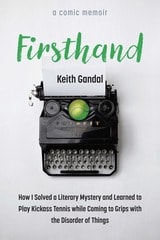
Firsthand
How I Solved a Literary Mystery and Learned to Play Kickass Tennis while Coming to Grips with the Disorder of ThingsKeith Gandal
University of Michigan Press, 2024
Keith Gandal combines this scholarly detective story with a comic personal narrative about how a midlife crisis accidentally sent him on a journey to write a research monograph that many in his profession—including at times himself—were dubious about. While researching how Hemingway, Fitzgerald, and Faulkner faced their forgotten crises of masculinity, Gandal discovers that his own crisis is instrumental to his creative process. Incorporating stories from Gandal’s comic romp through the hyper-competitive world of middle-aged men’s tennis, adopting pitbulls, and discussing Michel Foucault, Firsthand gives readers an inside look at how to acquire accurate knowledge—about the world, about history, and about oneself.

Law and Disorder in the Postcolony
Edited by Jean Comaroff and John L. Comaroff
University of Chicago Press, 2006
Are postcolonies haunted more by criminal violence than other nation-states? The usual answer is yes. In Law and Disorder in the Postcolony, Jean and John Comaroff and a group of respected theorists show that the question is misplaced: that the predicament of postcolonies arises from their place in a world order dominated by new modes of governance, new sorts of empires, new species of wealth—an order that criminalizes poverty and race, entraps the “south” in relations of corruption, and displaces politics into the realms of the market, criminal economies, and the courts.
As these essays make plain, however, there is another side to postcoloniality: while postcolonies live in states of endemic disorder, many of them fetishize the law, its ways and itsmeans. How is the coincidence of disorder with a fixation on legalities to be explained? Law and Disorder in the Postcolony addresses this question, entering into critical dialogue with such theorists as Benjamin, Agamben, and Bayart. In the process, it also demonstrates how postcolonies have become crucial sites for the production of contemporary theory, not least because they are harbingers of a global future under construction.
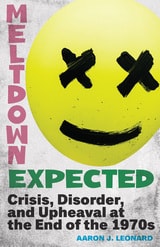
Meltdown Expected
Crisis, Disorder, and Upheaval at the end of the 1970sAaron J. Leonard
Rutgers University Press, 2024
Meltdown Expected tells the story of the power shifts from late 1978 through 1979 whose repercussions are still being felt. Iran’s revolution led to a hostage crisis while neighbouring Afghanistan became the site of a proxy war between the USSR and the US, who supplied aid to Islamic mujahideen fighters that would later form the Taliban. Meanwhile, as tragedies like the Jonestown mass suicide and the assassination of Harvey Milk captured the nation’s attention, the government quietly reasserted and expanded the FBI’s intelligence powers. Drawing from recently declassified government documents and covering everything from Three Mile Island to the rise of punk rock, Aaron J. Leonard paints a vivid portrait of a tumultuous yet pivotal time in American history.
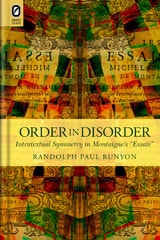
Order in Disorder
Intratextual Symmetry in Montaigne's “Essais”Randolph Paul Runyon
The Ohio State University Press, 2013
Order in Disorder: Intratextual Symmetry in Montaigne’s “Essais,” by Randolph Paul Runyon, offers a new answer to the question of how ordered the Essays may be. Following up on Montaigne’s likening them to a painter’s “grotesques” surrounding a central image, and seeing in this an allusion to the ancient Roman decorative style, rediscovered in the Renaissance, of symmetrical motifs on either side of a central image, Runyon uncovers an extensive network of symmetrical verbal echoes linking every chapter with another. Often two chapters of greatly different length and apparent importance (one on thumbs, for instance, balanced against one on the limits of human understanding) will in this way be brought together—not without, Runyon finds, an intended irony. The Essays emerge as even more self-reflexive than we thought, an amazingly intratextual work.

Panic Diaries
A Genealogy of Panic DisorderJackie Orr
Duke University Press, 2006
Orr, who has experienced panic attacks herself, kept a diary of her participation as a research subject in clinical trials for the Upjohn Company’s anti-anxiety drug Xanax. This “panic diary” grounds her study and suggests the complexity of her desire to track the diffusion and regulation of panic in U.S. society. Orr’s historical research, theoretical reflections, and biographical narrative combine in this remarkable and compelling genealogy, which documents the manipulation of panic by the media, the social sciences and psychiatry, the U.S. military and government, and transnational drug companies.
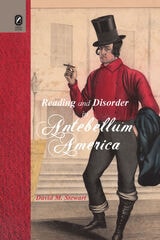
Reading and Disorder in Antebellum America
David M. Stewart
The Ohio State University Press, 2011

Roots of Disorder
Race and Criminal Justice in the American South, 1817-80Christopher Waldrep
University of Illinois Press, 1998
"Delivers what no other study has yet attempted. . . . Waldrep's book is one of the first systematically to use local trial data to explore questions of society and culture." -- Vernon Burton, author of "A Gentleman and an Officer": A Social and Military History of James B. Griffin's Civil War
Sentient Flesh
Thinking in Disorder, Poiesis in BlackR. A. Judy
Duke University Press, 2020

Terms of Disorder
Keywords for an InterregnumAlberto Toscano
Seagull Books, 2023
There is widespread agreement, across a voluble political spectrum and around the planet, that we live in times of intensifying insecurity and turmoil. If ours is an age of transition, its direction is anything but certain. Momentous transformations in ecology, geopolitics, and everyday life are shadowed by a suffocating sense of stasis. The limits to capital and the limits of nature are entangled in frightful ways, while the profoundly obsolete form of leadership, domination, and conflict exacerbate an already baleful situation. And yet struggles for liberation have not been quelled. Terms of Disorder confronts this moment by probing some of the defining terms in the modern vocabulary of emancipation, with the aim of testing their capacity to name and orient collective action set on abolishing the present state of things. Ranging from communism to leadership, the eleven keywords addressed in this book provide a set of interlocking points of entry into the common task of forging a political language capable of navigating our disorientation. If, as Gramsci famously noted, the interregnum is a time when the new struggles to be born while the old order is moribund, we may wish to heed Cedric Robinson’s call to “choose wisely among the dying.”
Wild Things
The Disorder of DesireJack Halberstam
Duke University Press, 2020