Results by title
5 books match the query 'Displacement (Psychology) in literature'
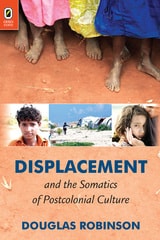
Displacement and the Somatics of Postcolonial Culture
Douglas Robinson
The Ohio State University Press, 2013
Displacement and the Somatics of Postcolonial Culture is Douglas Robinson’s study of postcolonial affect—specifically, of the breakdown of the normative (regulatory) circulation of affect in the refugee experience and the colonial encounter, the restructuring of that regulatory circulation in colonization, and the persistence of that restructuring in decolonization and intergenerational trauma. Robinson defines “somatics” as a cultural construction of “reality” and “identity” through the regulatory circulation of evaluative affect. This book is divided into three essays covering the refugee experience, colonization and decolonization, and intergenerational trauma. Each essay contains a review of empirical studies of its main topic, a study of literary representations of that topic, and a study of postcolonial theoretical spins. The literary representations in the refugee essay are a novel and short story by the Haitian writer Edwidge Danticat; in the colonization essay a short film by Javier Fesser and a novella by Mahasweta Devi (translated by Gayatri Chakravorty Spivak); and in the intergenerational trauma essay novels by James Welch and Toni Morrison and a short story by Percival Everett. The first essay’s theoretical spins include Deleuze and Guattari on nomad thought and Iain Chambers on migrancy; the second’s, Nietzsche’s Genealogy of Morals and theories of postcolonial affect in Bhabha and Spivak; the third’s, work on historical trauma by Cathy Caruth and Dominic LaCapra.
[more]
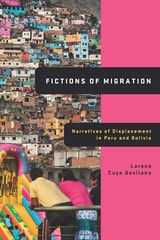
Fictions of Migration
Narratives of Displacement in Peru and BoliviaLorena Cuya Gavilano
The Ohio State University Press, 2021
Lorena Cuya Gavilano’s Fictions of Migration: Narratives of Displacement in Peru and Bolivia is an aesthetic and cultural analysis of how political and economic trends have impacted narratives about migration in Peru and Bolivia in the late twentieth and early twenty-first centuries. Going beyond representations of migrants as subjects of crisis, Fictions of Migration approaches the migrant as a subject of knowledge, examining how narratives of migrancy in the Andes have become affective epistemological tools to learn about migrants’ experiences, cultural roots, and the mishaps of modernity that caused their displacement in the first place. Through the examination of films and novels—by such writers and filmmakers as José María Arguedas, Blanca Wiethüchter, Daniel Alarcón, Claudia Llosa, Jorge Sanjinés, Juan Carlos Valdivia, Jesús Urzagasti, and Paolo Agazzi, among others–Cuya Gavilano looks at the intersection of crisis, knowledge, and affect in order to piece together seemingly incompatible images of migrancy. She explores how dissimilar images of migration in two countries with a common ethnic and cultural history are the result of differentiated emotional and social responses to the adoption and adaptation of neoliberal economic agendas. Fictions of Migration thereby shows Andean stories of displacement can serve as distinctive models to understand multiethnic national spaces globally.
[more]
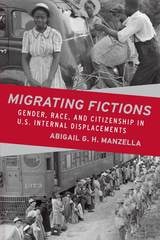
Migrating Fictions
Gender, Race, and Citizenship in U.S. Internal DisplacementsAbigail G. H. Manzella
The Ohio State University Press, 2018
Winner, 2021 Society for the Study of American Women Writers Book Award
Winner, 2021 CCCC Outstanding Book Award
Migrating Fictions analyzes the role of race, gender, and citizenship in the major internal displacements of the 20th century in history and in narrative. Surveying the particular tactics employed by the United States during the Great Migration, the Dust Bowl, the Japanese American incarceration, and the migrant labor of the Southwest, Abigail G. H. Manzella reveals how the country’s past is imbued with governmentally (en)forced movements that diminished access to full citizenship rights for the laboring class, people of color, and women.
This work is the first book-length study to examine all of these movements together along with their literature, including Zora Neale Hurston’s Their Eyes Were Watching God, Sanora Babb’s Whose Names Are Unknown, Julie Otsuka’s When the Emperor Was Divine, Helena María Viramontes’s Under the Feet of Jesus, and Jesmyn Ward’s Salvage the Bones. Manzella shows how the United States’ history of spatial colonization within its own borders extends beyond isolated incidents into a pattern based on ideology about nation-building, citizenship, and labor. This book seeks to theorize a Thirdspace, an alternate location for social justice that acknowledges the precarity of the internally displaced person.
[more]
Novels of Displacement
Fiction in the Age of Global CapitalMarco Codebò
The Ohio State University Press, 2020
In Novels of Displacement: Fiction in the Age of Global Capital, Marco Codebò assesses the state of fiction in our time, an age defined by the combined hegemony of global capital and software. Codebò argues that present-day displacement originates in the dualism of power that pervades our polarized society and in the sweeping deterritorialization that is affecting people, objects, and signs. As the ties between subjectivity and territory break, being in the world means being displaced. Rather than narrating how subjectivity can mark a place, novels of displacement convey the crisis of subjectivity’s connection to place.
Using four works as case studies—Bernardo Carvalho’s Nove noites, Daniel Sada’s Porque parece mentira la verdad nunca se sabe, Zadie Smith’s White Teeth, and Mathias Énard’s Zone—Codebò investigates how globalization, displacement, and technology inform our understanding of subjectivity and one’s place in the world. Coming from different literary traditions––Brazilian-Portuguese, Spanish, English, and French–– Novels of Displacement traces the development of displacement caused by organized crime, migration, and war. Ultimately what emerges from this study is evidence of how cultures of untruth damage but do not destroy human agency.
Using four works as case studies—Bernardo Carvalho’s Nove noites, Daniel Sada’s Porque parece mentira la verdad nunca se sabe, Zadie Smith’s White Teeth, and Mathias Énard’s Zone—Codebò investigates how globalization, displacement, and technology inform our understanding of subjectivity and one’s place in the world. Coming from different literary traditions––Brazilian-Portuguese, Spanish, English, and French–– Novels of Displacement traces the development of displacement caused by organized crime, migration, and war. Ultimately what emerges from this study is evidence of how cultures of untruth damage but do not destroy human agency.
[more]
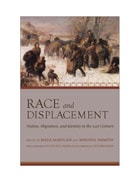
Race and Displacement
Nation, Migration, and Identity in the Twenty-First CenturyEdited by Maha Marouan and Merinda Simmons
University of Alabama Press, 2013
Race and Displacement captures a timely set of discussions about the roles of race in displacement, forced migrations, nation and nationhood, and the way continuous movements of people challenge fixed racial definitions.
The multifaceted approach of the essays in Race and Displacement allows for nuanced discussions of race and displacement in expansive ways, exploring those issues in transnational and global terms. The contributors not only raise questions about race and displacement as signifying tropes and lived experiences; they also offer compelling approaches to conversations about race, displacement, and migration both inside and outside the academy. Taken together, these essays become a case study in dialogues across disciplines, providing insight from scholars in diaspora studies, postcolonial studies, literary theory, race theory, gender studies, and migration studies.
The contributors to this volume use a variety of analytical and disciplinary methodologies to track multiple articulations of how race is encountered and defined. The book is divided by editors Maha Marouan and Merinda Simmons into four sections: “Race and Nation” considers the relationships between race and corporality in transnational histories of migration using literary and oral narratives. Essays in “Race and Place” explore the ways spatial mobility in the twentieth century influences and transforms notions of racial and cultural identity. Essays in “Race and Nationality” address race and its configuration in national policy, such as racial labeling, federal regulations, and immigration law. In the last section, “Race and the Imagination” contributors explore the role imaginative projections play in shaping understandings of race.
Together, these essays tackle the question of how we might productively engage race and place in new sociopolitical contexts. Tracing the roles of "race" from the corporeal and material to the imaginative, the essays chart new ways that concepts of origin, region, migration, displacement, and diasporic memory create understandings of race in literature, social performance, and national policy.
Contributors: Regina N. Barnett, Walter Bosse, Ashon T. Crawley, Matthew Dischinger, Melanie Fritsh, Jonathan Glover, Delia Hagen, Deborah Katz, Kathrin Kottemann, Abigail G.H. Manzella, Yumi Pak, Cassander L. Smith, Lauren Vedal
[more]