Results by title
18 books match the query 'Dispossession'
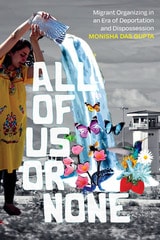
All of Us or None
Migrant Organizing in an Era of Deportation and DispossessionMonisha Das Gupta
Duke University Press, 2024

Bordering Blackness
Migration and Dispossession in the Afro-MediterraneanLeslie Gross-Wyrtzen
Duke University Press, 2027
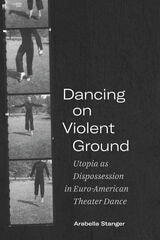
Dancing on Violent Ground
Utopia as Dispossession in Euro-American Theater DanceArabella Stanger
Northwestern University Press, 2021
Developing a new theory of choreographic space, Arabella Stanger shows how embodied forms of hope promised in ballet and progressive dance modernisms conceal and depend on spatial operations of imperial, colonial, and racial subjection. Stanger unearths dance’s violent ground by interrogating the expansionist fantasies of Marius Petipa’s imperial ballet, settler colonial and corporate land practices in the modern dance of Martha Graham and George Balanchine, reactionary discourses of the human in Rudolf von Laban’s and Oskar Schlemmer’s movement geometries; Merce Cunningham’s experimentalism as a white settler fantasy of the land of the free, and the imperial amnesia of Boris Charmatz’s interventions into metropolitan museums. Drawing on materialist thought, critical race theory, and indigenous studies, Stanger ultimately advocates for dance studies to adopt a position of “critical negativity,” an analytical attitude attuned to how dance’s exuberant modeling of certain forms of life might provide cover for life-negating practices. Bold in its arguments and rigorous in its critique, Dancing on Violent Ground asks how performance scholars can develop a practice of thinking hopefully, without expunging history from their site of analysis.
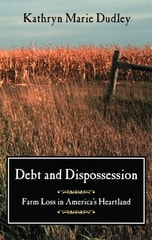
Debt and Dispossession
Farm Loss in America's HeartlandKathryn Marie Dudley
University of Chicago Press, 2000
The farm crisis of the 1980s was the worst economic disaster to strike rural America since the Depression—thousands of farmers lost their land and homes, irrevocably altering their communities and, as Kathryn Marie Dudley shows, giving rise to devastating social trauma that continues to affect farmers today. Through interviews with residents of an agricultural county in western Minnesota, Dudley provides an incisive account of the moral dynamics of loss, dislocation, capitalism, and solidarity in farming communities.

Dispossession
Plundering German Jewry, 1933-1953Christoph Kreutzmüller and Jonathan R. Zatlin, Editors
University of Michigan Press, 2020
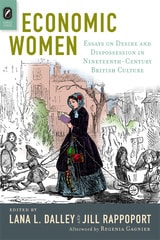
Economic Women
Essays on Desire and Dispossession in Nineteenth-Century British CultureEdited by Lana L. Dalley and Jill Rappoport
The Ohio State University Press, 2013

Indigenomicon
American Indians, Video Games, and the Structures of DispossessionJodi A. Byrd
Duke University Press, 2025
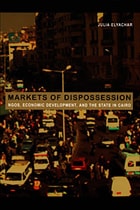
Markets of Dispossession
NGOs, Economic Development, and the State in CairoJulia Elyachar
Duke University Press, 2005
Julia Elyachar studied the efforts of bankers, social scientists, ngo members, development workers, and state officials to turn the craftsmen and unemployed youth of Cairo into the vanguard of a new market society based on microenterprise. She considers these efforts in relation to the alternative notions of economic success held by craftsmen in Cairo, in which short-term financial profit is not always highly valued. Through her careful ethnography of workshop life, Elyachar explains how the traditional market practices of craftsmen are among the most vibrant modes of market life in Egypt. Long condemned as backward, these existing market practices have been seized on by social scientists and development institutions as the raw materials for experiments in “free market” expansion. Elyachar argues that the new economic value accorded to the cultural resources and social networks of the poor has fueled a broader process leading to their economic, social, and cultural dispossession.
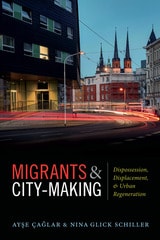
Migrants and City-Making
Dispossession, Displacement, and Urban RegenerationAyse Caglar and Nina Glick Schiller
Duke University Press, 2018

Post-Soviet Chaos
Violence and Dispossession in KazakhstanJoma Nazpary
Pluto Press, 2001
Rhythm
Form and DispossessionVincent Barletta
University of Chicago Press, 2020
Vincent Barletta explores rhythm through three historical moments, each addressing it as a phenomenon that transcends poetry, aesthetics, and even temporality. He reveals rhythm to be a power that holds us in place, dispossesses us, and shapes the foundations of our world. In these moments, Barletta encounters rhythm as a primordial and physical binding force that establishes order and form in the ancient world, as the anatomy of lived experience in early modern Europe, and as a subject of aesthetic and ethical questioning in the twentieth century.
A wide-ranging book covering a period spanning two millennia and texts from over ten languages, Rhythm will expand the conversation around this complex and powerful phenomenon.
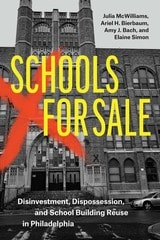
Schools for Sale
Disinvestment, Dispossession, and School Building Reuse in PhiladelphiaJulia McWilliams, Ariel H. Bierbaum, Amy J. Bach and Elaine Simon
University of Chicago Press, 2026
School districts across the United States have closed thousands of schools since 2000 to cope with chronic underfunding and budget crises, declining enrollment, and poorly maintained buildings. Our knowledge about school closures has focused on battles over closure decision-making and the impacts of closing schools on communities of color in the immediate aftermath of these decisions. But what of the large, sometimes magisterial, formerly public spaces once at the center of community life? How do these now vacant buildings change daily life in the surrounding neighborhood?
In Schools for Sale, Julia McWilliams, Ariel H. Bierbaum, Amy J. Bach, and Elaine Simon examine how school closures change the spatial and social arrangements of neighborhoods. Following a series of school closures in Philadelphia, the authors draw from research in urban studies, education, planning, and geography to explain how race, place, and capital merge to influence the trajectory of closed schools in Black and Brown communities and their surrounding neighborhoods. Some closed schools are repurposed as charter schools, upending the role those buildings have historically played in bringing communities together. Other buildings are sold for commercial development, caught up in cycles of gentrification even as developers foster programs to support community members. Others are left vacant or are demolished in the heart of their neighborhoods, decisions that reflect not only disinvestment in Black communities but the sobering reality of environmental racism.
Drawing needed attention to one of the significant consequences of school closures, Schools for Sale imparts a deeper understanding of the connections between place, race, and education amid broader urban transformations, prompting us to consider how school districts can work toward a new vision for public education and community development.
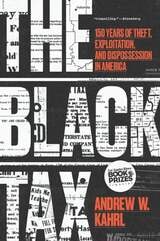
The Black Tax
150 Years of Theft, Exploitation, and Dispossession in AmericaAndrew W. Kahrl
University of Chicago Press, 2024
American taxation is unfair, and it is most unfair to the very people who critically need its support. Not only do taxpayers with fewer resources—less wealth, power, and land—pay more than the well-off, but they are forced to fight for their rights within an unjust system that undermines any attempts to improve their position or economic standing. In The Black Tax, Andrew W. Kahrl reveals the shocking history and ruinous consequences of inequitable and predatory tax laws in this country—above all, widespread and devastating racial dispossession.
Throughout the twentieth century, African Americans acquired substantial amounts of property nationwide. But racist practices, obscure processes, and outright theft diminished their holdings and their power. Of these, Kahrl shows, few were more powerful, or more quietly destructive, than property taxes. He examines all the structural features and hidden traps within America’s tax system that have forced Black Americans to pay more for less and stripped them of their land and investments, and he reveals the staggering cost. The story of America’s now enormous concentration of wealth at the top—and the equally enormous absence of wealth among most Black households—has its roots here.
Kahrl exposes the painful history of these practices, from Reconstruction up to the present, and tells, for the first time, the story of Black Americans’ experiences as taxpayers and their fight for a more fair and equitable system for raising and spending the public’s money. This is a history that deepens our understanding of the disadvantages and persistent inequalities that African American households continue to face and reveals hidden engines of economic inequality in America. Detailing the hows and whys of America’s profoundly unequal tax system, The Black Tax equips readers with the knowledge needed to combat inequality and injustice today.

The Black Tax
150 Years of Theft, Exploitation, and Dispossession in AmericaAndrew W. Kahrl
University of Chicago Press, 2024
Revealing a history that is deep, broad, and infuriating, The Black Tax casts a bold light on the racist practices long hidden in the shadows of America’s tax regimes.
American taxation is unfair, and it is most unfair to the very people who critically need its support. Not only do taxpayers with fewer resources—less wealth, power, and land—pay more than the well-off, but they are forced to fight for their rights within an unjust system that undermines any attempts to improve their position or economic standing. In The Black Tax, Andrew W. Kahrl reveals the shocking history and ruinous consequences of inequitable and predatory tax laws in this country—above all, widespread and devastating racial dispossession.
Throughout the twentieth century, African Americans acquired substantial amounts of property nationwide. But racist practices, obscure processes, and outright theft diminished their holdings and their power. Of these, Kahrl shows, few were more powerful, or more quietly destructive, than property taxes. He examines all the structural features and hidden traps within America’s tax system that have forced Black Americans to pay more for less and stripped them of their land and investments, and he reveals the staggering cost. The story of America’s now enormous concentration of wealth at the top—and the equally enormous absence of wealth among most Black households—has its roots here.
Kahrl exposes the painful history of these practices, from Reconstruction up to the present, and tells, for the first time, the story of Black Americans’ experiences as taxpayers and their fight for a more fair and equitable system for raising and spending the public’s money. This is a history that deepens our understanding of the disadvantages and persistent inequalities that African American households continue to face and reveals hidden engines of economic inequality in America. Detailing the hows and whys of America’s profoundly unequal tax system, The Black Tax equips readers with the knowledge needed to combat inequality and injustice today.
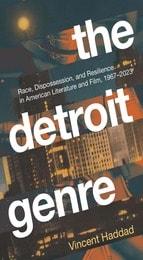
The Detroit Genre
Race, Dispossession, and Resilience in American Literature and Film, 1967-2023Vincent Haddad
Lever Press, 2024
The book first establishes the concept of the “Detroit genre” that emerged in late 1960s and traces the tropes of this white-centric narrative genre in popular culture, touching on key texts including Blue Collar, Robocop, The Crow, It Follows, and Barbarian. The second part shows how Black writers, including Alice Randall, adrienne maree brown, Stephen Mack Jones, and Angela Flournoy, reclaimed and revised the Detroit genre by un-fixing Detroit narratives of dispossession, criminality, and industrial and social failure through formal experimentations on genre itself.
Where Detroit has typically been painted in the news as one of three things—the center of the automotive industry; crime-ridden and in ruins; or as a “blank canvas” with limitless potential of entrepreneurship—Vincent Haddad shows that the Detroit genre in literature and film can be far more powerful than news media in narrating Black dispossession as a pragmatic, even liberal consensus. The texts studied here condition forgetfulness about Detroit’s history or expose it to a full reckoning, direct attention toward or away from the city’s agents of injustice, fetishize resilience or model resistance, and foreclose or imagine a future of Black liberation. Appealing to scholars of popular literature, media, race, and American studies, The Detroit Genre is an accessible and engaging study of the city’s influence on a wide array of genres in pop culture.
The Terms of Our Surrender
Colonialism, Dispossession and the Resistance of the InnuElizabeth Cassell
University of London Press, 2021
Based on extensive fieldwork and oral history, The Terms of Our Surrender is a powerful critical appraisal of unceded indigenous land ownership in eastern Canada. Set against an ethnographic, historical, and legal framework, this book traces the myriad ways the Canadian state has evaded the 1763 Royal Proclamation that guaranteed First Nations people a right to their land and way of life.
Focusing on the Innu of Quebec and Labrador, whose land has been taken for resource extraction and development, this book strips back the law of fiduciary duty to its origins. The Terms of Our Surrender argues for the preservation of land ownership and positions First Nations people as natural land defenders amidst a devastating climate crisis. This volume offers a voice to the Innu people, detailing the spirituality practices, culture, and values that make it impossible for them to willingly cede their land.
This book is intended to bridge the gap in knowledge between legal practitioners and those working at the intersections of human rights, social work, and public policy. It offers a potent template for using the law to fight back against the indignities suffered by indigenous communities.
Theft Is Property!
Dispossession and Critical TheoryRobert Nichols
Duke University Press, 2020
Violent Utopia
Dispossession and Black Restoration in TulsaJovan Scott Lewis
Duke University Press, 2022