Results by title
8 books match the query 'Dissenters in literature'
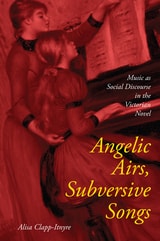
Angelic Airs, Subversive Songs
Music as Social Discourse in the Victorian NovelAlisa Clapp-Itnyre
Ohio University Press, 2027
Music was at once one of the most idealized and one of the most contested art forms of the Victorian period. Yet this vitally important nineteenth-century cultural form has been studied by literary critics mainly as a system of thematic motifs. Angelic Airs, Subversive Songs positions music as a charged site of cultural struggle, promoted concurrently as a transcendent corrective to social ills and as a subversive cause of those ills. Alisa Clapp-Itnyre examines Victorian constructions of music to advance patriotism, Christianity, culture, and domestic harmony, and suggests that often these goals were undermined by political tensions in song texts or “immoral sensuality” in the “spectacle” of live music-making. Clapp-Itnyre turns her focus to the novels of Elizabeth Gaskell, George Eliot, and Thomas Hardy, who present complex engagements with those musical genres most privileged by Victorian society: folk songs, religious hymns, and concert music. Angelic Airs, Subversive Songs recovers the pervasive ambiguities of the Victorian musical period, ambiguities typically overlooked by both literary scholars and musicologists. To the literary critic and cultural historian, Clapp-Itnyre demonstrates the necessity of further exploring the complete aesthetic climate behind some of the Victorian period’s most powerful literary works. And to the feminist scholar and the musicologist, Clapp-Itnyre reveals the complexities of music as both an oppressive cultural force and an expressive, creative outlet for women.

CONTESTED CASTLE
GOTHIC NOVELS AND THE SUBVERSION OF DOMEKate Ferguson Ellis
University of Illinois Press, 1989
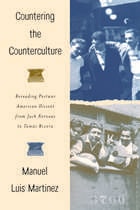
Countering the Counterculture
Rereading Postwar American Dissent from Jack Kerouac to Tomás RiveraManuel Luis Martinez
University of Wisconsin Press, 2003
Rebelling against bourgeois vacuity and taking their countercultural critique on the road, the Beat writers and artists have long symbolized a spirit of freedom and radical democracy. Manuel Martinez offers an eye-opening challenge to this characterization of the Beats, juxtaposing them against Chicano nationalists like Raul Salinas, Jose Montoya, Luis Valdez, and Oscar Acosta and Mexican migrant writers in the United States, like Tomas Rivera and Ernesto Galarza.
In an innovative rereading of American radical politics and culture of the 1950s and 1960s, Martinez uncovers reactionary, neoromantic, and sometimes racist strains in the Beats’ vision of freedom, and he brings to the fore the complex stances of Latinos on participant democracy and progressive culture. He analyzes the ways that Beats, Chicanos, and migrant writers conceived of and articulated social and political perspectives. He contends that both the Beats’ extreme individualism and the Chicano nationalists’ narrow vision of citizenship are betrayals of the democratic ideal, but that the migrant writers presented a distinctly radical and inclusive vision of democracy that was truly countercultural.

Dreaming Revolution
Transgression in the Development of American RomanceScott Bradfield
University of Iowa Press, 1993
Dreaming Revolution usefully employs current critical theory to address how the European novel of class revolt was transformed into the American novel of imperial expansion. Bradfield shows that early American romantic fiction—including works by William Godwin, Charles Brockden Brown, James Fenimore Cooper, and Edgar Allan Poe—can and should be considered as part of a genre too often limited to the nineteenth-century European novel. In a spirited discussion of the works from these four authors, Bradfield argues that Americans take the class dynamics of the European psychological novel and apply them to the American landscape, reimagining psychological spaces as geographical ones.
Lewd and Notorious
Female Transgression in the Eighteenth CenturyKatharine Kittredge, Editor
University of Michigan Press, 2003
Rhetoric and Resistance
The Literary Arts of Dissent in Nineteenth-Century BritainMaeve Adams
Ohio University Press, 2025
A fresh perspective on the enduring relationship between literature, democracy, and dissent
Rhetoric and Resistance explores the transformative role of nineteenth-century literature in shaping modern concepts and practices of democratic dissent. By examining the works of Romantic and Victorian novelists, poets, and journalists, Maeve Adams identifies origins of modern theories and practices of resistance in nineteenth-century literary forms. Offering a literary history of dissent, the book recovers the intertwined development of democracy and aesthetics, revealing how narrative form became a potent tool for challenging authority.
Tracing the lineage of dissent from the radical fiction and journalism of the 1800s to contemporary movements like #MeToo, Adams offers a genealogy that highlights how literary texts experimented with political power, granting new and consequential voices to working-class individuals, women, colonized peoples, and other marginalized groups.
Adams takes an interdisciplinary approach, weaving together close readings of works by Thomas De Quincey, Walter Scott, Elizabeth Gaskell, and H. G. Wells, as well as lesser-known journalists, with insights from modern moral and political philosophy. Drawing on theories of democratic ethics and justice from scholars such as Miranda Fricker, Sharon Krause, Martha Nussbaum, and Philip Pettit, the book bridges literary history and contemporary debates about political agency and expression.
The Plight of Feeling
Sympathy and Dissent in the Early American NovelJulia A. Stern
University of Chicago Press, 1997
Stern argues that these novels gave voice to a collective mourning over the violence of the Revolution and the foreclosure of liberty for the nation's noncitizens—women, the poor, Native and African Americans. Properly placed in the context of late eighteenth-century thought, the republican novel emerges as essentially political, offering its audience gothic and feminized counternarratives to read against the dominant male-authored accounts of national legitimation.
Drawing upon insights from cultural history and gender studies as well as psychoanalytic, narrative, and genre theory, Stern convincingly exposes the foundation of the republic as an unquiet crypt housing those invisible Americans who contributed to its construction.
The Suburb of Dissent
Cultural Politics in the United States and Canada during the 1930sCaren Irr
Duke University Press, 1998
Irr highlights works by Richard Wright, John Dos Passos, Nathanael West, and others to uncover the complex relationship between American anti-communism and communist anti-Americanism. In an unprecedented move, she extends her inquiry to the work of Canadian intellectuals such as Dorothy Livesay and Hugh MacLennan to reveal the important yet overlooked fact that the territory at the border of the United States and Canada provided a vital contact zone and transnational “home” for leftist thinkers. Attending to intersections of race, ethnicity, and gender, Irr illustrates the ways dissenting writers made culture actively respond to the political crises of the Great Depression and questioned the nature of what it means to be “American.”
Drawing on insights from postcolonial and American studies and taking into account the intellectual and cultural dimensions of leftist politics, The Suburb of Dissent is the first study of the 1930s to bring together U.S. and Canadian writings. In doing so, it reveals how the unique culture of the left contributed to North American history at this critical juncture and beyond.