Results by title
6 books match the query 'District courts'
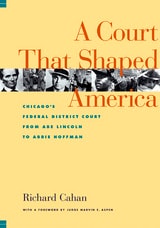
A Court That Shaped America
Chicago's Federal District Court from Abe Lincoln to Abbie HoffmanRichard Cahan
Northwestern University Press, 2002
A Court That Shaped America traces the flesh-and-blood courtroom scenes from the district's first cases in the early nineteenth century through the turn of the millennium. Historical figures—including Mormon leader Joseph Smith, inventor Thomas Edison, and author Mark Twain—as well as contemporary superstars like Michael Jackson and Oprah Winfrey have all had their day in the Northern Illinois court. Some were victorious; some came out scathed. This book examines these great trials and the people behind them to offer a unique look at Chicago and U.S. history.
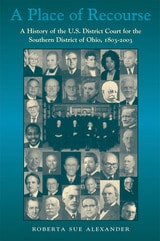
A Place of Recourse
A History of the U.S. District Court for the Southern District of Ohio, 1803–2003Roberta Sue Alexander
Ohio University Press, 2005
The first history of a federal district court in a midwestern state, A Place of Recourse explains a district court’s function and how its mission has evolved. The court has grown from an obscure institution adjudicating minor debt and land disputes to one that plays a central role in the political, economic, and social lives of southern Ohioans.
In tracing the court’s development, Alexander explores the central issues confronting the district court judges during each historical era. She describes how this court in a non-slave state responded to fugitive slave laws and how a court whose jurisdiction included a major coal-mining region responded to striking workers and the unionization movement. The book also documents judicial responses to Prohibition, New Deal legislation, crime, mass tort litigation, and racial desegregation.
The history of a court is also the history of its judges. Accordingly, Alexander provides historical insight on current and past judges. She details behind-the-scenes maneuvers in judicial appointments and also the creativity some judges displayed on the bench—such as Judge Leavitt, who adopted admiralty law to deal with the problems of river traffic.
A Place of Recourse demonstrates that, at least in the Southern District of Ohio, the federal district court has played the role its creators hoped it would—upholding federal law even when the citizens of the region actively opposed such enforcement.
It's Not Personal
Politics and Policy in Lower Court Confirmation HearingsLogan Dancey, Kjersten R. Nelson, and Eve M. Ringsmuth
University of Michigan Press, 2020
In order to be confirmed to a lifetime appointment on the federal bench, all district and circuit court nominees must appear before the Senate Judiciary Committee for a confirmation hearing. Despite their relatively low profile, these lower court judges make up 99 percent of permanent federal judgeships and decide cases that relate to a wide variety of policy areas. To uncover why senators hold confirmation hearings for lower federal court nominees and the value of these proceedings more generally, the authors analyzed transcripts for all district and circuit court confirmation hearings between 1993 and 2012, the largest systematic analysis of lower court confirmation hearings to date. The book finds that the time-consuming practice of confirmation hearings for district and circuit court nominees provides an important venue for senators to advocate on behalf of their policy preferences and bolster their chances of being re-elected. The wide variation in lower court nominees’ experiences before the Judiciary Committee exists because senators pursue these goals in different ways, depending on the level of controversy surrounding a nominee. Ultimately, the findings inform a (re)assessment of the role hearings play in ensuring quality judges, providing advice and consent, and advancing the democratic values of transparency and accountability.
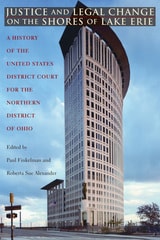
Justice and Legal Change on the Shores of Lake Erie
A History of the United States District Court for the Northern District of OhioPaul Finkelman
Ohio University Press, 2012
Justice and Legal Change on the Shores of Lake Erie explores the many ways that the United States District Court for the Northern District of Ohio has affected the region, the nation, the development of American law, and American politics.
The essays in this book, written by eminent law professors, historians, political scientists, and practicing attorneys, illustrate the range of cases and issues that have come before the court. Since the court’s inception in 1855, judges have influenced economic developments and social issues, beginning with the court’s most famous early case, involving the rescue of the fugitive slave John Price by residents of Northern Ohio. Chapters focusing on labor strikes, free speech, women’s rights, the environment, the death penalty, and immigration illustrate the impact this court and its judges have had in the development of society and the nation’s law. Some of the cases here deal with local issues with huge national implications xad—like political corruption, school desegregation, or pollution on the Cuyahoga River. But others are about major national issues that grew out of incidents, such as the prosecution of Eugene V. Debs for opposing World War I, the litigation resulting from the Kent State shootings and opposition to the Vietnam War, and the immigration status of the alleged Nazi war criminal John Demyanjuk.
This timely history confirms the significant role played by district courts in the history of the United States.
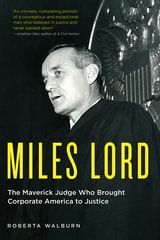
Miles Lord
The Maverick Judge Who Brought Corporate America to JusticeRoberta Walburn
University of Minnesota Press, 2017
The life of a crusading federal judge who stood up and fought for “the little guy”
This is the story of Miles Lord (1919–2016), who rose from humble beginnings on Minnesota’s Iron Range to become one of the most colorful and powerful judges in the country, described as “an unabashed Prairie populist” and “a live-wire slayer of corporate behemoths.” He cut a wide swath through history on his path to the bench: coming of age alongside a cadre of young Midwestern social-gospel progressives, including Hubert H. Humphrey, Eugene McCarthy, and Walter Mondale, in the days before they reached national fame; teaming with Bobby Kennedy as a hotshot prosecutor in pursuit of Jimmy Hoffa; and serving as the secret envoy between his friends Hubert and Eugene in their battle for the soul of the Democratic party in the historic 1968 presidential campaign. Later, after donning his black robe, he reshaped jurisprudence with precedent-breaking rulings—on issues ranging from women’s rights to consumer protection to education reform—and breaking trail when he ordered the shutdown of the Reserve Mining Company in northern Minnesota, which was spewing its waste into Lake Superior, in the most sensational trial of the early environmental era.
One of Judge Lord’s landmark cases—and interlaced as a centerpiece narrative of this book—involved the Dalkon Shield intrauterine device, which caused horrific infections in thousands of women, resulting in infertility and sometimes death. Author Roberta Walburn served as the judge’s law clerk during that litigation in 1983–84, and she provides a page-turning account (both an insider’s view and an in-depth chronicle) of what was called “one of the most disastrous episodes of American corporate misconduct.” In the end, more than 200,000 women received nearly $3 billion in compensation, and the Fortune 500 defendant was left in ruins. But Judge Lord was hauled up on judicial misconduct charges for his no-holds-barred actions that were certainly provocative but also stand as a timely reminder, even (or especially) today, of the challenges in balancing the scales of justice for a legal system that too often skews to the rich and powerful.
The author deftly weaves the Dalkon Shield drama into the larger story of the life of a one-of-a-kind man, crafting a sweeping and spirited true-life tale with not only her first-hand experiences as the judge’s law clerk but also with unrestricted access to the judge’s personal files. This is a rare and compelling portrait of a remarkable man and his place in both Minnesota and U.S. history.
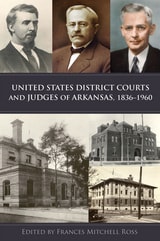
United States District Courts and Judges of Arkansas, 1836–1960
Frances Mitchell Ross
University of Arkansas Press, 2016
The book begins with statehood and continues with Congress’s decision to expand jurisdiction of the original 1836 District Court of Arkansas to include the vast Indian Territory to the west. The territory’s formidable size and rampant lawlessness brought in an overwhelming number of cases. The situation was only somewhat mitigated in 1851, when Congress split the state into eastern and western districts, which were still served by just one judge who travelled between the two courts.
A new judgeship for the Western District was created in 1871, and new seats for that court were established, but it wasn’t until 1896 that Congress finally ended all jurisdiction of Arkansas’s Western District Court over the Indian Territory.
Contributors to this collection include judges, practicing attorneys, academics, and thoughtful and informed family members who reveal how the judges made decisions on issues involving election laws, taxes, civil rights, railroads, liquor and prohibition, quack medicine, gangsters, bankruptcy, personal injury, the draft and Selective Service, school desegregation, prisons, and more. United States District Courts and Judges of Arkansas, 1836–1960 will be of value to anyone interested in Arkansas history—particularly Arkansas legal and judicial history as it relates to the local and national issues that came before these judges.
This project was supported in part by the United States District Court for the Eastern District of Arkansas and the United States District Court for the Western District of Arkansas.