Results by title

2 books match the query 'Divided World'

cover of A Divided World: Hollywood Cinema and Emigré Directors in the Era of Roosevelt and Hitler, 1933-1948

A Divided World

Hollywood Cinema and Emigré Directors in the Era of Roosevelt and Hitler, 1933-1948

Nick Smedley

Intellect Books, 2011

The New Deal introduced sweeping social, political, and cultural change across the United States, which Hollywood embraced enthusiastically. Then, when the heady idealism of the 1930s was replaced by the paranoia of the postwar years, Hollywood became an easy target for the anticommunists. A Divided World examines some of the important programs of the New Deal and the subsequent response of the film community—especially in relation to social welfare, women’s rights, and international affairs. The book also provides an analysis of the major works of three European directors—Billy Wilder, Ernst Lubitsch, and Fritz Lang—compared and contrasted with the products of mainstream Hollywood. This is a new interpretation of an influential period in American film history and it is sure to generate further debate and scholarship.
[more]
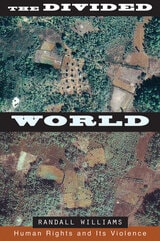
cover of The Divided World: Human Rights and Its Violence

The Divided World

Human Rights and Its Violence

Randall Williams

University of Minnesota Press, 2010

Taking a critical view of a venerated international principle, Randall Williams shows how the concept of human rights—often taken for granted as a force for good in the world—corresponds directly with U.S. imperialist aims. Citing internationalists from W. E. B. Du Bois and Frantz Fanon to, more recently, M. Jacqui Alexander and China Miéville, Williams insists on a reckoning of human rights with the violence of colonial modernity.
 
Despite the emphasis on international human rights since World War II, Williams notes that the discourse of human rights has consistently reinforced the concerns of the ascendant global power of the United States. He demonstrates how the alignment of human rights with the interests of U.S. expansion is not a matter of direct control or conspiratorial plot but the result of a developing human rights consensus that has been shaped by postwar international institutions and debates, from the United Nations to international law. Williams probes high-profile cases involving Amnesty International, Nelson Mandela, the International Lesbian and Gay Human Rights Commission, Abu Ghraib, and Guantánamo, as well as offering readings of works such as Hotel Rwanda, Caché, and Death and the Maiden that have put forth radical critiques of political violence.
 
The most forceful contradictions of international human rights discourse, he argues, come into relief within anticolonial critiques of racial violence. To this end, The Divided World examines how a human rights–based international policy is ultimately mobilized to manage violence—by limiting the access of its victims to justice.
[more]