Results by title
8 books match the query 'Division'
Criteria for Divisibility
N. N. Vorob'ev
University of Chicago Press, 1980
All this is done comprehensively with the help of a unique plan for study which encourages the student to skip large sections of the book on first reading and return to them later. The more general and conceptually challenging material appears in small print, so that the student must have a good grasp of the number-theoretic concepts on which the generalizations are based before making the step to generalization. The booklet provides both specific knowledge in a particular field of mathematical investigation and a fine basis on which to continue studies in mathematics.
Philadelphia
Neighborhoods, Division, and Conflict in a Post-Industrial CityCarolyn Adams
Temple University Press, 1993

Schools for Scandal
The Dysfunctional Marriage of Division I Sports and Higher EducationSheldon Anderson
University of Missouri Press, 2024
The Division of Europe after World War II
1946By W. W. Rostow
University of Texas Press, 1981
Should the negotiation of the post–World War II peace treaties in Europe have been pursued separately or should they have been approached within the framework of a general European settlement? The debate on this fundamental foreign policy issue, which has left only faint tracks in the documentary record, is fully explored here for the first time.
W. W. Rostow, in his second book in the Ideas and Action Series, describes a meeting that took place on the eve of the departure of Secretary of State James Byrnes for Paris to participate in treaty negotiations. The meeting was probably the only occasion during 1946 when the peace treaty issue as a whole was explicitly addressed at a high level with lucid alternatives on the table. The plan laid before Secretary of State Byrnes by his senior subordinates, Under Secretary Dean Acheson and Assistant Secretary for Economic Affairs Will Clayton, aimed to halt the movement toward the split of Europe and the emergence of hostile blocs. It outlined an all-European settlement, including economic and security institutions linked to the United Nations. Only one part of the proposal gained Byrnes's support and came to life: the United Nations Economic Commission for Europe in Geneva. But the Acheson-Clayton proposal foreshadowed the Marshall Plan.
The book's larger theme is the process by which the Cold War came about. Rostow's interpretation differs from either conventional or revisionist views, emphasizing as it does the process of incremental deterioration that occurred in 1946 and the role of uncertainty and weakness in American policy.
This second volume in the Ideas and Action Series will interest general readers as well as those with a particular interest in World War II. It should be of special value to political scientists, economists, military historians, and policy makers, and may serve as a case study in a variety of courses.
The Division of Literature
Or the University in DeconstructionPeggy Kamuf
University of Chicago Press, 1996
Kamuf begins by analyzing the complex history of literary study within the modern university, critically reading developments from the French Revolution through the nineteenth century and beyond in Europe. She then turns to one of the most troubling works in the American literary canon—Melville's The Confidence-Man—to show how academic literary history has avoided confronting the implications of works in which meaning is never solely confined within a past. By engaging a future readership to which it applies for credit, Kamuf argues, literature cannot serve as a stable object of study. It locates, rather, a site of "the university in deconstruction."
Ranging from disciplinary histories of literature to our current culture wars, Kamuf offers a fascinating critique of academic literary study.

The Division of the World
On Archives, Empires and the Vanity of BordersMartin Zimmerman
Haus Publishing, 2021
At a time when Western nations are being urged to confront their colonial past, this book examines a major archive, revealing the scale of the Spanish colonial enterprise in South and Central America.
Established in 1785, the Archivo General de Indias in Seville holds roughly three hundred years of Spanish colonial history in the Americas. It houses 8,000 charts and around ninety million documents—among them Christopher Columbus’s logbook and the famous Treaty of Tordesillas which, mediated by the Pope and signed in 1494, entitled the Spanish and Portuguese kings to divide the world between them. With this treaty as a starting point, the historian Martin Zimmermann journeys into the age of discovery and recounts stories of dangerous passages, encounters with the unknown, colonial brutality, and the power of cartographers, illustrating the insatiable lust of colonialists to conquer, exploit, and own the world. Ursula Schulz-Dornburg’s photographs show the archive before its redevelopment in 2002, offering a unique view into one of Europe’s most significant archives.
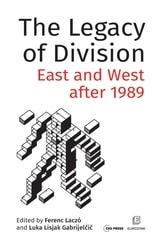
The Legacy of Division
East and West after 1989Ferenc Laczó
Central European University Press, 2020
This volume examines the legacy of the East–West divide since the implosion of the communist regimes in Europe. The ideals of 1989 have largely been frustrated by the crises and turmoil of the past decade. The liberal consensus was first challenged as early as the mid-2000s. In Eastern Europe, grievances were directed against the prevailing narratives of transition and ever sharper ethnic-racial antipathies surfaced in opposition to a supposedly postnational and multicultural West. In Western Europe, voices regretting the European Union's supposedly careless and premature expansion eastward began to appear on both sides of the left–right and liberal–conservative divides. The possibility of convergence between Europe's two halves has been reconceived as a threat to the European project.
In a series of original essays and conversations, thirty-three contributors from the fields of European and global history, politics and culture address questions fundamental to our understanding of Europe today: How have perceptions and misperceptions between the two halves of the continent changed over the last three decades? Can one speak of a new East–West split? If so, what characterizes it and why has it reemerged? The contributions demonstrate a great variety of approaches, perspectives, emphases, and arguments in addressing the daunting dilemma of Europe's assumed East–West divide.
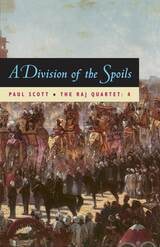
The Raj Quartet, Volume 4
A Division of SpoilsPaul Scott
University of Chicago Press, 1998
After exploiting India's divisions for years, the British depart in such haste that no one is prepared for the Hindu-Muslim riots of 1947. The twilight of the raj turns bloody. Against the backdrop of the violent partition of India and Pakistan, A Division of the Spoils illuminates one last bittersweet romance, revealing the divided loyalties of the British as they flee, retreat from, or cling to India.