Results by title
9 books match the query 'Divorce & Separation'
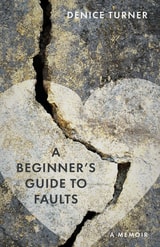
A Beginner's Guide to Faults
A MemoirDenice Turner
University of Nevada Press, 2026
A bighearted memoir of fidelity and forgiveness, A Beginner’s Guide to Faults draws on the language of geology to explore fault lines in a long marriage—deep fractures formed by unmet needs, quiet betrayals, and the human longing for connection and freedom.
After twenty-five years of marriage, Denice is blindsided when her husband reveals his romance with a Las Vegas stripper. This latest move in their tit-for-tat game of infidelity is too much for her. She files for divorce and heads to South Dakota, where she hopes to fulfill her wildest fantasies. Instead, plagued by guilt about her own faults, she wrecks each new relationship, convinced that she is unforgivable.
Through fleeting romances and soul-deep self-reflection, Denice rebuilds a life and a family on her own terms. A Beginner’s Guide to Faults is a memoir of transformation—one that shows how love can change without ever being lost.
A Beginner's Guide to Faults
A MemoirDenice Turner
University of Nevada Press, 2026
A bighearted memoir of fidelity and forgiveness, A Beginner’s Guide to Faults draws on the language of geology to explore fault lines in a long marriage—deep fractures formed by unmet needs, quiet betrayals, and the human longing for connection and freedom.
After twenty-five years of marriage, Denice is blindsided when her husband reveals his romance with a Las Vegas stripper. This latest move in their tit-for-tat game of infidelity is too much for her. She files for divorce and heads to South Dakota, where she hopes to fulfill her wildest fantasies. Instead, plagued by guilt about her own faults, she wrecks each new relationship, convinced that she is unforgivable.
Through fleeting romances and soul-deep self-reflection, Denice rebuilds a life and a family on her own terms. A Beginner’s Guide to Faults is a memoir of transformation—one that shows how love can change without ever being lost.
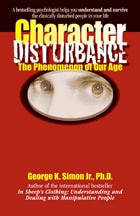
Character Disturbance
the phenomenon of our ageGeorge K. Simon
Parkhurst Brothers, Inc., 2011
Modern permissiveness and the new culture of entitlement allows disturbed people to reach adulthood without proper socialization. In a book meant both for the general public and for professionals, bestselling author and psychologist George Simon explains in plain English:
•How most disturbed characters think.•The habitual behaviors the disturbed use to avoid responsibility and to manipulate, deceive, and exploit others.
•Why victims in relationships with disturbed characters do not get help they need from traditional therapies.
•A straightforward guide to recognizing and understanding all relevant personality types, especially those most likely to undermine relationships.
•A new framework for making sense of the crazy world many find themselves in when there's a disturbed character in their lives.
•Concrete principles that promote responsibility and positive change when engaging disturbed characters.
•Tactics (for both lay persons and therapists) to lessen the chances for victimization and empower those who would otherwise be victims in their relationships with many types of disturbed characters.
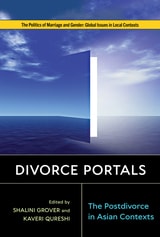
Divorce Portals
The Postdivorce in Asian ContextsShalini Grover
Rutgers University Press, 2027
Across Asia and its global diasporas, marriage remains a dominant and public institution, and divorce generates widespread comment and concern. Breaking new ground, Divorce Portals reveals divorce to be generative of transformations in individual intimate lives and wider societies. Through compelling, sensitive ethnographic accounts inviting readers into the lives of people undergoing separation and divorce, chapters capture the antecedent-lives of uncoupling – the imaginary, anticipatory, and cautionary – and the afterlives of divorce, in the immediate aftermath and across life courses and generations. Chapters explore the vivid and bold new selves that divorcees are fashioning for themselves and highlight the intersecting inequalities that shape postdivorce predicaments, sometimes belying the hoped-for freedoms of divorce and remarriage. Together, chapters chart nascent and haltering accommodations of the single, repartnered, and queer. Across cases drawn from diverse geographic contexts, this book unlocks new, expansive, and accessible ways to think about divorce and its aftermath.

Forcing Divorce
Intimate and Non-Intimate Coercive Control in Marriage DissolutionPéter Berta
Rutgers University Press, 2027
Forcing Divorce seeks to contribute to a more nuanced understanding of what possible causes, motivations, constraints, and dynamics may lie behind forced divorce cases in various social and political contexts. This volume points out that coercive and controlling behavior plays a key role in forcing divorce and provides a detailed insight into the diverse set of strategies and tactics of marital coercive control, as well as the negative emotional, psychological, social, economic, legal , and physical consequences of their use. The chapters reveal that marital coercive control can develop not only in cases of forced divorce related to intimate partnerships, but also in non-intimate, large-scale social contexts, such as the relationship between the state and its citizens, or between religious leaders and their followers. They also highlight why contextual pressure is significant and how it operates, and why it is useful to distinguish between conducive contexts (soft contextual pressure) and coercive contexts (hard contextual pressure) in order to gain a more thorough understanding of the dynamics of restriction of individual marital choice and consent in cases of forced divorce.
Marriage in Past, Present and Future Tense
Edited by Janet Carsten, Hsiao-Chiao Chiu, Siobhan Magee, Eirini Papadaki, and Koreen M. Reece
University College London, 2021
A series of global case studies, Marriage in Past, Present and Future Tense unravels the ever-changing intimate and institutional questions united by marriage. Traversing politics, economics, and religion, the authors explore how marital practices both react to and produce broader social transformation. In particular, the authors contend that contexts marked by violent sociopolitical ruptures such as civil war or colonization illuminate the links between the personal and political. What emerges is a complex portrait of marriage as a site of cultural memory, embodied experience, and active imagination.
Recovering Origins
A Unique Healing Program for Adult Children of DivorceMargaret Harper McCarthy
Catholic University of America Press, 2021

Silent Revolution
The Transformation of Divorce Law in the United StatesHerbert Jacob
University of Chicago Press, 1988
Since 1966, divorce laws in the United States have undergone a radical transformation. No-fault divorce is now universally available. Alimony functions simply as a brief transitional payment to help a dependent spouse become independent. Most states divide assets at divorce according to a community property scheme, and, whenever possible, many courts prefer to award custody of children to the mother and the father jointly.
These changes in policy represent a profound departure from traditional American values, and yet the legislation by which they were enacted was treated as a technical correction of minor problems. No-fault divorce, for example, was a response to the increasing number of fraudulent divorce petitions. Since couples were often forced to manufacture the evidence of guilt that many states required, and since judges frequently looked the other way, legal reformers sought no more than to bring divorce statutes into line with current practice.
On the basis of such observations, Jacob formulates a new theory of routine—as opposed to conflictual—policy-making processes. Many potentially controversial policies—divorce law reforms among them—pass unnoticed in America because legislators treat them as matters of routine. Jacob's is indeed the most plausible account of the enormous number and steady flow of policy decisions made by state legislatures. It also explains why no attention was paid to the effect divorce reform would have on divorced women and their children, a subject that has become increasingly controversial and that, consequently, is not likely to be handled by the routine policy-making process in the future.
The Illusion of Equality
The Rhetoric and Reality of Divorce ReformMartha Albertson Fineman
University of Chicago Press, 1991