Results by title
3 books match the query 'Divorced people'
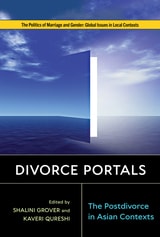
Divorce Portals
The Postdivorce in Asian ContextsShalini Grover
Rutgers University Press, 2027
Across Asia and its global diasporas, marriage remains a dominant and public institution, and divorce generates widespread comment and concern. Breaking new ground, Divorce Portals reveals divorce to be generative of transformations in individual intimate lives and wider societies. Through compelling, sensitive ethnographic accounts inviting readers into the lives of people undergoing separation and divorce, chapters capture the antecedent-lives of uncoupling – the imaginary, anticipatory, and cautionary – and the afterlives of divorce, in the immediate aftermath and across life courses and generations. Chapters explore the vivid and bold new selves that divorcees are fashioning for themselves and highlight the intersecting inequalities that shape postdivorce predicaments, sometimes belying the hoped-for freedoms of divorce and remarriage. Together, chapters chart nascent and haltering accommodations of the single, repartnered, and queer. Across cases drawn from diverse geographic contexts, this book unlocks new, expansive, and accessible ways to think about divorce and its aftermath.
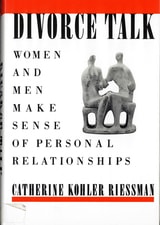
Divorce Talk
Women and Men Make Sense of Personal RelationshipsCatherine Kohler Riessman
Rutgers University Press, 1990
Riessman looks at the ideology of the companionate marriage: husband and wife should be each other's closest companion, and in marriage one should achieve emotial intimacy and sexual fulfillment. These beliefs imply a level of equality that rarely exists. In reality, most wives are subordinate to their husbands, most husbands want neither "deep talk" nor small talk that women want, and many husbands resent their wife's ties to kin and friends. To explain divorce, women and men construct gendered visions of what marriage should provide, and at the same time they mourn gender divisions and blame their divorces on them. Riessman examines the stories people tell about their marriages--the protagonists, inciting conditions, and culminating events--and how these narrative structures provide ways to persuade both teller and listener that divorce was justified.
Although divorce is invariably stressful, many people believe that men suffer less than women. This is an artifact of what Riessman calls the "feminization of psychological distress"--traditional ways of measuring distress reflect women's idioms, not men's. Departing from a literature that casts divorce in only negative terms, she finds paradoxically that women sense rewards, even as they report hardship. There is a shakeup in gender roles, and women more than men feel they gain a fuller idea of who they are. The author allows us to enter the points of view of her subjects, while her analytic approach makes links between the self and society.
Divorce Talk
Women and Men Make Sense of Personal RelationshipsCatherine Kohler Riessman
Rutgers University Press, 1990
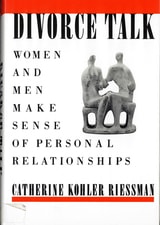
Riessman looks at the ideology of the companionate marriage: husband and wife should be each other's closest companion, and in marriage one should achieve emotial intimacy and sexual fulfillment. These beliefs imply a level of equality that rarely exists. In reality, most wives are subordinate to their husbands, most husbands want neither "deep talk" nor small talk that women want, and many husbands resent their wife's ties to kin and friends. To explain divorce, women and men construct gendered visions of what marriage should provide, and at the same time they mourn gender divisions and blame their divorces on them. Riessman examines the stories people tell about their marriages--the protagonists, inciting conditions, and culminating events--and how these narrative structures provide ways to persuade both teller and listener that divorce was justified.
Although divorce is invariably stressful, many people believe that men suffer less than women. This is an artifact of what Riessman calls the "feminization of psychological distress"--traditional ways of measuring distress reflect women's idioms, not men's. Departing from a literature that casts divorce in only negative terms, she finds paradoxically that women sense rewards, even as they report hardship. There is a shakeup in gender roles, and women more than men feel they gain a fuller idea of who they are. The author allows us to enter the points of view of her subjects, while her analytic approach makes links between the self and society.