Results by title
15 books match the query 'Doctors'
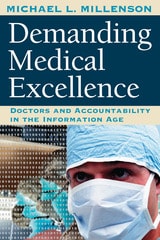
Demanding Medical Excellence
Doctors and Accountability in the Information AgeMichael L. Millenson
University of Chicago Press, 2000
"If you read only one book this year, read Demanding Medical Excellence. It's that good, and the revolution it describes is that important."—Health Affairs
"Millenson has done yeoman's work in amassing and understanding that avalanche of data that lies beneath most of the managed-care headlines. . . . What he finds is both important and well-explained: inconsistency, overlap, and inattention to quality measures in medical treatment cost more and are more dangerous than most cost-cutting measures. . . . [This book] elevates the healthcare debate to a new level and deserves a wide readership."—Library Journal
"An involving, human narrative explaining how we got to where we are today and what lies ahead."—Mark Taylor, Philadelphia Inquirer
"Read this book. It will entertain you, challenge, and strengthen you in your quest for better accountability in health care."—Alex R. Rodriguez, M.D., American Journal of Medical Quality
"Finally, a health-care book that doesn't wring its hands over the decline of medicine at the hands of money-grubbing corporations. . . . This is a readable account of what Millenson calls a 'quiet revolution' in health care, and his optimism makes for a refreshing change."—Publishers Weekly
"With meticulous detail, historical accuracy, and an uncommon understanding of the clinical field, Millenson documents our struggle to reach accountability."—Saty Satya-Murti, M.D., Journal of the American Medical Association
Doctors and Demonstrators
How Political Institutions Shape Abortion Law in the United States, Britain, and CanadaDrew Halfmann
University of Chicago Press, 2011
Doctors and Their Workshops
Economic Models of Physician BehaviorMark V. Pauly
University of Chicago Press, 1980
Doctors are obviously influential in determining the costs of their services. But even more important, many believe, is the influence physicians have over the use and cost of nonphysician health-care resources and services. Doctors and Their Workshops is the first comprehensive attempt to use economic analysis to understand some of the physician effects on nonphysician aspects of health care.

Doctors and the State
The Politics of Health Care in France and the United StatesDavid Wilsford
Duke University Press, 1991
In France, Wilsford shows, the state is strong in the health policy domain, while organized medicine is weak and divided. Consequently, physicians exercise little influence over health care policymaking. By contrast, in the United States the state is weak, the employers and insurers who pay for health care are fragmented, and organized medicine is strong and well financed. As a result, medical professionals are able to exert a greater influence on policymaking, thus making cost control more difficult.
Wilsford extends his comparison to health care systems in the United Kingdom, West Germany, Italy, Canada, and Japan. Whether the private or public sector finances health care, he discovers, there is now an important trend in all of the advanced industrial countries toward controlling escalating costs by curbing both the medical profession’s clinical autonomy and physicians’ incomes.

Doctors and the State
The Politics of Health Care in France and the United StatesDavid Wilsford
Duke University Press, 0
In France, Wilsford shows, the state is strong in the health policy domain, while organized medicine is weak and divided. Consequently, physicians exercise little influence over health care policymaking. By contrast, in the United States the state is weak, the employers and insurers who pay for health care are fragmented, and organized medicine is strong and well financed. As a result, medical professionals are able to exert a greater influence on policymaking, thus making cost control more difficult.
Wilsford extends his comparison to health care systems in the United Kingdom, West Germany, Italy, Canada, and Japan. Whether the private or public sector finances health care, he discovers, there is now an important trend in all of the advanced industrial countries toward controlling escalating costs by curbing both the medical profession’s clinical autonomy and physicians’ incomes.

Doctors in the Making
Memoirs and Medical EducationSuzanne Poirier
University of Iowa Press, 2009
Through close readings of these accounts, Poirier draws attention to the complex nature of power in medicine, the rewards and hazards of professional and interpersonal relationships in all aspects of physicians’ lives, and the benefits to and threats from the vulnerability that medical students and residents experience.
Although most students emerge from medical education as well-trained, well-prepared professionals, few of them will claim that they survived the process unscathed. The authors of these accounts document—for better or for worse—the ways in which they have been changed. Based on their stories, Poirier recommends that medical education should make room for the central importance of personal relationships, the profound sense of isolation and powerlessness that can threaten the wellbeing of patients and physicians alike, and the physical and moral vulnerability that are part of every physician’s life.
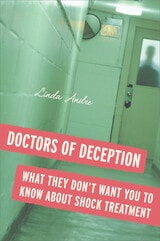
Doctors of Deception
What They Don't Want You to Know about Shock TreatmentAndre, Linda
Rutgers University Press, 2009
Doctors of Deception is a revealing history of ECT (or shock therapy) in the United States, told here for the first time. Through the examination of court records, medical data, FDA reports, industry claims, her own experience as a patient of shock therapy, and the stories of others, Andre exposes tactics used by the industry to promote ECT as a responsible treatment when all the scientific evidence suggested otherwise.
As early as the 1940s, scientific literature began reporting incidences of human and animal brain damage resulting from ECT. Despite practitioner modifications, deleterious effects on memory and cognition persisted. Rather than discontinue use of ECT, the $5-billion-per-year shock industry crafted a public relations campaign to improve ECT’s image. During the 1970s and 1980s, psychiatry’s PR efforts misled the government, the public, and the media into believing that ECT had made a comeback and was safe.
Andre carefully intertwines stories of ECT survivors and activists with legal, ethical, and scientific arguments to address issues of patient rights and psychiatric treatment. Echoing current debates about the use of psychopharmaceutical interventions shown to have debilitating side-effects, she candidly presents ECT as a problematic therapy demanding greater scrutiny, tighter control, and full disclosure about its long-term cognitive effects.

Doctors, Ambassadors, Secretaries
Humanism and Professions in Renaissance ItalyDouglas Biow
University of Chicago Press, 2002
Examining a wide range of treatises, poems, and other works that humanists wrote both as and about doctors, ambassadors, and secretaries, Biow shows how interactions with these professions forced humanists to make their studies relevant to their own times, uniting theory and practice in a way that strengthened humanism. His detailed analyses of writings by familiar and lesser-known figures, from Petrarch, Machiavelli, and Tasso to Maggi, Fracastoro, and Barbaro, will especially interest students of Renaissance Italy, but also anyone concerned with the rise of professionalism during the early modern period.
ETERNALLY WOUNDED WOMAN
"WOMEN, DOCTORS, AND EXERCISE IN THE LATPatricia A. Vertinsky
University of Illinois Press, 1994
"A review of thinking is needed in the field of sociohistorical analysis concerning attitudes toward the female body and attempts to regulate female physical activity. Such analyses may generate new insights into the questions of both social control and the unevenness of progress in women's real or perceived opportunities for participating freely and fully in sports and exercise of their choice."
From Popular Medicine to Medical Populism
Doctors, Healers, and Public Power in Costa Rica, 1800–1940Steven Palmer
Duke University Press, 2003
Steven Palmer breaks with the view of popular and professional medicine as polar opposites—where popular medicine is seen as representative of the authentic local community and as synonymous with oral tradition and religious and magical beliefs and professional medicine as advancing neocolonial interests through the work of secular, trained academicians. Arguing that there was significant and formative overlap between these two forms of medicine, Palmer shows that the relationship between practitioners of each was marked by coexistence, complementarity, and dialogue as often as it was by rivalry. Palmer explains that while the professionalization of medical practice was intricately connected to the nation-building process, the Costa Rican state never consistently displayed an interest in suppressing the practice of popular medicine. In fact, it persistently found both tacit and explicit ways to allow untitled healers to practice. Using empirical and archival research to bring people (such as the famous healer or curandero Professor Carlos Carbell), events, and institutions (including the Rockefeller Foundation) to life, From Popular Medicine to Medical Populism demonstrates that it was through everyday acts of negotiation among agents of the state, medical professionals, and popular practitioners that the contours of Costa Rica’s modern, heterogeneous health care system were established.
Lessons in Mortality
Doctors and Patients Struggling TogetherAllen B. Weisse, M.D.
University of Missouri Press, 2006
Shamans, Mystics and Doctors
A Psychological Inquiry into India and its Healing TraditionsSudhir Kakar
University of Chicago Press, 1990
"With extraordinary sympathy, open-mindedness, and insight Sudhir Kakar has drawn from both his Eastern and Western backgrounds to show how the gulf that divides native healer from Western psychiatrist can be spanned."—Rosemary Dinnage, New York Review of Books
"Each chapter describes the geographical and cultural context within which the healers work, their unique approach to healing mental illness, and . . . the philosophical and religious underpinnings of their theories compared with psychoanalytical theory."—Choice

Sister Kenny
The Woman Who Challenged the DoctorsVictor Cohn
University of Minnesota Press, 1976
Sister Kenny was first published in 1976. Minnesota Archive Editions uses digital technology to make long-unavailable books once again accessible, and are published unaltered from the original University of Minnesota Press editions.
Sister Elizabeth Kenny, the Australian-born nurse, is remembered by thousands of grateful parents and grandparents of young polio patients, as well as others who were less personally affected, as the woman who successfully fought the medical profession to win acceptance of her techniques to combat the crippling effects of this disease.
In this biography Victor Cohn, a prize-winning science writer, details the life of Sister Kenny and her significant role in the history of medicine. It is an inspiring story and one which will be of particular interest to those of the present generation who are engaged in the movement for women's equality. Sister Kenny's struggle against the bitter opposition of many doctors to her concepts for the treatment of polio dramatized the then common attitude of male chauvinism on the part of the medical profession toward nurses.
The biography traces Sister Kenny's life from her birth in Australia, through her early nursing career in the bush, to her rise to prominence in America. Much of the narrative focuses on her confrontation with the medical establishment. Throughout, the author writes from an objective viewpoint, and in conclusion he assesses Sister Kenny's accomplishments.
Surviving Modern Medicine
How to Get the Best From Doctors, Family, and FriendsClarke, Peter
Rutgers University Press, 1998
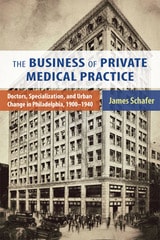
The Business of Private Medical Practice
Doctors, Specialization, and Urban Change in Philadelphia, 1900-1940James A. Schafer Jr.
Rutgers University Press, 2013
Unevenly distributed resources and rising costs have become enduring problems in the American health care system. Health care is more expensive in the United States than in other wealthy nations, and access varies significantly across space and social classes. James A. Schafer Jr. shows that these problems are not inevitable features of modern medicine, but instead reflect the informal organization of health care in a free market system in which profit and demand, rather than social welfare and public health needs, direct the distribution and cost of crucial resources.
The Business of Private Medical Practice is a case study of how market forces influenced the office locations and career paths of doctors in one early twentieth-century city, Philadelphia, the birthplace of American medicine. Without financial incentives to locate in poor neighborhoods, Philadelphia doctors instead clustered in central business districts and wealthy suburbs. In order to differentiate their services in a competitive marketplace, they also began to limit their practices to particular specialties, thereby further restricting access to primary care. Such trends worsened with ongoing urbanization.
Illustrated with numerous maps of the Philadelphia neighborhoods he studies, Schafer’s work helps underscore the role of economic self-interest in shaping the geography of private medical practice and the growth of medical specialization in the United States.