Results by title
7 books match the query 'Dog'
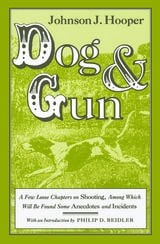
Dog and Gun
A Few Loose Chapters on Shooting, Among Which Will Be Found Some Anecdotes and IncidentsJohnson J. Hooper, with an Introduction by Philip D. Beidler
University of Alabama Press, 1992
A classic portrait of hunting, sport, and gentlemanly culture in the antebellum South.
The least well known of Johnson Jones Hooper’s works, Dog and Gun was first published as a newspaper series, then appeared in six book editions between 1856 and 1871. Hooper is Alabama’s most celebrated antebellum author, and here he gives insight into the meaning of a culture where every male hunts – and a man who shoots as a gentleman will be assumed a gentleman. Beidler’s introduction to this reprint edition explores the social, literary, and technical dimensions of Dog and Gun, which he sees as an important commentary on class distinctions in the antebellum South, as well as a straightforward treatise on hunting.
Although the book is a manual for the hunter, with characteristic humor and a certain disdain, Hooper gives a full picture of the gentlemanly sport of hunting – clearly distinct from hunting for food – in all aspects including hunter, weaponry, and sporting dogs. He takes us back to an autumnal ritual of the hunt, where one is always a boy with his first gun – to the natural mystery of quest, competition, predation, pursuit, survival, bravery, endurance, and eventual defeat, called the mystery of the hunt.
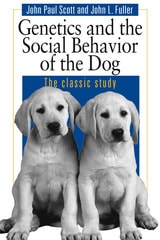
Genetics and the Social Behaviour of the Dog
John Paul Scott and John L. Fuller
University of Chicago Press, 1974
Scott and Fuller’s classic study of dog behavior gathers into one volume the authoritative information that came from their twenty years of research at the Jackson Laboratory. Central to their book is the role heredity plays in the development of behavior. Giving puppies an environment designed on the principles of a well-run school, Scott and Fuller tested five breeds representing the major dog groups and carried out a Mendelian experiment with two of the most different breeds: the basenji and the cocker spaniel.
They found that heredity affects almost every trait tested; that sex affects aggressiveness and the dominance order, but not trainability and problem-solving; that emotional traits profoundly influence performance; that, although breeds differ widely in emotional and motivational characteristics, none shows distinct superiority in problem solving; and that detailed statistical analyses indicate a highly complex pathway between primary gene action and its final effect on behavior.
Included is important information on:
• rearing methods
• the origin and history of dog breeds
• basic behavior patterns
• the physiological and behavioral development of puppies

Introduction to Animal Rights
Your Child or the Dog?Gary L. Francione, foreword by Alan Watson
Temple University Press, 2000
In this easy-to-read introduction, animal rights advocate Gary Francione looks at our conventional moral thinking bout animals. Using examples, analogies, and thought-experiments, he reveals the dramatic inconsistency between what we say we believe about animals and how we actually treat them.
Introduction to Animal Rights: Your Child or the Dog? provides a guidebook to examining our social and personal ethical beliefs. It takes us through concepts of property and equal consideration to arrive at the basic contention of animal rights: that everyone -- human and non-human -- has the right not to be treated as a means to an end. Along the way, it illuminates concepts and theories that all of us use but few of us understand -- the nature of "rights" and "interests," for example, and the theories of Locke, Descartes, and Bentham.
Filled with fascinating information and cogent arguments, this is a book that you may love or hate, but that will not fail to inform, enlighten, and educate.
Just a Dog
Animal Cruelty, Self, and SocietyArnold Arluke
Temple University Press, 2006
The Difficulty of Being a Dog
Roger Grenier
University of Chicago Press, 2000
What Is a Dog?
Raymond Coppinger and Lorna Coppinger
University of Chicago Press, 2016
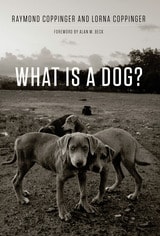
Exploring the natural history of these animals, the Coppingers explain how the village dogs of Vietnam, India, Africa, and Mexico are strikingly similar. These feral dogs, argue the Coppingers, are in fact the truly archetypal dogs, nearly uniform in size and shape and incredibly self-sufficient. Drawing on nearly five decades of research, they show how dogs actually domesticated themselves in order to become such efficient scavengers of human refuse. The Coppingers also examine the behavioral characteristics that enable dogs to live successfully and to reproduce, unconstrained by humans, in environments that we ordinarily do not think of as dog friendly.
Providing a fascinating exploration of what it actually means—genetically and behaviorally—to be a dog, What Is a Dog? will undoubtedly change the way any beagle or bulldog owner will reflect on their four-legged friend.

Year of the Dog
A NovelBy Shelby Hearon
University of Texas Press, 2007
When her husband dumps her for an old girlfriend and sets all of Peachland, South Carolina, gossiping, Janey Daniels has to get away—far away—for a "sabbatical" year. She flees to Burlington, Vermont, home of Aunt May, her mother's only living relative. There she adopts Beulah, a Labrador puppy in training to become a companion dog for the blind. Not for a moment does Janey suspect that this "year of the dog" will change her life forever.
Shelby Hearon is an acknowledged master at illuminating the nuances of relationships. In Year of the Dog, she explores the surprising ways that the heart heals after a betrayal. While Janey is training Beulah, Beulah leads Janey to a new love, James Maarten, a smart, "fidgety" teacher they meet at the dog park. As Janey soon discovers, James has suffered a betrayal of his own that makes it hard for him to open up and trust her with even the smallest details of his past. While Janey tries to help James, she also reaches out to her enigmatic Aunt May, a retired librarian reputed to be the friend, perhaps even the lover, of popular mystery writer Bert Greenwood. When Janey attempts to solve the twin mysteries of why her great aunt has distanced herself from the family—and what her true relationship is with Bert Greenwood—Beulah provides the clues that lead Janey to uncover the secrets of her aunt's life. By the time Beulah's stay with Janey comes to an end, the people whose lives she's linked will discover that healing and reconciliation can come in the most unexpected ways.