Results by title
3 books match the query 'Dogma, Development of'
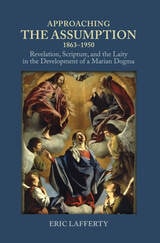
Approaching the Assumption, 1863-1950
Revelation, Scripture, and the Laity in the Development of a Marian DogmaEric Lafferty
Catholic University of America Press, 2026
The Assumption of Mary refers to the ancient Christian belief that the Mother of God was taken up into Heaven, body and soul, at the end of her earthly life. For centuries, Catholics and other Christians celebrated the Assumption as a liturgical feast and meditated on the miraculous event in the Rosary. Nevertheless, its relationship to Revelation remained undefined. This changed in 1950 when Pope Pius XII declared the Assumption of Mary a dogma of the Catholic Church. In this rare exercise of papal authority, Pius XII infallibly and irrevocably taught that the Assumption was a truth revealed by God. This book explores how the definition of this Marian dogma came to fruition.
After a brief history of the prior three Marian dogmas — Mother of God, Ever-Virgin, and the Immaculate Conception — this book narrates the major moments in the effort to obtain a dogmatic definition of the Assumption. The beginning of this “Assumptionist movement” can be dated to 1863 when Queen Isabel II of Spain petitioned the pope to declare the Assumption a dogma. Subsequently, petitionary efforts and scholarly inquiry increased and spread throughout the world. In addition to the narrative of this movement, this book gives special consideration to three vital aspects: debate over the Assumption’s definability as a dogma, if and how Scripture reveals the Assumption, and the contribution of the laity on a matter of doctrine.
Collectively, the Assumptionist movement emerges as a critical event in the nineteenth- and twentieth-century Catholic Church. Culminating in a dogmatic definition shortly before the opening of Vatican II, it also serves as a key point of inquiry for continuity and development of doctrine. A final chapter argues that the operative beliefs pertaining to Revelation, Scripture, and the laity during the Assumptionist movement stand in continuity with the teachings of Vatican II.
[more]
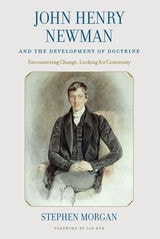
John Henry Newman and the Development of Doctrine
Encountering Change, Looking for ContinuityStephen Morgan
Catholic University of America Press, 2022
John Henry Newman and the Development of Doctrine provides an analysis of the attempts by John Henry Newman to account for the historical reality of doctrinal change within Christianity in the light of his lasting conviction that the idea of Christianity is fixed by reference to the dogmatic content of the deposit of faith. It argues that Newman proposed a series of hypotheses to account for the apparent contradiction between change and continuity, that this series begins much earlier than is generally recognized and that the final hypothesis he was to propose, contained in An Essay on the Development of Christian Doctrine, provides a methodology of lasting theological value and contemporary relevance.
Stephen Morgan establishes the centrality of the problem of change and continuity in theology, to Newman's theological work as an Anglican, its part in his conversion to Catholicism and its contemporary relevance to Catholic theology. It also surveys the major secondary literature relating to the question, with particular reference to those works published within the last fifty years. Additionally, Morgan considers the legacy of the Essay as a tool in Newman’s theology and in the work of later theologians, finally suggesting that it may offer a useful methodological contribution to the contemporary Catholic debate about hermeneutical approaches to the Second Vatican Council and post-conciliar developments in doctrine.
[more]
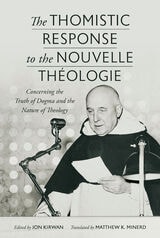
The Thomistic Response to the Nouvelle Theologie
Concerning the Truth of Dogma and the Nature of TheologyJon Kirwan
Catholic University of America Press, 2023
The Thomistic Response to the Nouvelle Théologie: Concerning the Truth of Dogma and the Nature of Theology retrieves the most important and largely forgotten exchanges in the mid-20th-century debate surrounding ressourcement thinkers. It makes available new translations of works by the leading Thomists in the exchange: Dominican Fathers Reginald Garrigou-Lagrange, Michel Labourdette, Marie-Joseph Nicolas, and Raymond Bruckberger. In addition to a lengthy historical and theological introduction, the volume contains sixteen articles, thirteen of which have never appeared in English. All the major critical responses of the Dominican Thomists to the nouvelle théologie are here presented chronologically according to the primary debates carried on, respectively, in the journals Revue Thomiste and Angelicum. A lengthy introduction describes the unfolding of the entire debate, article by article, and explains and references the ressourcement interventions.
Unfortunately, the history of this important debate is largely surrounded by polemics, half-truths, caricatures, and journalistic soundbites. In the articles gathered in this volume, along with the accompanying introduction, the Toulouse and Roman Dominicans speak in their own voice. The central theses that define the two sides of the debate are sympathetically set forth. However, the texts gathered here show the immense lengths to which the Thomists went to initiate an authentic and fraternal theological dialogue with the nouveaux théologiens. Frs. Labourdette and Nicolas repeatedly argued for the importance of ressourcement work: they applauded its historical efforts, and they were generally sympathetic and complementary (although always pointed and persistent in gently expressing their concerns). Even Fr. Garrigou-Lagrange—whose infamous intervention is remembered as being a theological “atomic bomb”—is revealed as being no more guilty of escalation than the Dominicans’ interlocutors in their own responses to him and Fr. Labourdette.
This volume will greatly aid in the task of theological and historical reconstruction and will, undoubtedly, assist in a certain rapprochement between the two sides, as the essential texts, concerns, and theological arguments are made available in their entirety to professional and lay anglophone readers.
[more]