Results by title
9 books match the query 'Doing'

A Rhetoric of Doing
Essays on Written Discourse in Honor of James L. KinneavyEdited by Stephen P. Witte, Neil Nakadate, and Roger D. Cherry
Southern Illinois University Press, 1992
Concerned with both the nature and the practice of discourse, the eighteen essays collected here treat rhetoric as a dynamic enterprise of inquiry, exploration, and application, and in doing so reflect James L. Kinneavy’s firm belief in the vital relationship between theory and practice, his commitment to a spirit of accommodation and assimilation that promotes the development of ever more powerful theories and ever more useful practices.
A thorough introduction provides the reader with clear summaries of the essays by leading-edge theorists, researchers, and teachers of writing and rhetoric. A "field context" for the ideas presented in this book is provided through the division of the various chapters into four major sections that focus on classical rhetoric and rhetorical theory in historical contexts; on dimensions of discourse theory, aspects of discourse communities, and the sorts of knowledge people access and use in producing written texts; on writing in school-related contexts; and on several dimensions of nonacademic writing. A fifth section contains a bibliographic survey and an appreciation of James Kinneavy’s work. The exceptional range of these essays makes A Rhetoric of Doing an ecumenical examination of the current state of mind in rhetoric and written communication, a survey and description of what discourse and those in the field of discourse are, in fact, doing.
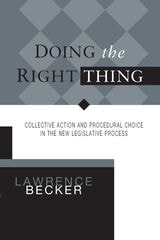
DOING THE RIGHT THING
Collective Action and Procedural Choice in the New Legislative ProcessLawrence Becker
The Ohio State University Press, 2005
Doing the Right Thing examines the use of extraordinary legislative procedures in four cases in the U.S. Congress to accomplish policy objectives that many political scientists would argue are impossible to achieve. It not only shows that Congress is capable of imposing parochial costs in favor of general benefits but it argues that Congress is able to do so in a variety of policy areas through the use of very different kinds of procedural mechanisms that are underappreciated.
The book opens by developing a theory of procedural choice to explain why Congress chooses to delegate in differing degrees in dealing with similar kinds of policy problems. The theory is then applied to four narrative case studies—military base closures, the Yucca Mountain Project, NAFTA, and the Tax Reform Act of 1986—that both show the variety of factors that impact procedural choice and highlight how our national legislature was able to “do the right thing.”
The book concludes by pointing to the variety of ways in which Congress will be confronted with similar policy problems in the coming years and offering some lessons from these cases about what kinds of procedures and policy outcomes we might expect. In short, Congress is remarkably adept at “doing the right thing,” even under difficult circumstances, but only when legislators are willing to manipulate procedures in all the necessary ways.
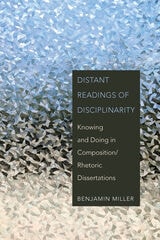
Distant Readings of Disciplinarity
Knowing and Doing in Composition/Rhetoric Dissertationsby Benjamin Miller
Utah State University Press, 2022
Writing studies has long been marked by a multitude of methods and interlocking purposes, partaking of not just humanities approaches but also social scientific ones, with data drawn from interviews and surveys alongside historical and philosophical arguments and with corpus analytics in large-scale collections jostling against small-scale case studies of individuals. These areas of study aren’t always cleanly separable; shifting modes mark the discipline as open and welcoming to many different angles of research. The field needs to embrace that vantage point and generate new degrees of familiarity with methods beyond those of any individual scholar.
Not only a training genre and not only a knowledge-making genre, the dissertation is also a discipline-producing genre. Illustrating what the field has been studying, and how, Distant Readings of Disciplinarity supports more fruitful collaborations within and across research areas and methods.
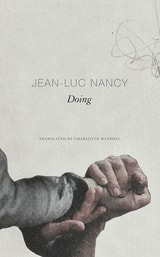
Doing
Jean-Luc Nancy
Seagull Books, 2020
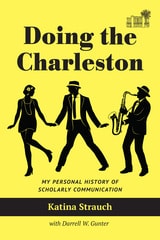
Doing the Charleston
My Personal History of Scholarly CommunicationKatina Strauch with Darrell W. Gunter
Against the Grain, LLC, 2025
Doing the Charleston
My Personal History of Scholarly CommunicationKatina Strauch with Darrell W. Gunter
Against the Grain, LLC, 2025
Feminist Making, Doing, and Sensing
Experiments in PhilosophyLauren Guilmette and Ada S. Jaarsma, editors
Duke University Press, 2026
Science is Golden
A Problem-Solving Approach to Doing Science with ChildrenAnn Finkelstein
Michigan State University Press, 2002
The first book of its kind, Science is Golden discusses how to implement an inquiry-based, problem-solving approach to science education (grades K-5). Finkelstein shows parents and teachers how to help students investigate their own scientific questions. Rather than a set of guidelines for science fair projects, this book presents a method for helping students expand their creativity and develop logical thinking while learning science.
Starting with an introduction to the "brains-on method," Science is Golden explains brainstorming, experimental controls, collecting data, and how to streamline children's questions about science so that the questions define an experiment. Students will learn how to: ask good questions; clarify terminology; research, plan, and design experiments and controls; test assumptions; collect and analyze data; present results to others; and collaborate with adults.
Science is Golden is consistent with the National Science Education Standards proposed by the National Academy of Sciences, and the Michigan Essential Goals and Objectives for Science Education (K-12) from the Michigan State Board of Education.
The Voiding of Being
The Doing and Undoing of Metaphysics in ModernityWilliam Desmond
Catholic University of America Press, 2020