Results by title
3 books match the query 'Doktor Faustus'

DR. FAUSTUS
ARCHETYPAL SUBTEXT AT THE MILLENNIUMPETER WERRES
West Virginia University Press, 1999
[more]
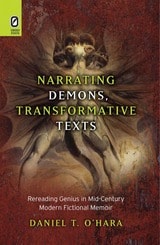
Narrating Demons, Transformative Texts
Rereading Genius in Mid-Century Modern Fictional MemoirDaniel T. O’Hara
The Ohio State University Press, 2012
Narrating Demons, Transformative Texts: Rereading Genius in Mid-Century Modern Fictional Memoir, by Daniel T. O’Hara, acknowledges that the modern conception of literary genius is probably most lucidly expressed in the criticism of Lionel Trilling. But O’Hara also demonstrates that certain important and widely read mid-century modern fictional memoirs subversively return to an earlier conception that emphasizes the demonic nature of genius, a conception that is associated with the occult and the visionary and embraces the vision of evil articulated in earlier literature. O’Hara argues that Thomas Mann’s Doctor Faustus (1947), Vladimir Nabokov’s Lolita (1955), and William Burroughs’s Naked Lunch (1959) all demonstrate an imagining of genius in art and in life that stands in stark and total opposition to the emerging post–World War II age of conformity. These influential works show that genius is inherently a dangerous reality, albeit a creative one. Despite its most transcendent appearances, the full immanence of this conception of demonic genius condemns the modern world to a Last Judgment that is every bit as severe as any envisioned in the Western religious traditions.
[more]
Textual Awareness
A Genetic Study of Late Manuscripts by Joyce, Proust, and MannDirk Van Hulle
University of Michigan Press, 2004
Aware of the act of writing as a temporal process, many modernist authors preserved numerous manuscripts of their works, which themselves thematized time. Textual Awareness analyzes the writing processes in James Joyce's Finnegans Wake, Marcel Proust's À la recherche du temps perdu, and Thomas Mann's Doktor Faustus and relates these to Anglo-American, French, and German theories of text. By relating theory to practice, this comparative study reveals the links between literary and textual criticism.
A key issue in both textual criticism and the so-called crisis of the novel is the tension between the finished and the unfinished. After a theoretical examination of the relationship between genetic and textual criticism, Dirk Van Hulle uses the three case studies to show how?at each stage in the writing process?the text still had the potential of becoming something entirely different; how and why these geneses proceeded the way they did; how Joyce, Proust, and Mann allowed contingencies to shape their work; how these authors recycled the words of their critics in order to inoculate their works against them; how they shaped an intertextual dimension through the processing of source texts and reading notes; and how text continually generated more text.
Van Hulle's exploration of process sheds new light on the remarkable fact that so many modernist authors protected their manuscripts, implying both the authors' urge to grasp everything and their awareness of the dangers of their encyclopedic projects. Textual Awareness offers new insights into the artificiality of the artifact?the novel?that are relevant to the study of literary modernism in general and the study of James Joyce, Marcel Proust, and Thomas Mann in particular.
Dirk Van Hulle is Assistant Professor of English and German Literature, University of Antwerp.
[more]