Results by title
8 books match the query 'Domestication'
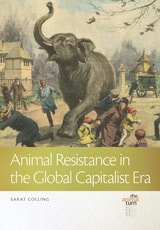
Animal Resistance in the Global Capitalist Era
Sarat Colling
Michigan State University Press, 2020
The concept of animal resistance is now reaching a wide audience across the social media landscape. Animal Resistance in the Global Capitalist Era offers an overview of how animals resist human orderings in the context of capitalism, domestication, and colonization. Exploring this understudied phenomenon, this book is attentive to both the standpoints of animal resisters and the ways they are represented in human society. Together, these lenses provide insight into how animals’ resistance disrupts the dominant paradigm of human exceptionalism and the distancing strategies of enterprises that exploit animals for profit. Animals have been relegated to the margins by human spatial and ideological orderings, but they are also the subjects of their own struggle, located at the center of their liberation movement. Well-researched and accessible, with over fifty images that aid in understanding both the experiences of and responses to animals who resist, Animal Resistance in the Global Capitalist Era is an important contribution to scholarship on animals and society. The text will appeal to a broad audience interested in the relationships between humans and the other animals with whom we share this planet.
[more]
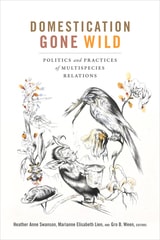
Domestication Gone Wild
Politics and Practices of Multispecies RelationsHeather Anne Swanson, Gro B. Ween, and Marianne E. Lien, editors
Duke University Press, 2018
The domestication of plants and animals is central to the familiar and now outdated story of civilization's emergence. Intertwined with colonialism and imperial expansion, the domestication narrative has informed and justified dominant and often destructive practices. Contending that domestication retains considerable value as an analytical tool, the contributors to Domestication Gone Wild reengage the concept by highlighting sites and forms of domestication occurring in unexpected and marginal sites, from Norwegian fjords and Philippine villages to British falconry cages and South African colonial townships. Challenging idioms of animal husbandry as human mastery and progress, the contributors push beyond the boundaries of farms, fences, and cages to explore how situated relations with animals and plants are linked to the politics of human difference—and, conversely, how politics are intertwined with plant and animal life. Ultimately, this volume promotes a novel, decolonizing concept of domestication that radically revises its Euro- and anthropocentric narrative.
Contributors. Inger Anneberg, Natasha Fijn, Rune Flikke, Frida Hastrup, Marianne Elisabeth Lien, Knut G. Nustad, Sara Asu Schroer, Heather Anne Swanson, Anna Lowenhaupt Tsing, Mette Vaarst, Gro B. Ween, Jon Henrik Ziegler Remme
Contributors. Inger Anneberg, Natasha Fijn, Rune Flikke, Frida Hastrup, Marianne Elisabeth Lien, Knut G. Nustad, Sara Asu Schroer, Heather Anne Swanson, Anna Lowenhaupt Tsing, Mette Vaarst, Gro B. Ween, Jon Henrik Ziegler Remme
[more]
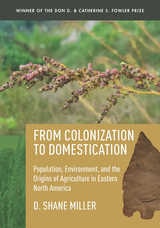
From Colonization to Domestication
Population, Environment, and the Origins of Agriculture in Eastern North AmericaD. Shane Miller
University of Utah Press, 2018
Winner of the Don D. and Catherine S. Fowler Prize.
Eastern North America is one of only a handful of places in the world where people first discovered how to domesticate plants. In this book, anthropologist Shane Miller uses two common, although unconventional, sources of archaeological data—stone tools and the distribution of archaeological sites—to trace subsistence decisions from the initial colonization of the American Southeast at the end of the last Ice Age to the appearance of indigenous domesticated plants roughly 5,000 years ago.
Miller argues that the origins of plant domestication lie within the context of a boom/bust cycle that culminated in the mid-Holocene, when hunter-gatherers were able to intensively exploit shellfish, deer, oak, and hickory. After this resource “boom” ended, some groups shifted to other plants in place of oak and hickory, which included the suite of plants that were later domesticated. Accompanying these subsistence trends is evidence for increasing population pressure and declining returns from hunting. Miller contends, however, that the appearance of domesticated plants in eastern North America, rather than simply being an example of necessity as the mother of invention, is the result of individuals adjusting to periods of both abundance and shortfall driven by climate change.
[more]
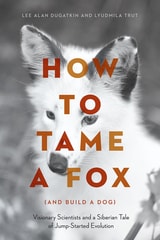
How to Tame a Fox (and Build a Dog)
Visionary Scientists and a Siberian Tale of Jump-Started EvolutionLee Alan Dugatkin and Lyudmila Trut
University of Chicago Press, 2017
Tucked away in Siberia, there are furry, four-legged creatures with wagging tails and floppy ears that are as docile and friendly as any lapdog. But, despite appearances, these are not dogs—they are foxes. They are the result of the most astonishing experiment in breeding ever undertaken—imagine speeding up thousands of years of evolution into a few decades. In 1959, biologists Dmitri Belyaev and Lyudmila Trut set out to do just that, by starting with a few dozen silver foxes from fox farms in the USSR and attempting to recreate the evolution of wolves into dogs in real time in order to witness the process of domestication. This is the extraordinary, untold story of this remarkable undertaking.
Most accounts of the natural evolution of wolves place it over a span of about 15,000 years, but within a decade, Belyaev and Trut’s fox breeding experiments had resulted in puppy-like foxes with floppy ears, piebald spots, and curly tails. Along with these physical changes came genetic and behavioral changes, as well. The foxes were bred using selection criteria for tameness, and with each generation, they became increasingly interested in human companionship. Trut has been there the whole time, and has been the lead scientist on this work since Belyaev’s death in 1985, and with Lee Dugatkin, biologist and science writer, she tells the story of the adventure, science, politics, and love behind it all. In How to Tame a Fox, Dugatkin and Trut take us inside this path-breaking experiment in the midst of the brutal winters of Siberia to reveal how scientific history is made and continues to be made today.
To date, fifty-six generations of foxes have been domesticated, and we continue to learn significant lessons from them about the genetic and behavioral evolution of domesticated animals. How to Tame a Fox offers an incredible tale of scientists at work, while also celebrating the deep attachments that have brought humans and animals together throughout time.
[more]

Live Stock and Dead Things
The Archaeology of Zoopolitics between Domestication and ModernityHannah Chazin
University of Chicago Press, 2024
Reconceptualizes human-animal relationships and their political significance in ancient and modern societies.
In Live Stock and Dead Things, Hannah Chazin combines zooarchaeology and anthropology to challenge familiar narratives about the role of nonhuman animals in the rise of modern societies. Conventional views of this process tend to see a mostly linear development from hunter-gatherer societies, to horticultural and pastoral ones, to large-scale agricultural ones, and then industrial ones. Along the way, traditional accounts argue that owning livestock as property, along with land and other valuable commodities, introduced social inequality and stratification. Against this, Chazin raises a provocative question: What if domestication wasn’t the origin of instrumentalizing nonhuman animals after all?
Chazin argues that these conventional narratives are inherited from conjectural histories and ignore the archaeological data. In her view, the category of “domestication” flattens the more complex dimensions of humans’ relationship to herd animals. In the book’s first half, Chazin offers a new understanding of the political possibilities of pastoralism, one that recognizes the powerful role herd animals have played in shaping human notions of power and authority. In the second half, she takes readers into her archaeological fieldwork in the South Caucasus, which sheds further light on herd animals’ transformative effect on the economy, social life, and ritual. Appealing to anthropologists and archaeologists alike, this daring book offers a reconceptualization of human-animal relationships and their political significance.
[more]
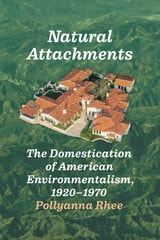
Natural Attachments
The Domestication of American Environmentalism, 1920–1970Pollyanna Rhee
University of Chicago Press, 2025
A nuanced analysis takes a California oil spill as its point of departure to show how affluent homeowners pushed for an environmentalism that would protect not only the earth but also property and community norms.
A massive oil spill in the Pacific Ocean near Santa Barbara, California, in 1969 quickly became a landmark in the history of American environmentalism, helping to inspire the creation of both the Environmental Protection Agency and Earth Day. But what role did the history of Santa Barbara itself play in this? As Pollyanna Rhee shows, the city’s past and demographics were essential to the portrayal of the oil spill as momentous. Moreover, well-off and influential Santa Barbarans were positioned to “domesticate” the larger environmental movement by embodying the argument that individual homes and families—not society as a whole—needed protection from environmental abuses. This soon would put environmental rhetoric and power to fundamentally conservative—not radical—ends.
A massive oil spill in the Pacific Ocean near Santa Barbara, California, in 1969 quickly became a landmark in the history of American environmentalism, helping to inspire the creation of both the Environmental Protection Agency and Earth Day. But what role did the history of Santa Barbara itself play in this? As Pollyanna Rhee shows, the city’s past and demographics were essential to the portrayal of the oil spill as momentous. Moreover, well-off and influential Santa Barbarans were positioned to “domesticate” the larger environmental movement by embodying the argument that individual homes and families—not society as a whole—needed protection from environmental abuses. This soon would put environmental rhetoric and power to fundamentally conservative—not radical—ends.
[more]
Natural Attachments
The Domestication of American Environmentalism, 1920–1970Pollyanna Rhee
University of Chicago Press, 2025
This is an auto-narrated audiobook version of this book.
A nuanced analysis takes a California oil spill as its point of departure to show how affluent homeowners pushed for an environmentalism that would protect not only the earth but also property and community norms.
A massive oil spill in the Pacific Ocean near Santa Barbara, California, in 1969 quickly became a landmark in the history of American environmentalism, helping to inspire the creation of both the Environmental Protection Agency and Earth Day. But what role did the history of Santa Barbara itself play in this? As Pollyanna Rhee shows, the city’s past and demographics were essential to the portrayal of the oil spill as momentous. Moreover, well-off and influential Santa Barbarans were positioned to “domesticate” the larger environmental movement by embodying the argument that individual homes and families—not society as a whole—needed protection from environmental abuses. This soon would put environmental rhetoric and power to fundamentally conservative—not radical—ends.
[more]
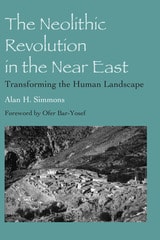
The Neolithic Revolution in the Near East
Transforming the Human LandscapeAlan H. Simmons; foreword by Ofer Bar-Yosef
University of Arizona Press, 2007
One of humanity's most important milestones was the transition from hunting and gathering to food production and permanent village life. This Neolithic Revolution first occurred in the Near East, changing the way humans interacted with their environment and each other, setting the stage, ultimately, for the modern world.
Based on more than thirty years of fieldwork, this timely volume examines the Neolithic Revolution in the Levantine Near East and the Mediterranean island of Cyprus. Alan H. Simmons explores recent research regarding the emergence of Neolithic populations, using both environmental and theoretical contexts, and incorporates specific case studies based on his own excavations. In clear and graceful prose, Simmons traces chronological and regional differences within this land of immense environmental contrasts—woodland, steppe, and desert. He argues that the Neolithic Revolution can be seen in a variety of economic, demographic, and social guises and that it lacked a single common stimulus.
Each chapter includes sections on history, terminology, geographic range, specific domesticated species, the composition of early villages and households, and the development of social, symbolic, and religious behavior. Most chapters include at least one case study and conclude with a concise summary. In addition, Simmons presents a unique chapter on the island of Cyprus, where intriguing new research challenges assumptions about the impact and extent of the Neolithic.
The Neolithic Revolution in the Near East conveys the diversity of our Neolithic ancestors, providing a better understanding of the period and the new social order that arose because of it. This insightful volume will be especially useful to Near Eastern scholars and to students of archaeology and the origins of agriculture.
[more]